- Plants
- ›Vascular Plants
- ›flowering plants
- ›monocots
- ›Agaves, Orchids, Irises, and Allies
- ›iris family
- ›Iridoideae
- ›Irideae
- ›Iris
- ›Iris
- ›Iris
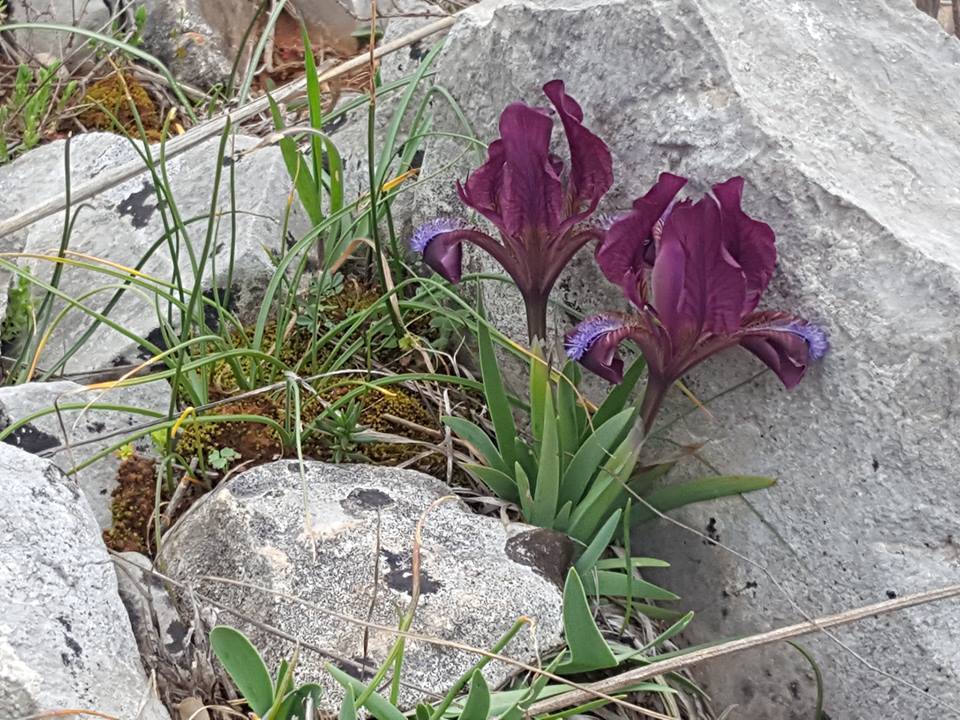
Iris adriatica
Iris adriatica is a plant species in the genus Iris, it is also in the subgenus Iris. It is a rhizomatous perennial, from the Dalmatia region of Croatia in Europe. It has short sickle shaped leaves, small stem and flowers that vary from yellow to purple or violet. It is rarely cultivated as an ornamental plant in temperate regions.
From the article Iris adriatica on Wikipedia (CC BY-SA), quoted section by section
Description
It is similar in form to Iris pseudopumila, Iris pumila and Iris attica. It has a rhizome, and has falcate (sickle-shaped), or straight leaves, that can grow up to between 3–10 cm (1–4 in) long, and between 0.5 and 1 cm wide. They are normally longer than the flowering stem, and die back at winter. It has a dwarf stem, that can grow up to between 1–5 cm (0–2 in) tall. The stem has green spathes (leaves of the flower bud), that have wide scarious (membranous) margins, they are similar in size to the perianth tube, at 4–7 cm (2–3 in) long and slightly keeled at blooming time. The stems hold 1 terminal (top of stem) flower, blooming in spring, in March and April. The large flowers, come in shades of yellow, red, purple, or violet. Or they can be a combination of these colours. Like other irises, it has 2 pairs of petals, 3 large sepals (outer petals), known as the 'falls' and 3 inner, smaller petals (or tepals), known as the 'standards'. The falls have a beard in the centre, which is either blue of yellow. After the iris has flowered, it produces an elliptical or trigonous (having three angles or corners) seed capsule, that is 2–3 cm long, when ripe it is straw coloured. Inside the capsule are many little, elliptical shaped, dark brownish seeds. They are smaller and darker than other similar irises.
Biochemistry. …
Range & habitat
It is found in the Mediterranean country, of Croatia, within the Dalmatia region. Including around the Croatian towns of Zadar, Šibenik, Split, Drniš and Unešić. As well as being found on the islands of Ciovo, Brač, Kornati, and Vir.
Wikipedia: “Range”
Toxicity
Like many other irises, most parts of the plant are poisonous (rhizome and leaves), if mistakenly ingested can cause stomach pains and vomiting. Also handling the plant may cause a skin irritation or an allergic reaction.
How it is grown
It is hardy to USDA Zone 8. It needs dry summers. It is thought to be difficult to grow in cultivation. It can be found growing in Biokovo Botanical Garden Kotišina.
Wikipedia: “Cultivation”
Where it lives
Recorded sightings
—
geo-referenced records in GBIF, from museums, herbaria and field observers.
Drag the globe to turn it. Dots are where records exist, not a range map; darker means more records.
In the stacks
Searching the stacks…
Every page naming Iris adriatica in the Biodiversity Heritage Library →
This page is assembled live from iNaturalist, GBIF, Wikipedia, the Source Library and the Internet Archive. It is not yet part of the hand-edited codex. iNaturalist taxon 902039.