- Plants
- ›Vascular Plants
- ›flowering plants
- ›Dicots
- ›Legumes, Milkworts, and Allies
- ›Legumes
- ›Faboideae
- ›Brongniartieae
- ›Templetonia
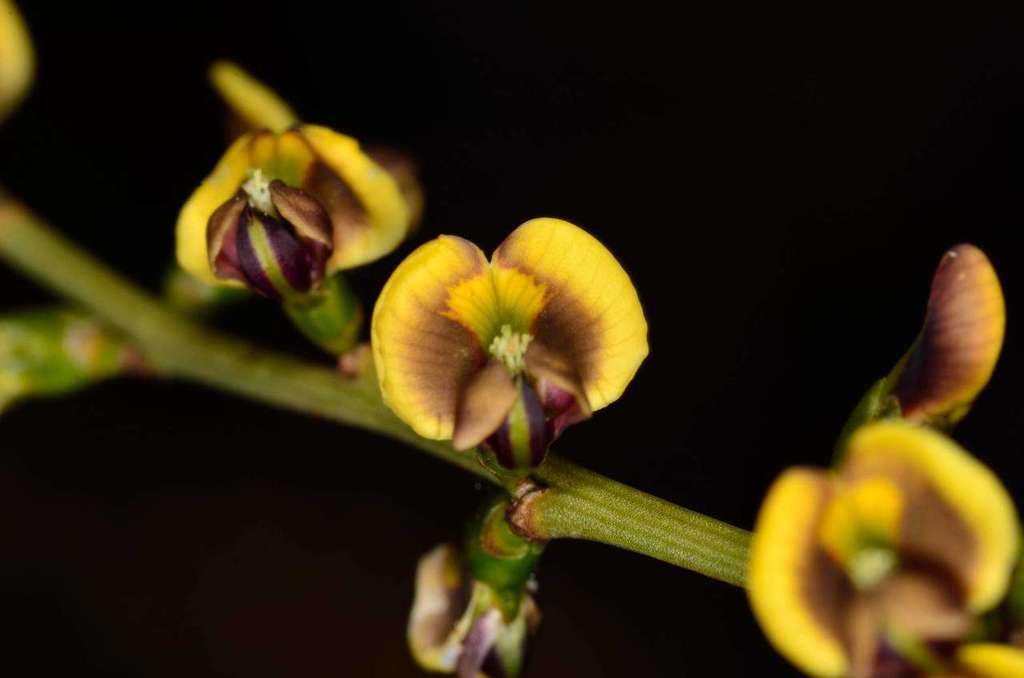
desert broombush
Templetonia egena
Templetonia egena commonly known as desert broom bush, is a flowering plant in the family Fabaceae. It is an upright, leafless shrub with yellowish-brown pea-like flowers and grows in all mainland states and the Northern Territory in Australia.
From the article Templetonia egena on Wikipedia (CC BY-SA), quoted section by section
Description
Templetonia egena is a multi-branched shrub 1–3 m (3 ft 3 in – 9 ft 10 in) high with ridged, upright, yellow-green stems 1–3 mm (0.039–0.118 in) wide, rounded at the apex, leaves small, triangular scales. Flowers are borne in pairs or singly in leaf axils, 6–9 mm (0.24–0.35 in) long, pea-like, thickly racemose, pedicel less than 1 mm (0.039 in) long and petals yellow or reddish brown. Flowering occurs mostly in spring and the fruit is a flattened, oval to oblong pod 10–20 mm (0.39–0.79 in) long and usually one-seeded.
Range & habitat
Desert broom bush grows on deep sandy soils in drier locations in Victoria, South Australia, New South Wales, Queensland, Western Australia and the Northern Territory.
== References ==
Wikipedia: “Distribution and habitat”
Where it lives
Recorded sightings
—
geo-referenced records in GBIF, from museums, herbaria and field observers.
Drag the globe to turn it. Dots are where records exist, not a range map; darker means more records.
In the stacks
Searching the stacks…
Every page naming Templetonia egena in the Biodiversity Heritage Library →
This page is assembled live from iNaturalist, GBIF, Wikipedia, the Source Library and the Internet Archive. It is not yet part of the hand-edited codex. iNaturalist taxon 905048.