- Plants
- ›Vascular Plants
- ›flowering plants
- ›Dicots
- ›pinks, cactuses, and allies
- ›Amaranth family
- ›Salsoloideae
- ›Salsoleae
- ›Halothamnus
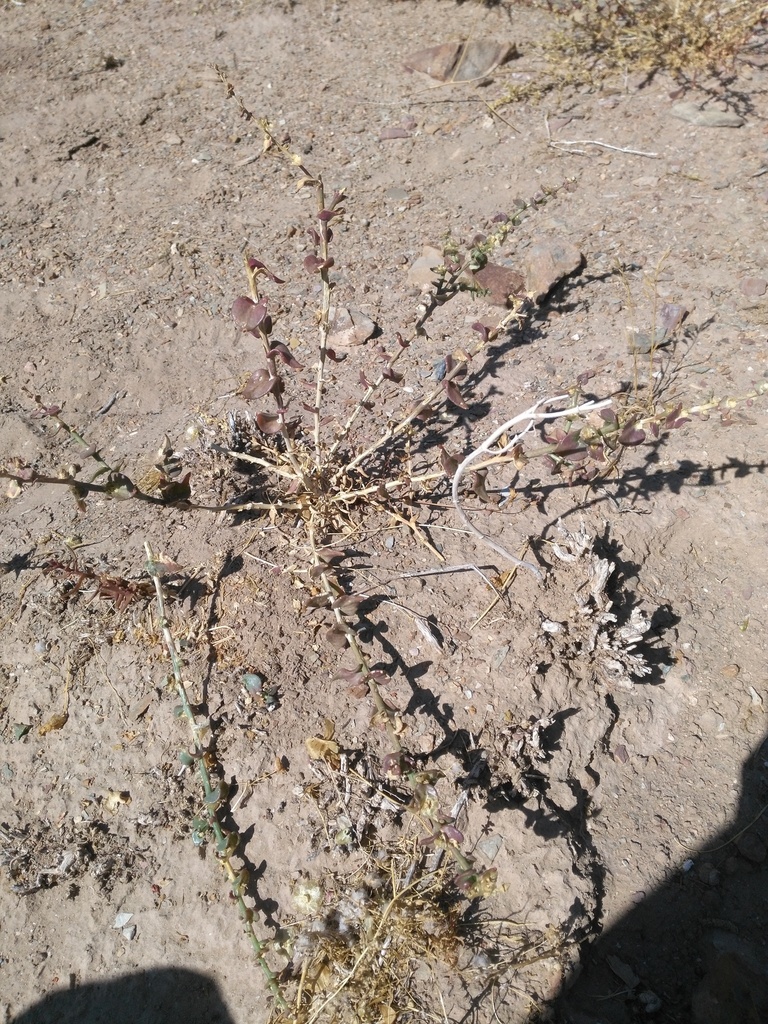
Halothamnus auriculus
Halothamnus auriculus is a species of the plant genus Halothamnus, that belongs to the subfamily Salsoloideae of the family Amaranthaceae, (formerly Chenopodiaceae). It occurs in Western and Middle Asia.
From the article Halothamnus auriculus on Wikipedia (CC BY-SA), quoted section by section
Description
Halothamnus auriculus is a sub-shrub up to 90 cm high, with olive-grey or blueish-green pale-striate branches. The flat and slightly fleshy leaves are very variably shaped (lanceolate, triangular, ovate, cordate, kidney-shaped, or roundish), up to 68 mm long and 2,5–45 mm wide, with distinct membranous margins, often half-stem-clasping, the lower ones often decurrent, the upper ones often auriculate. The bracts are similar to the leaves. The bracteoles are adpressed to the perianth, scale-like, surrounded by membranous margins, shorter than perianth. The flowers are 3,4-1,7 mm long, the stigmas are widened and truncate at the apex. The winged fruit is 12–18 mm in diameter, their wings inserting in or above the middle. The tube of the fruit is broadly barrel-shaped, at its bottom with deep, furrow-like, linear or curved pits.
The subspecies H. auriculus subsp. acutifolius differs from subsp. auriculus by lanceolate, only 2,5–9 mm wide leaves, that are hardly clasping and not or very shortly decurrent, and by longer stigmas.
Wikipedia: “Morphology”
Range & habitat
The distribution area of Halothamnus auriculus covers northern Iran, Pakistan (Baluchistan), Afghanistan, southern Turkmenistan, Tajikistan, Uzbekistan and Kyrgyzstan. It grows in semideserts and dry shrubland on clay-gravel, often saline or gypsum soils from 500– 2550 m above sea-level.
Wikipedia: “Distribution”
At the table
Halothamnus auriculus is a good fodder plant and is planted for recultivation of pasture. In their leaves the plants accumulate boron. The whole plant contains the phytochemical compounds Quercetin-3-glucoside, 8-C-glucopyranosylapigenin, 5,6-dihydroxy-3′,4′,7-trimethoxy-flavone, 4′,5,7-trihydroxy-3′,6-dimethoxy-flavone, Quercetin-3′,4′-dimethyl ether, Allantoic acid, Allantoin, Oleanolic acid, β-Sitosterol, β-Sitosterol 3-O-β-D-glucopyranoside, and Lupeol.
Wikipedia: “Cultivation and uses”
Where it lives
Recorded sightings
—
geo-referenced records in GBIF, from museums, herbaria and field observers.
Drag the globe to turn it. Dots are where records exist, not a range map; darker means more records.
In the stacks
Searching the stacks…
Every page naming Halothamnus auriculus in the Biodiversity Heritage Library →
This page is assembled live from iNaturalist, GBIF, Wikipedia, the Source Library and the Internet Archive. It is not yet part of the hand-edited codex. iNaturalist taxon 910465.