- Plants
- ›Vascular Plants
- ›flowering plants
- ›Dicots
- ›Mints, Plantains, Olives, and Allies
- ›bignonia family
- ›Jacarandeae
- ›Jacaranda
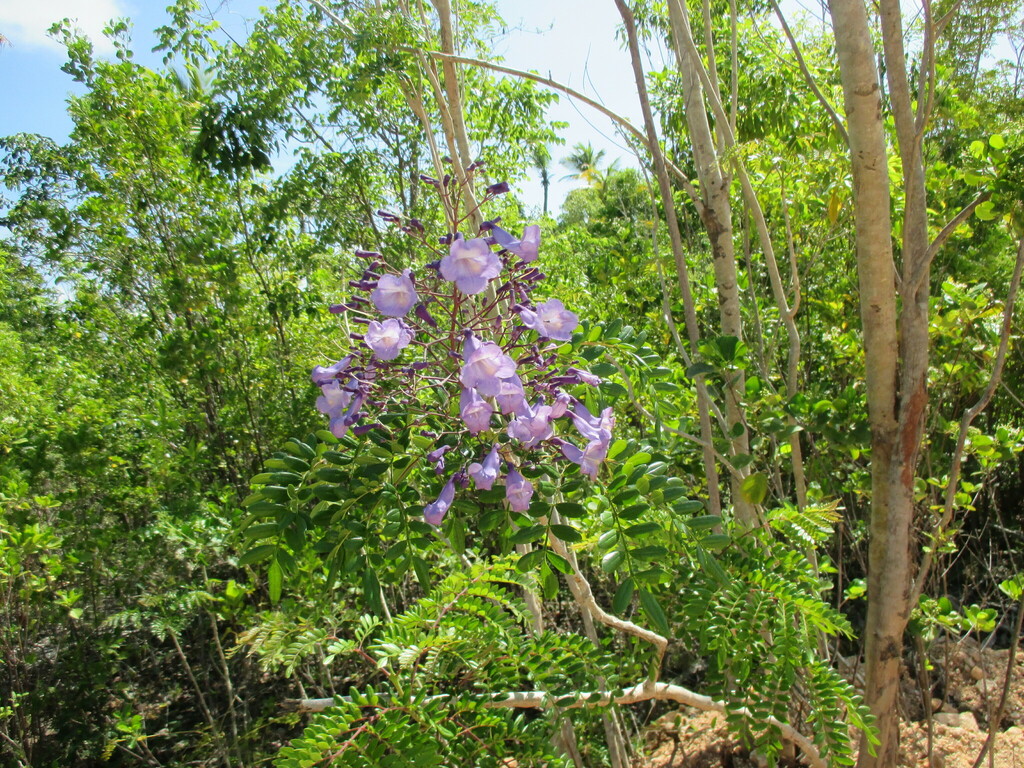
Jacaranda caerulea
Jacaranda caerulea (boxwood or cancertree) is a flowering tree belonging to the genus Jacaranda. It is native to the West Indies, in Cuba, Hispaniola (the Dominican Republic and Haiti) and the Bahamas.
From the article Jacaranda caerulea on Wikipedia (CC BY-SA), quoted section by section
Description
Jacaranda caerula was described in 1805 by French naturalist Jean Henri Jaume Saint-Hilaire. It grows up to 12 metres (39 ft) in height and has 40 cm long, bipinnate leaves each with 8 to 26 pinna. The flowers are purplish blue in colour with a tubular shape, being narrower towards the base and larger at the tip. They measure 3.5 to 4 cm long and 1 to 1.4 cm wide at the mouth. It flowers intermittently throughout spring and summer, rather than having one big bloom during spring.
Range & habitat
The tree is native to the Bahamas, Hispaniola, and Cuba, but can also be found in Florida where it was introduced for landscaping purposes. It most commonly found in limestone areas between sea level and 300 m (980 ft).
Wikipedia: “Distribution”
At the table
The leaves are used in some places for their antiseptic properties. In the Bahamas, decoctions are made from the dried leaves and used as an alternative treatment for a variety of skin complaints, including skin cancer. In Cuba, decoctions of leafy branches are used to treat eczema and acne.
Wikipedia: “Uses”
Where it lives
Recorded sightings
—
geo-referenced records in GBIF, from museums, herbaria and field observers.
Drag the globe to turn it. Dots are where records exist, not a range map; darker means more records.
In the stacks
Searching the stacks…
Every page naming Jacaranda caerulea in the Biodiversity Heritage Library →
This page is assembled live from iNaturalist, GBIF, Wikipedia, the Source Library and the Internet Archive. It is not yet part of the hand-edited codex. iNaturalist taxon 910602.