- Plants
- ›Vascular Plants
- ›flowering plants
- ›monocots
- ›lilies, supplejacks, and allies
- ›Peruvian Lily family
- ›Alstroemeria
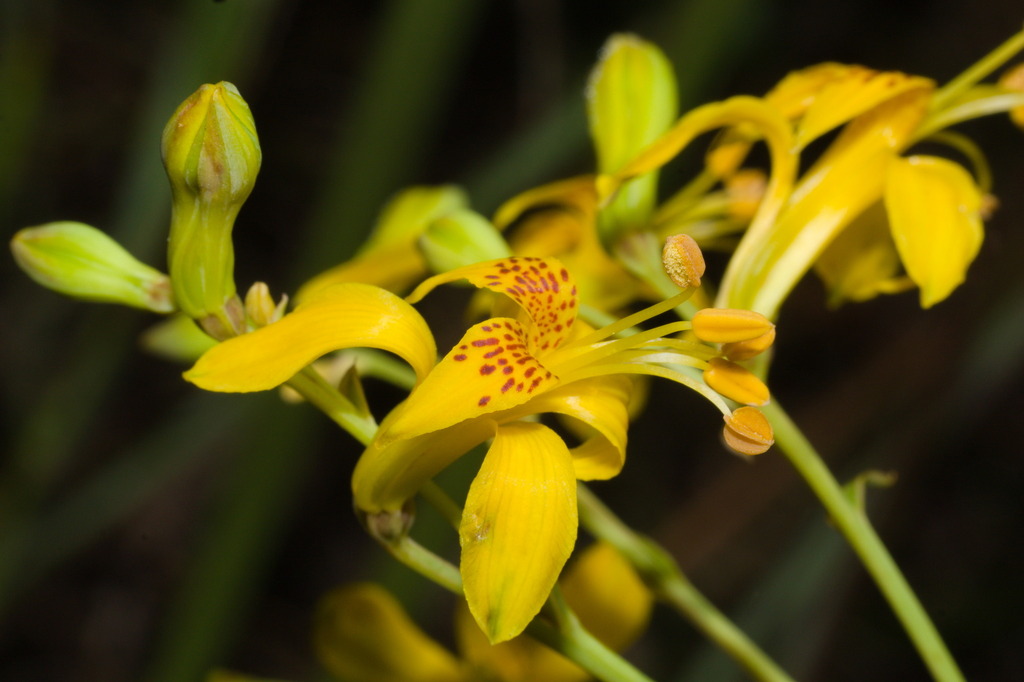
Alstroemeria apertiflora
Alstroemeria apertiflora is a species of flowering plant in the family Alstroemeriaceae. It is a herb with bell-shaped yellow flowers, and papery to leathery leaves. The species is native to Argentina, Brazil, and Paraguay, and was described in 1888.
From the article Alstroemeria apertiflora on Wikipedia (CC BY-SA), quoted section by section
Description
Alstroemeria apertiflora is a herb, with a stem over 3 feet (91 cm) high. It has underground storage organs. The rhizomes are sympodial. The leaves are papery or leathery in texture. They are up to 2 inches (5.1 cm) long. The inflorescence is an umbel. The flowers are yellow to red, bell-shaped, and have three parts. The internal tepals have spots. The perianth is around 1 inch (2.5 cm) long. The fruit is a capsule that undergoes loculicidal dehiscence. The seeds are spherical, and have small protuberances.
Range & habitat
The species is native to the subtropical biome of north-eastern Argentina (Misiones Province), south, south-east, and west-central Brazil, and Paraguay.
Wikipedia: “Distribution”
Where it lives
Recorded sightings
—
geo-referenced records in GBIF, from museums, herbaria and field observers.
Drag the globe to turn it. Dots are where records exist, not a range map; darker means more records.
In the stacks
Searching the stacks…
Every page naming Alstroemeria apertiflora in the Biodiversity Heritage Library →
This page is assembled live from iNaturalist, GBIF, Wikipedia, the Source Library and the Internet Archive. It is not yet part of the hand-edited codex. iNaturalist taxon 911087.