- Plants
- ›Vascular Plants
- ›flowering plants
- ›Dicots
- ›proteas, lotuses, planes, and allies
- ›Protea family
- ›Singlet Proteas
- ›Featherbushes and Conesticks
- ›Petrophile
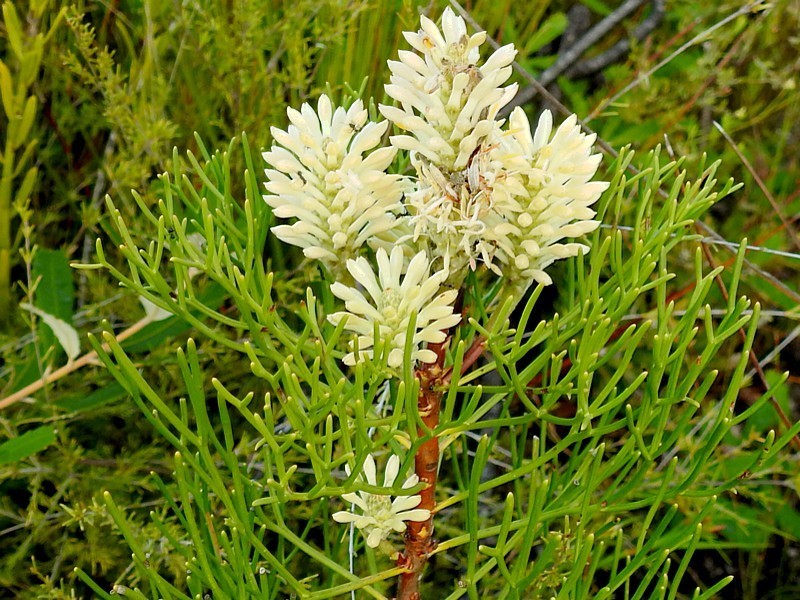
Petrophile shirleyae
Petrophile shirleyae is a species of flowering plant in the family Proteaceae and is endemic to Queensland. It is a shrub with pinnate, needle-shaped, sharply-pointed leaves, and narrow oval heads of silky-hairy white to pale cream-coloured flowers.
From the article Petrophile shirleyae on Wikipedia (CC BY-SA), quoted section by section
Description
Petrophile shirleyae is an erect shrub that typically grows to a height of 0.3–1.2 m (1 ft 0 in – 3 ft 11 in) and has more or less glabrous leaves and branchlets. The leaves are bipinnate or tripinnate, 80–200 mm (3.1–7.9 in) long on a petiole 30–50 mm (1.2–2.0 in) long, with pinnae 30–65 mm (1.2–2.6 in) long. The flowers are arranged on the ends of branchlets in narrow oval heads 30–55 mm (1.2–2.2 in) long, sometimes in pairs, with a few broadly egg-shaped involucral bracts at the base. The flowers are up to about 12 mm (0.47 in) long, silky-hairy and white to pale cream-coloured. Flowering occurs from October to February and the fruit is a nut, fused with others in an oval head up to about 80 mm (3.1 in) long.
Range & habitat
Petrophile shirleyae grows in sandy heath and forest in near-coastal areas of south-eastern Queensland.
Wikipedia: “Distribution and habitat”
Where it lives
Recorded sightings
—
geo-referenced records in GBIF, from museums, herbaria and field observers.
Drag the globe to turn it. Dots are where records exist, not a range map; darker means more records.
In the stacks
Searching the stacks…
Every page naming Petrophile shirleyae in the Biodiversity Heritage Library →
This page is assembled live from iNaturalist, GBIF, Wikipedia, the Source Library and the Internet Archive. It is not yet part of the hand-edited codex. iNaturalist taxon 911272.