- Animals
- ›Molluscs
- ›Gastropods
- ›Heterobranchs
- ›Euthyneura
- ›Tectipleura
- ›Hygrophila
- ›Pond Snails, Bladder Snails, and Allies
- ›Pond and Melantho Snails
- ›Radicine Pond Snails
- ›Radicini
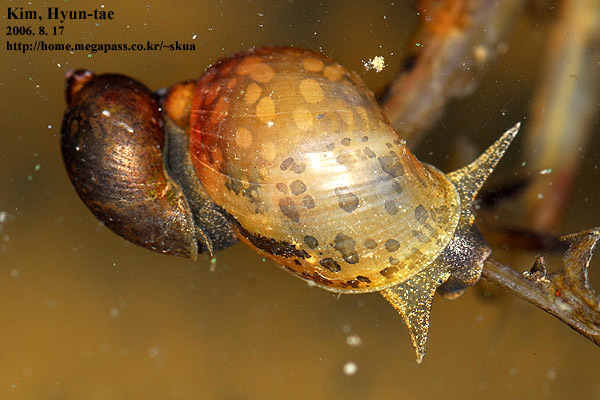
Radix
In a positional numeral system, the radix (pl. radices) or base is the number of unique digits, including the digit zero, used to represent numbers. For example, in decimal systems (the most common systems in use today) the radix is ten.
In any standard positional numeral system, a number is conventionally written as (x)y with x as the string of digits and y as its base. For base ten, the subscript is usually assumed and omitted (together with the enclosing parentheses), as it is the most common way to express value. For example, (100)10 is equivalent to 100 (the decimal system is implied in the latter) and represents the number one hundred, while (100)2 (in the binary system with base 2) represents the number four.
11 branches of this genus, most-observed first

Big-eared Radix
speciesRadix auricularia
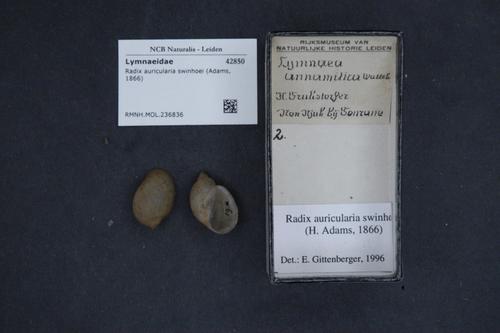
Radix plicatula
speciesRadix plicatula

Rust-coloured Pond Snail
speciesRadix rubiginosa

Common Pond Snail
speciesRadix natalensis
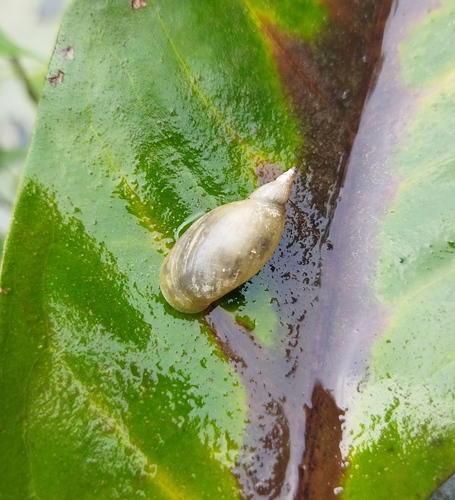
Radix rufescens
speciesRadix rufescens
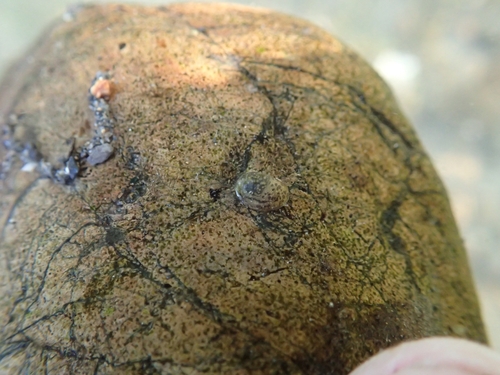
Radix onychia
speciesRadix onychia
Radix brevicauda
speciesRadix brevicauda
Radix skutaris
speciesRadix skutaris
Radix hamadai
speciesRadix hamadai
Radix euphratica
speciesRadix euphratica
Radix mongolica
speciesRadix mongolica
Where it lives
Recorded sightings
—
geo-referenced records in GBIF, from museums, herbaria and field observers.
Drag the globe to turn it. Dots are where records exist, not a range map; darker means more records.
In the old herbals & bestiaries

De Indiae utriusque re naturali et medica
Willem Piso · 1658 · p.287

De medicinali materia libri sex
Dioscorides · 1552 · p.550

Commentaries on the Six Books of Dioscorides on Medical Matter
Pietro Andrea Mattioli · 1563 · p.617

Latin Herbal
1484 · p.243

Herbarius latinus (with French synonyms)
1486 · p.245

Notable Commentaries on the History of Plants
Leonhart Fuchs · 1542 · p.699

Notable Commentaries on the History of Plants
Leonhart Fuchs · 1549 · p.697

On Medical Materials in Six Books
Dioscorides · 1550 · p.542

De medicinali materia libri sex
Dioscorides · 1552 · p.365

On the Names of Plants
Hieronymus Bock (Tragus) · 1552 · p.420

Commentaries on the Six Books of Dioscorides
Pietro Andrea Mattioli · 1560 · p.469

Commentaries on the Six Books of Dioscorides
Pietro Andrea Mattioli · 1560 · p.672
In the stacks
Searching the stacks…
Every page naming Radix in the Biodiversity Heritage Library →
This page is assembled live from iNaturalist, GBIF, Wikipedia, the Source Library and the Internet Archive. It is not yet part of the hand-edited codex. iNaturalist taxon 91634.