- Plants
- ›Vascular Plants
- ›flowering plants
- ›Dicots
- ›Legumes, Milkworts, and Allies
- ›Legumes
- ›Acacias, Mimosas, Mesquites, and Allies
- ›Mimoseae
- ›Mimosa
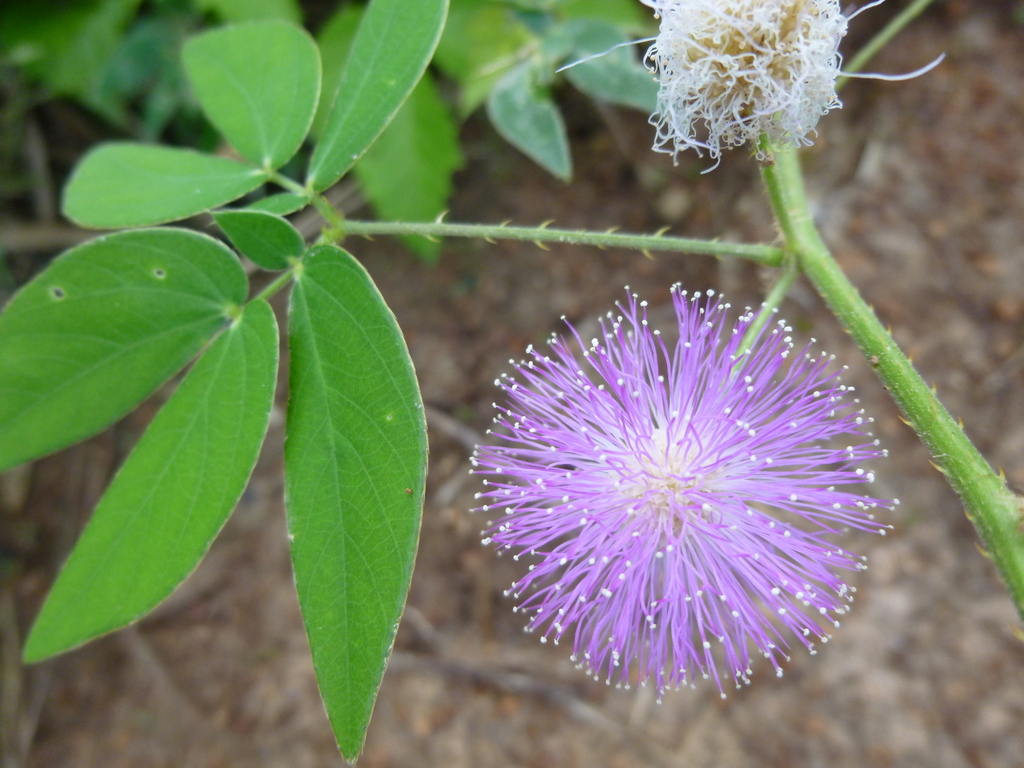
Mimosa sensitiva
Mimosa pudica (also called sensitive plant, sleepy grass, sleepy plant, action plant, humble plant, touch-me-not, touch-and-die, shame plant or shy plant) is a creeping annual or perennial flowering plant of the pea/legume family Fabaceae. It is often grown for its curiosity value: the sensitive compound leaves quickly fold inward and droop when touched or shaken and re-open a few minutes later. For this reason, this species is commonly cited as an example of rapid plant movement. Like a number of other plant species, it undergoes changes in leaf orientation termed "sleep" or nyctinastic movement. The foliage closes during darkness and reopens in light. This was first studied by French scientist Jean-Jacques d'Ortous. In the UK it has gained the Royal Horticultural Society's Award of Garden Merit.
The species is native to the Caribbean and South and Central America, but is now a pantropical weed, and can now be found in the Southern United States, South Asia, East Asia, Southeast Asia, Micronesia, Australia, South Africa, and West Africa as well. It is not shade-tolerant and is primarily found on soils with low nutrient concentrations.
From the article Mimosa pudica on Wikipedia (CC BY-SA), quoted section by section
Description
The stem is erect in young plants but becomes creeping or trailing with age. It can hang very low and become floppy. The stem is slender, branching, and sparsely to densely prickly, growing to a length of 1.5 m (5 ft). The erect height of M. pudica usually reaches around ~30 cm (~1 ft). The leaves are bipinnately compound, with one or two pinnae pairs, and 10–26 leaflets per pinna. The petioles are also prickly. Pedunculate (stalked) pale pink or purple flower heads arise from the leaf axils in mid-summer with more and more flowers as the plant gets older. A single flower survives for less than a day, and usually dies completely by the next day. Flowers of M. pudica are very brittle and soft. The globose to ovoid heads are 8–10 mm (0.3–0.4 in) in diameter (excluding the stamens). On close examination, it is seen that the floret petals are red in their upper part and the filaments are pink to lavender. Pollens are circular with approximately 8 microns in diameter.
The fruit consists of clusters of two to eight pods from 1–2 cm (0.4–0.8 in) long each, these being prickly on the margins. The pods break into two to five segments and contain pale brown seeds about 2.5 mm (0.1 in) long. The flowers are insect-pollinated and wind-pollinated. The seeds have hard seed coats which restrict germination and make osmotic pressure and soil acidity less significant hindrances. …
Range & habitat
Mimosa pudica is native to the tropical Americas. It can also be found in Asian countries such as Singapore, Bangladesh, Thailand, India, Nepal, Indonesia, Taiwan, Malaysia, the Philippines, Vietnam, Cambodia, Laos, Japan, and Sri Lanka. It has been introduced to many other regions and is regarded as an invasive species in Tanzania, South and Southeast Asia, and many Pacific islands. It is regarded as invasive in parts of Australia and is a declared weed in the Northern Territory, and Western Australia although not naturalized there. Control is recommended in Queensland. It has also been introduced to Uganda, Ghana, Nigeria, Seychelles, Mauritius and East Asia but is not regarded as invasive in those places. In the United States, it grows in Louisiana, Florida, Hawaii, Tennessee, Virginia, Maryland, Puerto Rico, Texas, Alabama, Arkansas, Mississippi, North Carolina, Georgia, the territory of Guam, and the Virgin Islands.
Wikipedia: “Distribution and habitat”
How it is grown
The species can be a weed for tropical crops, particularly when fields are hand-cultivated. Crops it tends to affect are corn, coconuts, tomatoes, cotton, coffee, bananas, soybeans, papaya, and sugar cane. Dry thickets may become a fire hazard. In some cases, it has become a forage plant although the variety in Hawaii is reported to be toxic to livestock. In addition, Mimosa pudica can change the physico-chemical properties of the soil it invades; total nitrogen and potassium, for example, have been seen to increase in significantly invaded areas.
Phytoremediation. Thirty-six native Thai plant species were tested to see which conducted the most phytoremediation of arsenic-polluted soils caused by tin mines. Mimosa pudica was one of the four species that significantly extracted and bioaccumulated the pollutant into its leaves. Other studies have found that Mimosa pudica extracts heavy metals such as copper, lead, tin, and zinc from polluted soils. In principle, this accumulative behavior could be used to decontaminate some polluted soils.
Nitrogen fixation. If nitrogen-fixing bacteria are present in the environment, Mimosa pudica may form root nodules for them to inhabit. These bacteria are able to convert atmospheric nitrogen into ammonia that plants can use for growth, i.e. …
Wikipedia: “Agricultural impact”
Where it lives
Recorded sightings
—
geo-referenced records in GBIF, from museums, herbaria and field observers.
Drag the globe to turn it. Dots are where records exist, not a range map; darker means more records.
In the old herbals & bestiaries

In the stacks
Searching the stacks…
Every page naming Mimosa sensitiva in the Biodiversity Heritage Library →
This page is assembled live from iNaturalist, GBIF, Wikipedia, the Source Library and the Internet Archive. It is not yet part of the hand-edited codex. iNaturalist taxon 918394.