- Plants
- ›Vascular Plants
- ›flowering plants
- ›Dicots
- ›Heathers, Balsams, Primroses, and Allies
- ›heath family
- ›Epacrids, Styphelias and Allies
- ›Styphelieae
- ›Trochocarpa
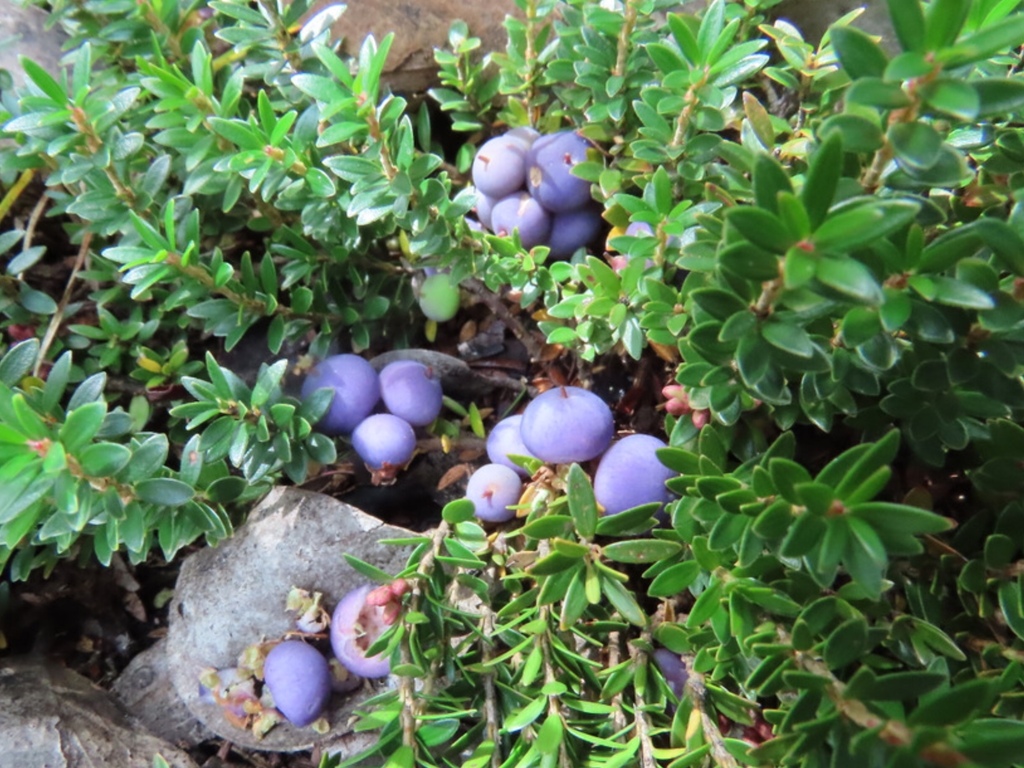
Lilac Berry
Trochocarpa clarkei
Trochocarpa clarkei, commonly known as lilac berry, is a rare flowering plant in the family Ericaceae. It is endemic to sub-alpine areas of Victoria in Australia. It is a shrub which grows to around 30 cm high. The flowers are maroon with a greenish base. The fruits, which appear in autumn, are about 8 mm in diameter. These are eaten by small mammals and birds. The species occurs in subalpine areas of the southern highlands, often in association...
From the article Trochocarpa clarkei on Wikipedia (CC BY-SA), quoted section by section
Description
Tracocarpa clarkei is a dense, often low-lying shrub that grows to a height of up to about 30 cm (12 in) and sometimes forms roots at the nodes. The leaves are oblong to elliptic, 3–11 mm (0.12–0.43 in) long 1.2–3.5 mm (0.047–0.138 in) wide and glabrous, the lower surface a paler shade of green with 3 to 7 more or less parallel veins. The flowers are bisexual and borne in dense spikes of 5 to 11, usually on old wood, with a bract 1.0–1.6 mm (0.039–0.063 in) wide and 2 bracteoles 1–2 mm (0.039–0.079 in) long under the sepals. The sepals are egg-shaped, 2–3 mm (0.079–0.118 in) long and the petals are joined at the base to form an urn-shaped to bell-shaped tube 2.5–4 mm (0.098–0.157 in) long. The petal tube is maroon, green at the base, 2.5–4 mm (0.098–0.157 in) long with lobes 2–3 mm (0.079–0.118 in) long. The anthers protrude beyond the end of the petal tube. The fruit is a flattened spherical, bluish-purple drupe about 7–8 mm (0.28–0.31 in) long.
Range & habitat
Lilac berry is endemic to alpine and sub-alpine areas of Victoria in Australia, usually growing near rocks, or in sheltered areas under snow gums (Eucalyptus pauciflora).
Wikipedia: “Distribution and habitat”
What it does
The fruits of lilac berry appear in autumn, about 8 mm (0.31 in) in diameter and are eaten by small mammals and birds.
== References ==
Wikipedia: “Ecology”
Where it lives
Recorded sightings
—
geo-referenced records in GBIF, from museums, herbaria and field observers.
Drag the globe to turn it. Dots are where records exist, not a range map; darker means more records.
In the stacks
Searching the stacks…
Every page naming Trochocarpa clarkei in the Biodiversity Heritage Library →
This page is assembled live from iNaturalist, GBIF, Wikipedia, the Source Library and the Internet Archive. It is not yet part of the hand-edited codex. iNaturalist taxon 918570.