 NL·0481
Herbarium of the Nature Library
- Name
- Urva edwardsii
- Family
- Herpestidae
- Native to
- India, Pakistan, Nepal, Sri Lanka and Bangladesh, west through Afghanistan and Iran to the Arabian Gulf
- Habitat
- Scrub, Dry forest, Farmland, Urban gardens
Indian grey mongoose
Urva edwardsii
Also calledNevlā (Hindi) · Neolā (Urdu) · Nakula (Sanskrit) · Kīri (Tamil) · Mungūsi (Telugu)
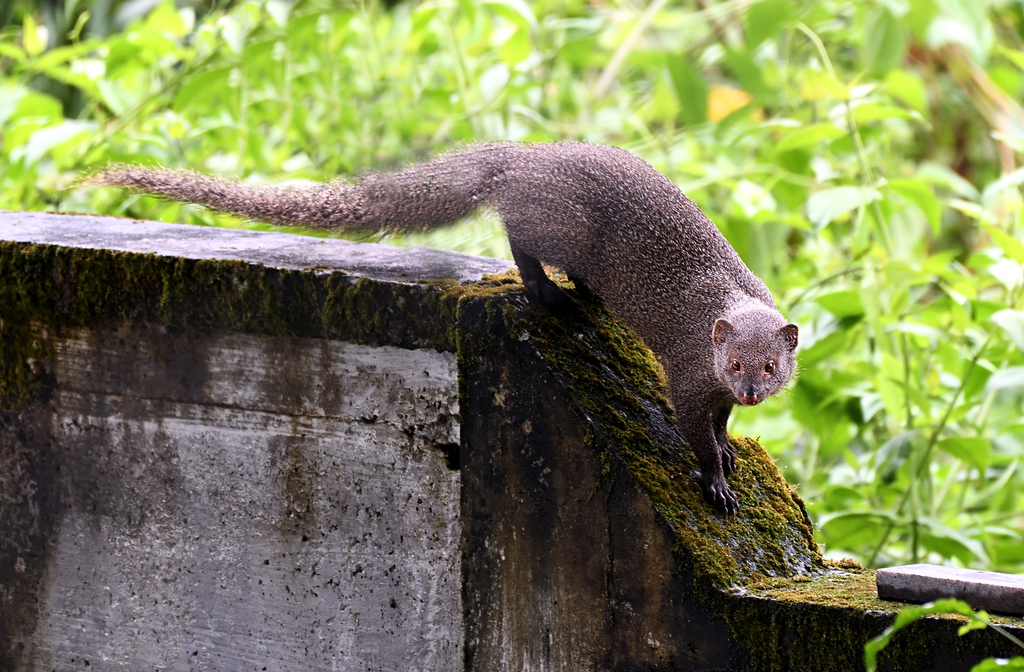
The famous snake-fighting mongoose of South Asia, a grizzled grey hunter of gardens, scrub and fields. Speed, a thick coat and modified acetylcholine receptors that resist cobra neurotoxins let it tackle venomous snakes, though most of its diet is rodents, insects and lizards.
The Indian grey mongoose or Asian grey mongoose is a mongoose species native to the Indian subcontinent and West Asia. It is listed as least concern on the IUCN Red List. Wikipedia
What it can do
- iPartially resistant to snake neurotoxins, owing to altered receptor proteins
- iiMoves so fast it can dodge a striking cobra, then bites the back of the head
- iiiHunts by darting in and out of reach, often seizing prey such as rats and lizards with a single bite to the head
In the field
Field marks
- aLow, long-bodied grey animal with a grizzled, salt-and-pepper coat
- bTail as long as the body, tapering, with a pale or reddish tip
- cReddish legs and face around the eyes
- dRuns with tail held out or slightly raised; tracks show five toes with claws
- Not to be confused with
- Small Indian mongoose (Urva auropunctata) is smaller with golden-flecked fur; ruddy mongoose (Urva smithii) has a black tail tip; stripe-necked mongoose has a black neck stripe. Squirrels have bushy tails and climb.
- Where to see it
- Common in gardens, farmland and parks across India and Pakistan; Sariska and Ranthambore (Rajasthan); Gir (Gujarat); Margalla Hills (Islamabad)
- When
- Resident; active in daylight year-round
Listen
Looking for field recordings…
Life & habits
- Diet
- Rodents, insects, snakes, lizards, birds, eggs, carrion and fruit
- Habitat
- Open forest, scrub, cultivated land and edges of villages and towns
- Size
- Body 36–45 cm, tail 45 cm; about 0.9–1.7 kg
- Lifespan
- About 7–8 years in the wild; to 12 in captivity
Diurnal, unlike many mongooses; usually alone or in pairs. Fluffs its fur to look larger when facing a snake.
Where it lives
Recorded sightings
—
geo-referenced records in GBIF, from museums, herbaria and field observers.
Native range
India, Pakistan, Nepal, Sri Lanka and Bangladesh, west through Afghanistan and Iran to the Arabian Gulf
Drag the globe to turn it. Dots are where records exist, not a range map; darker means more records.
In the old herbals & bestiaries
Woodcuts and engravings matched from the Source Library’s scanned books by name. Plates marked “relative” show a close kin rather than this exact species. Click a plate to read the page it came from, with translation.

Ortus sanitatis
1491 · p.601

Garden of Health
1507 · p.446

History of Animals, Book I: On Viviparous Quadrupeds
Conrad Gessner · 1554 · p.145

Ten Books of Exotic Things
Carolus Clusius · 1605 · p.596

Ortus sanitatis
1491 · p.548

History of Animals, Book I: On Viviparous Quadrupeds
Conrad Gessner · 1554 · p.145
In the stacks
Searching the stacks…
Every page naming Urva edwardsii in the Biodiversity Heritage Library →
Marginalia
Kubera, Hindu god of wealth, and the Buddhist Jambhala are depicted holding a mongoose that spits jewels. The Panchatantra tells of a loyal mongoose killed by a Brahmin who mistook the blood of a slain snake for that of his baby; Kipling's Rikki-Tikki-Tavi is usually taken to be this species.
Curiosity
The English word 'mongoose' comes from Marathi/Telugu names such as mangūs and mungisa.
Kinship


Fact-checked: 1 correction made to this sheet. Photographs: iNaturalist contributors under the licences shown. Records: GBIF.org. Historical plates: Source Library (CC BY-SA 4.0; originals public domain). Summary text: Nature Library editors and Wikipedia (CC BY-SA). Medicinal and edibility notes are historical and educational, not advice. iNaturalist taxon 925977.