- Plants
- ›Vascular Plants
- ›flowering plants
- ›Dicots
- ›Mints, Plantains, Olives, and Allies
- ›figwort family
- ›Eremophila
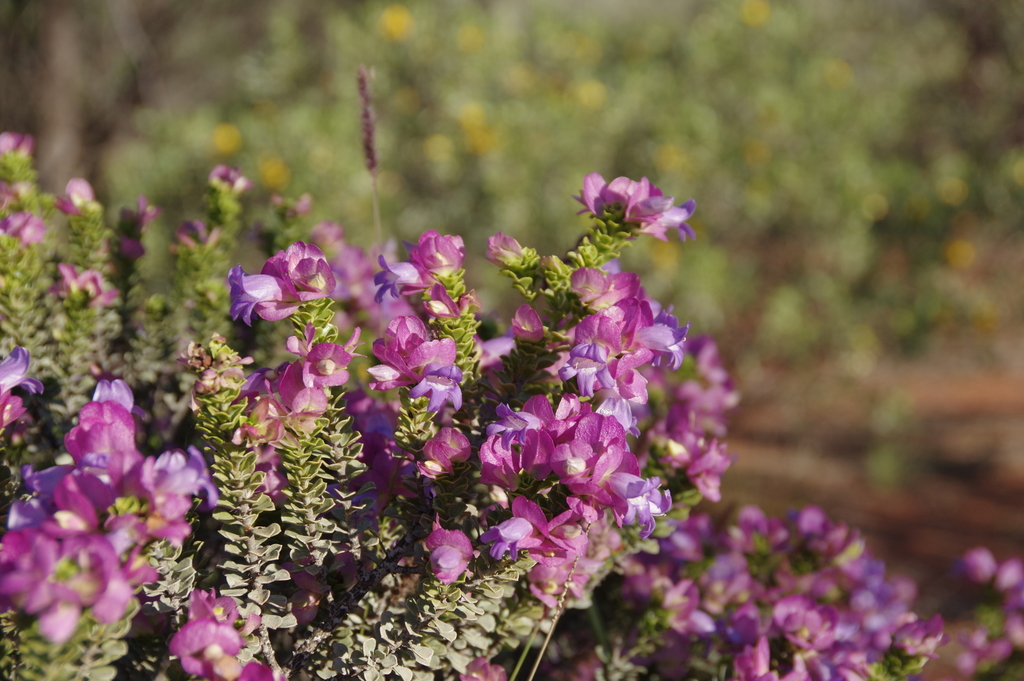
wedge-leaf desert fuchsia
Eremophila cuneifolia
Eremophila cuneifolia, commonly known as pinyuru, is a flowering plant in the figwort family, Scrophulariaceae and is endemic to the north-west of Western Australia. It is a spreading, sticky shrub with wedge-shaped leaves, coloured sepals and usually deep purple flowers.
From the article Eremophila cuneifolia on Wikipedia (CC BY-SA), quoted section by section
Description
Eremophila cuneifolia is a spreading shrub growing to a height of between 0.4 and 1.8 metres (1 and 6 ft) with hairy branches and with branches and leaves that are thickly covered with sticky, shiny resin. The leaves are arranged alternately and clustered near the ends of the stems, mostly 5–16 millimetres (0.2–0.6 in) long, about 3–14 millimetres (0.1–0.6 in) wide, wedge-shaped or heart-shaped but with a distinct small point at the tip. They are thick and stiff and the top surface of the leaves is glabrous while the lower surface is hairy.
The flowers are borne singly in leaf axils on hairy stalks 1–3.5 millimetres (0.04–0.1 in) long. There are five cream-coloured to pale reddish-purple, slightly overlapping, egg-shaped sepals differing in size from each other but mostly 8.5–26 millimetres (0.3–1 in) long. The petals are 16–26 millimetres (0.6–1 in) long and joined at their lower end to form a tube. The petal tube is usually deep purple on the outside, sometimes paler, and white inside with purple spots. There are scattered hairs on the outside of the tube and on the lobes but the tube is filled with long, soft hairs. The four stamens are fully enclosed within the tube. Flowering occurs mostly from June to October and is followed by fruits which are oval to cone-shaped, shiny and 5.5–9 millimetres (0.2–0.4 in) long.
Range & habitat
Pinyuru occurs between Leonora, Jigalong and Onslow in the Carnarvon, Little Sandy Desert, Central Ranges, Murchison, Pilbara and Gascoyne biogeographic regions. It grows in a range of soils and habitats, often in association with other Eremophila species and is sometimes the dominant plant species.
Wikipedia: “Distribution”
How it is grown
This is one of the most attractive eremophilas in cultivation with its colourful sepals and deep purple flowers. It is not easy to propagate or to maintain, especially in areas like Sydney where the humidity is high. It is usually propagated by grafting onto Myoporum and needs a well-drained soil. Pinyuru is also frost sensitive and for this reason is probably best grown in a container which can be moved as the seasons change.
== References ==
Wikipedia: “Use in horticulture”
Where it lives
Recorded sightings
—
geo-referenced records in GBIF, from museums, herbaria and field observers.
Drag the globe to turn it. Dots are where records exist, not a range map; darker means more records.
In the stacks
Searching the stacks…
Every page naming Eremophila cuneifolia in the Biodiversity Heritage Library →
This page is assembled live from iNaturalist, GBIF, Wikipedia, the Source Library and the Internet Archive. It is not yet part of the hand-edited codex. iNaturalist taxon 926207.