- Fungi Including Lichens
- ›Basidiomycete Fungi
- ›Higher Basidiomycetes
- ›Mushrooms, Bracket Fungi, Puffballs, and Allies
- ›Russulales
- ›Milkcaps, Brittlegills and Allies
- ›Lactarius
- ›Lactarius
- ›Scrobiculati
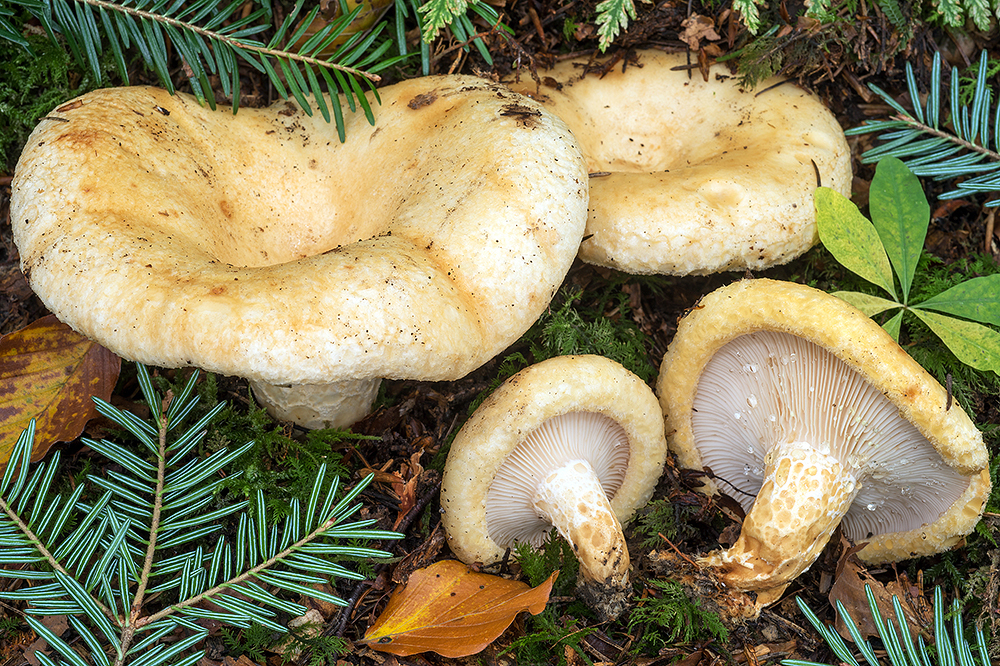
Lactarius intermedius
Lactarius torminosus, commonly known as the woolly milkcap or the bearded milkcap, is a large species of agaric fungus. It was first described scientifically by Jacob Christian Schäffer in 1774 as an Agaricus, and later transferred to the genus Lactarius in 1821 by Samuel Frederick Gray. L. torminosus officially became the type species of Lactarius in 2011 after molecular studies prompted the taxonomic reshuffling of species between several Russulaceae genera.
The caps are convex with a central depression, and attain a diameter of up to 10 cm (4 in). A blend of pink and ochre hues, the cap sometimes has concentric zones of alternating lighter and darker shades. The edge of the cap is rolled inward, and shaggy when young. On the underside of the cap are narrow flesh-colored gills that are crowded closely together. The cylindrical stem is a pale flesh color with a delicately downy surface and brittle flesh; it is up to 8 cm (3 in) long and 0.6–2 cm (1⁄4–3⁄4 in) thick. When cut or injured, the fruit bodies ooze a bitter white latex that does not change color upon exposure to air. The variety nordmanensis, in contrast, has latex that changes from white to yellow. Similar species like L. pubescens or L. villosus differ in morphology and coloration, as well as microscopic characteristics like spore shape and size.
From the article Lactarius torminosus on Wikipedia (CC BY-SA), quoted section by section
Description
The cap is initially convex, but as it matures the center forms a depression and the outer edges rise until it assumes the shape of a shallow funnel; its final width is typically between 2 and 12 cm (3⁄4 and 4+3⁄4 in). The cap margin is strongly curled inward; when young, it is tomentose (covered with a thick matting of hairs), forming a veil-like structure that partly covers up the gills. This tomentum diminishes with age. The cap surface is at first similarly tomentose, but eventually, the hairs wear off, leaving the surface more or less smooth. The surface starts off somewhat sticky with clear concentric rings of darker shade (a zonate pattern); these rings, especially the outer ones, usually fade in maturity. The cap color is pinkish-orange to pale dull pink, becoming orange to whitish toward the margin as the pink gradually fades. The white to flesh-colored flesh is firm and brittle, but becomes flaccid in age. The latex that is produced when the mushroom tissue is cut or injured is white to cream, and does not change color with prolonged exposure to air, nor does it stain the gills. It has an acrid taste, with a slight to pungent odor.
The gills are subdecurrent (running only a small way down the length of the stem), close to crowded together, narrow, and sometimes forked near the stem. Their color is whitish, becoming pink-tinged, turning pale tan with age. …
Range & habitat
Lactarius torminosus is found in northern temperate and boreal climates, penetrating sometimes into subarctic regions. It has been recorded from North Africa, northern Asia, Europe, and is common in North America, where it sometimes grows with aspen (Populus species). The North American distribution extends north into the Yukon and Alaska and south to Mexico.
Wikipedia: “Distribution and habitat”
What it does
Lactarius torminosus is a mycorrhizal species, and as such plays an important role in facilitating nutrient and water uptake by trees. It grows in association with birch (Betula) and hemlock (Tsuga) in mixed forests. It is also known to grow in urban settings when birch trees are nearby. A field study in Scotland concluded that the species is more likely to be present in older than in younger birch woodlands. Fruit bodies grow on the ground, scattered or grouped together. They are a component of the diet of the red squirrel, and serve as breeding sites for some fungus-feeding flies in the Drosophilidae and Mycetophilidae families. Lactarius torminosus mushrooms may be parasitized by the mold Hypomyces lithuanicus, which produces a cream-ochre to cinnamon-colored granular or velvety growth of mycelium on the surfaces of the gills and causes them to be deformed.
Wikipedia: “Ecology”
At the table
Despite the reports of toxicity, L. torminosus mushrooms are prepared in Finland, Russia, and other northern and eastern European countries by parboiling, soaking in brine for several days, or pickling, after which they are valued for their peppery taste. Mushrooms are harvested for commercial sale in Finland. The nutrient composition of Finnish specimens has been analyzed and found to contain the following components (as a percentage of dry weight): protein, 17.20%; phosphorus, 0.46%; calcium, 0.12%; magnesium, 0.09%; potassium, 2.97%; sodium 0.01%.
Wikipedia: “Uses”
Toxicity
The intensely peppery taste of the raw mushroom can blister the tongue if sampled in excess. Some authors have reported the species as outright poisonous, or causing "mild to fatal gastroenteritis". In a 1930 publication, Hans Steidle reported that although the mushroom was not toxic to "unicellular and cold-blooded organisms" when ingested, the liquid extract and the pressed juice of the fruit bodies, when injected under the skin of a frog, resulted in disturbed breathing, paralysis, and eventually death. Symptoms that are typically experienced after consuming raw mushrooms include nausea, vomiting, and severe diarrhea starting about one hour after ingestion. This combination can lead to dehydration, muscle spasms, and circulatory collapse. The gastroenteritis will usually resolve without treatment in a couple of days.
In human culture
The specific epithet torminosus means "tormenting" or "causing colic", in reference to the gastrointestinal distress associated with consuming the raw mushroom. Early English vernacular names were Gray's "bellyach milk-stool" (1821), and James Edward Smith's "bearded pepper agaric" (1824). More recent common names include "shaggy milkcap", "powderpuff milkcap", "pink-fringed milkcap", "bearded milkcap", and the British Mycological Society-recommended "woolly milkcap".
Wikipedia: “Etymology”
Where it lives
Recorded sightings
—
geo-referenced records in GBIF, from museums, herbaria and field observers.
Drag the globe to turn it. Dots are where records exist, not a range map; darker means more records.
In the stacks
Searching the stacks…
Every page naming Lactarius intermedius in the Biodiversity Heritage Library →
This page is assembled live from iNaturalist, GBIF, Wikipedia, the Source Library and the Internet Archive. It is not yet part of the hand-edited codex. iNaturalist taxon 926539.