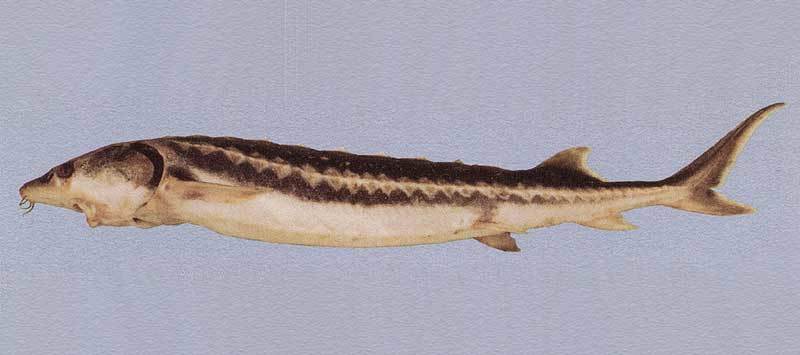
Persian sturgeon
Acipenser persicus
The Persian sturgeon (Huso persicus) is a species of fish in the family Acipenseridae. It is found in the Caspian Sea and to a lesser extent the Black Sea and ascends certain rivers to spawn, mainly the Volga, Kura, Araks and Ural Rivers. It is heavily fished for its flesh and its roe and is limited in its up-river migrations by damming of the rivers. Young fish feed on small invertebrates, graduating to larger prey such as crabs and fish as they grow. The threats faced by this fish include excessive fishing with the removal of immature fish before they have bred, damming of the rivers, loss of spawning areas and water pollution. The International Union for Conservation of Nature has listed the fish as critically endangered and has suggested that the increased provision of hatcheries could be of benefit.
From the article Persian sturgeon on Wikipedia (CC BY-SA), quoted section by section
Range & habitat
The Persian sturgeon feeds at the shelf zone of the sea, primarily in the eastern part of the South Caspian. Individual specimens are found in the North Caspian, western part of the Middle and South Caspian.
Wikipedia: “Distribution”
What it does
The Persian sturgeon is a heterotroph equipped with tactile and gustatory receptors; when feeding it simply sucks in its food. The eating habits of the sturgeon change throughout its life. As it begins life the sturgeon feeds on invertebrates including Mysid shrimp, Chironomid flies and gammarid amphipods. At approximately age 2–3 years many feed on crabs or fish, and finally in adulthood the Persian sturgeon consumption is primarily fish. The sturgeon mainly reproduces in the Volga, Kura, Araks, and Ural rivers. This sexual reproduction occurs in waters that are 20–25 °C (68–77 °F). Spawning occurs at different times for the different rivers. There is spawning in the Volga river from late July to early August, in the Krua river from April to mid-September and in the Ural river from June to July. Other than at times of spawning the sturgeon is a bottom dweller in the mud or sand.
Wikipedia: “Ecology”
Where it lives
Recorded sightings
—
geo-referenced records in GBIF, from museums, herbaria and field observers.
Drag the globe to turn it. Dots are where records exist, not a range map; darker means more records.
In the stacks
Searching the stacks…
Every page naming Acipenser persicus in the Biodiversity Heritage Library →
This page is assembled live from iNaturalist, GBIF, Wikipedia, the Source Library and the Internet Archive. It is not yet part of the hand-edited codex. iNaturalist taxon 93188.