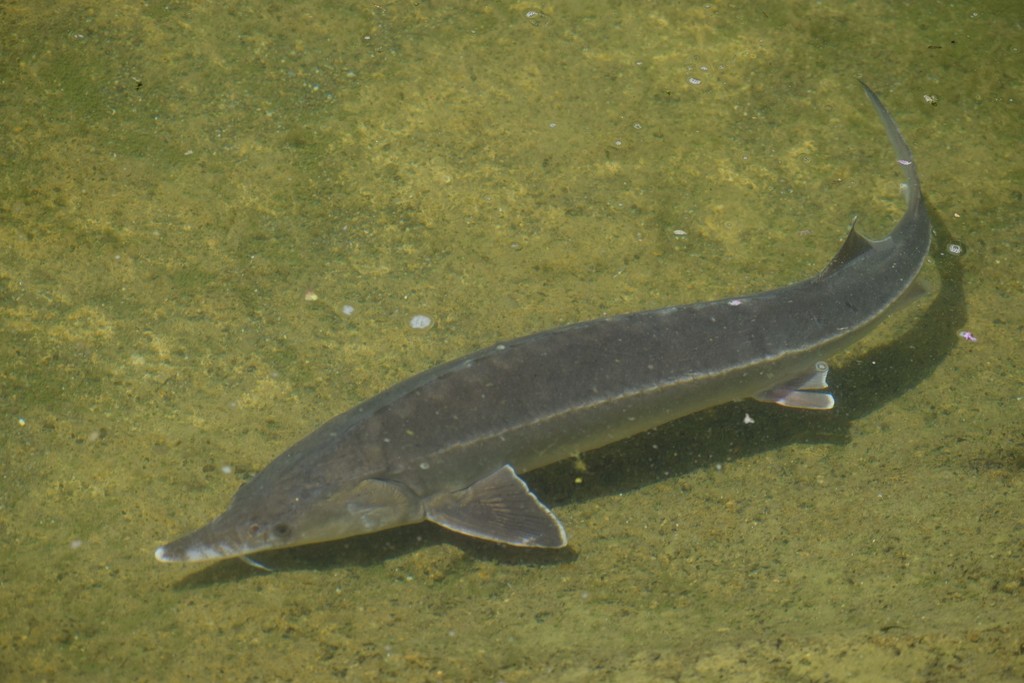
Sterlet
Acipenser ruthenus
The sterlet (Huso ruthenus) is a relatively small species of sturgeon from Eurasia native to large rivers that flow into the Black Sea, Azov Sea, and Caspian Sea, as well as rivers in Siberia as far east as Yenisei. Populations migrating between fresh and salt water (anadromous) have been extirpated. It is also known as the sterlet sturgeon.
Due to overfishing (for its flesh, caviar, and isinglass), pollution, and dams, the sterlet has declined throughout its native range and is considered endangered by the IUCN. Restocking projects are ongoing, and it has been introduced to some regions outside its native range, but the latter have generally not become self-sustaining. Today, the majority of the international trade involves sterlets from aquaculture.
From the article Sterlet on Wikipedia (CC BY-SA), quoted section by section
What it does
The sterlet's main source of food is benthic organisms; they commonly feed on crustaceans, worms, and insect larvae.
Wikipedia: “Feeding habits”
At the table
In Russia, it is held in high esteem on account of its flesh, contributing to kinds of caviar and isinglass.
Wikipedia: “As food”
In human culture
The sterlet commonly reaches the age of 22 to 25 years. Males reach sexual maturity at 3–7 years old and females at 4–12 years old. Spawning occurs from the middle of April to the beginning of June. Females may lay from 15,000 to 44,000 eggs, at water temperatures preferably 12–17 °C (54–63 °F).
Wikipedia: “Life history”
Where it lives
Recorded sightings
—
geo-referenced records in GBIF, from museums, herbaria and field observers.
Drag the globe to turn it. Dots are where records exist, not a range map; darker means more records.
In the stacks
Searching the stacks…
Every page naming Acipenser ruthenus in the Biodiversity Heritage Library →
This page is assembled live from iNaturalist, GBIF, Wikipedia, the Source Library and the Internet Archive. It is not yet part of the hand-edited codex. iNaturalist taxon 93189.