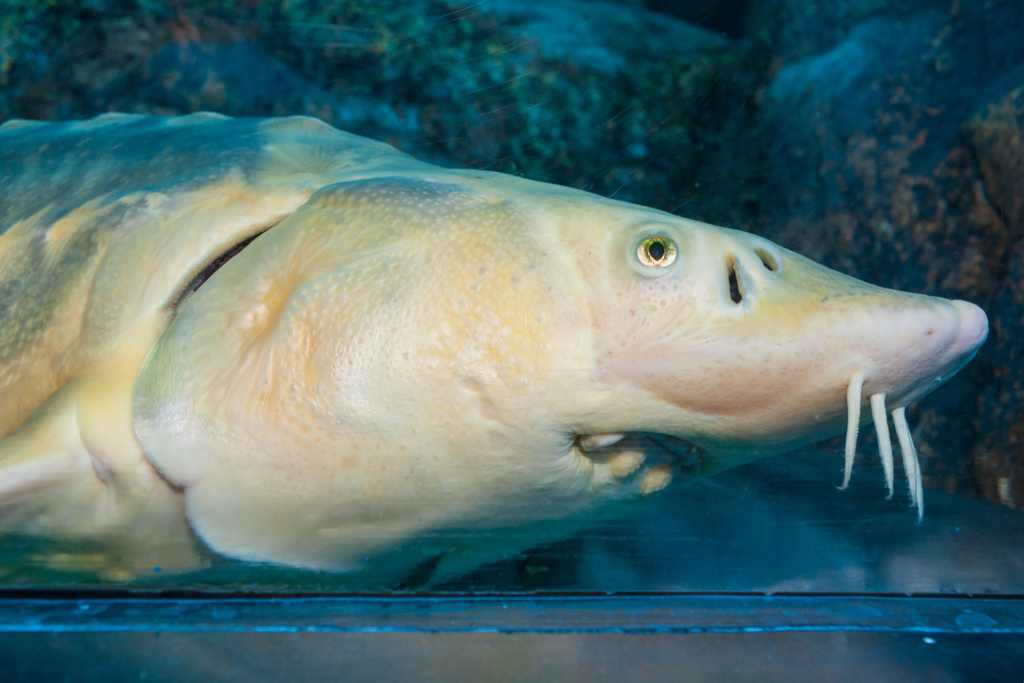
Chinese Sturgeon
Acipenser sinensis
The Chinese sturgeon (Sinosturio sinensis; Chinese: 中华鲟; pinyin: zhōnghuá xún) is a critically endangered member of the family Acipenseridae in the order Acipenseriformes. Historically, this anadromous fish was found in China, Japan, and the Korean Peninsula, but it has been extirpated from Korea, Japan, and most regions in China due to habitat loss and overfishing.
It is strictly protected by the Chinese government, named a "national treasure" much like its mammalian counterpart, the giant panda. China has several conservation programmes, including reserves specifically aimed at this species and restocking through release of juveniles in the Yangtze River.
From the article Chinese sturgeon on Wikipedia (CC BY-SA), quoted section by section
Range & habitat
The Chinese sturgeon is a critically endangered species native to China. It is largely dispersed over the main streams of the Yangtze River and coastal regions of Qiantang River, Minjiang River, and Pearl River. The adults are predators that consume any aquatic animal that can be swallowed, while the young feed on aquatic insects, larvae, diatoms, and humic substances. In the 1970s, an estimated 2,000 Chinese sturgeon spawned in the Yangtze River every year. Now, that number is down to several hundred due to the threats to its habitat, such as pollution and other human action. The channel for adult fish migrating to traditional spawning sites such as the Jinsha River in the upstream of Yangtze River was blocked after the construction of the Gezhouba Dam hydroelectric power project in the early 1980s. The Yangtze River Fisheries Research Institute of the Chinese Academy of Fisheries Sciences, the Institute of Hydrobiology of the Chinese Academy of Sciences, the Institute of Hydro-ecology of the Ministry of Water Resources of China, and the Chinese Sturgeon Research Institute of the Three Gorges Group have been collaboratively monitoring Chinese sturgeon spawning since the 1980s. However, from 2013 to 2014, no new spawning activity was detected and led to the belief that the Chinese sturgeon was near extinction. …
Wikipedia: “Habitat”
Where it lives
Recorded sightings
—
geo-referenced records in GBIF, from museums, herbaria and field observers.
Drag the globe to turn it. Dots are where records exist, not a range map; darker means more records.
In the stacks
Searching the stacks…
Every page naming Acipenser sinensis in the Biodiversity Heritage Library →
This page is assembled live from iNaturalist, GBIF, Wikipedia, the Source Library and the Internet Archive. It is not yet part of the hand-edited codex. iNaturalist taxon 93191.