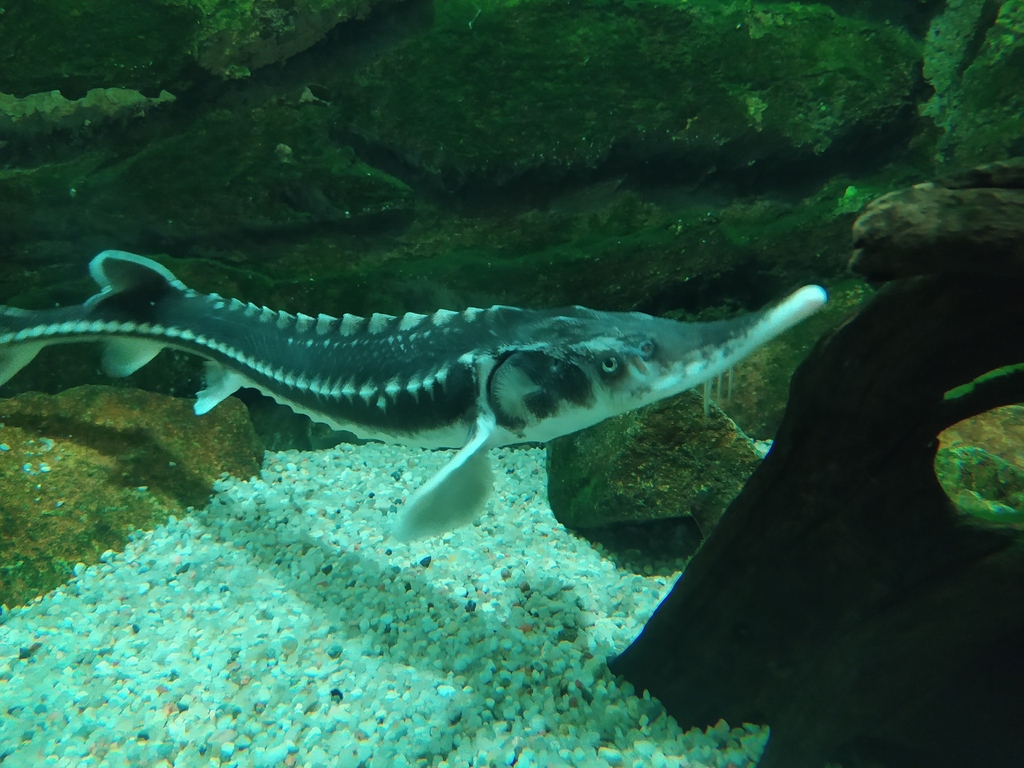
Starry Sturgeon
Acipenser stellatus
The starry sturgeon (Huso stellatus), also known as the stellate sturgeon or sevruga (Drakul, Persian: اوزون برون, and Turkish: Uzun Burun, lit. 'long nosed'), is a species of sturgeon. It is native to coastal and basin waters of the Black, Azov, Caspian and Aegean seas, but it has been extirpated from the last and it is predicted that the remaining natural population will follow soon due to overfishing.
The starry sturgeon is an anadromous species, which migrates up rivers to spawn.
From the article Starry sturgeon on Wikipedia (CC BY-SA), quoted section by section
Description
The starry sturgeon reaches about 220 cm (7.2 ft) in length and weighs up to 80 kg (180 lb). It is a slim-bodied fish easily distinguished from other sturgeons by its long, thin and straight snout that makes up roughly 25% of its total length. A row of five small barbels lies closer to the mouth than to the tip of the snout. The scales on the lateral line number between thirty and forty and these features distinguish this fish from the Russian sturgeon (H. gueldenstaedtii). It has many scutes along its top side as an act of protection. It has 9-16 on its dorsal, 26-43 on its lateral, 9-14 residing on the ventral, 40-54 resting on the dorsal fin rays, and 22-35 protecting the anal fin rays. Its general colouring is dark greyish-green or brown with a pale underside. The scales on the lateral line are pale. The maximum reported age for this species is 27 years.
Range & habitat
The starry sturgeon can be found in coastal, sea, and estuarine environments. They can mainly be residing in the Caspian sea, Black sea, Sea of Asov, and the Aegean Sea. However, during spring spawn season, the species is known to migrate to rivers with heavy currents and have a preference for stone-filled river bottoms. If a river is not an optimal spawn habitat, sturgeon have been recorded to reside in flooded river banks with sandy ground.
Wikipedia: “Distribution”
What it does
The starry sturgeon is a harmless species, thereby lacking significant natural protection and pose no threat to predators, that feeds on fish, worms, crustaceans and mollusks. It lies on the bottom of the seabed during the day and feeds mostly at night. This fish is anadromous and moves upriver into shallow waters to spawn during spring and winter.
Wikipedia: “Behaviour”
At the table
The starry sturgeon is an important commercial fish species that serves as food in many cuisines across Europe. It is an essential source of caviar, see Sevruga caviar, that food industries use along with the Beluga sturgeon and the Ossetra sturgeon. Its meat is packed with vitamins, amino acids, and mineral. It can be a common ingredient in kababs, and can be cooked in various methods such as pan frying, smoking, and broiling as seen in the Caspian regions, where the meat is a delicacy. In aquaculture, many countries around the world have attempted to farm the starry sturgeon, along with other sturgeon species, in hopes of supplying the increasing demand for its meat and caviar. Although, due to natural resource destruction and overfishing, the sustainability of these harvesting facilities become lost. With a recorded minimal population doubling time of 4.5 – 14 years, the species' ability to recover from a population loss is difficult to achieve in large quantities.
Wikipedia: “Uses”
Where it lives
Recorded sightings
—
geo-referenced records in GBIF, from museums, herbaria and field observers.
Drag the globe to turn it. Dots are where records exist, not a range map; darker means more records.
In the stacks
Searching the stacks…
Every page naming Acipenser stellatus in the Biodiversity Heritage Library →
This page is assembled live from iNaturalist, GBIF, Wikipedia, the Source Library and the Internet Archive. It is not yet part of the hand-edited codex. iNaturalist taxon 93192.