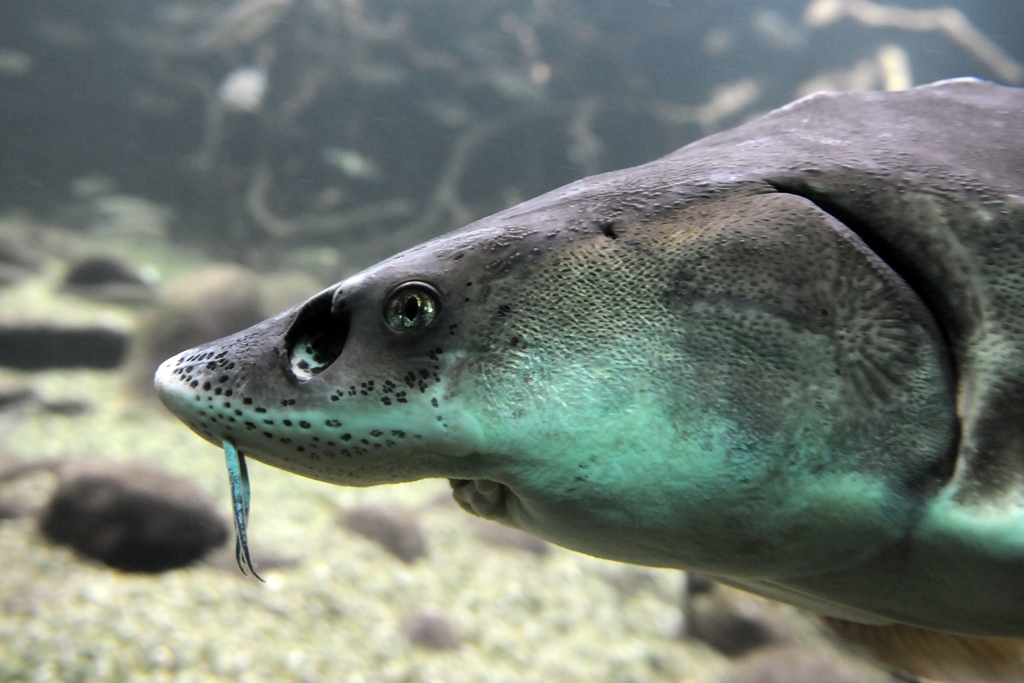
European Sea Sturgeon
Acipenser sturio
The European sea sturgeon (Acipenser sturio), also known as the Atlantic sturgeon or common sturgeon, is a species of sturgeon native to Europe. It was formerly abundant, being found in coastal habitats all over Europe. Most specifically, they reach the Black and Baltic Sea. It is anadromous and breeds in rivers. It is currently a critically endangered species. Although the name Baltic sturgeon sometimes has been used, it has now been established that sturgeon of the Baltic region are A. oxyrinchus, a species otherwise restricted to the Atlantic coast of North America.
From the article European sea sturgeon on Wikipedia (CC BY-SA), quoted section by section
Description
The wedge-shaped head of the European sea sturgeon ends in a long point. There are many sensitive barbels on the facial area. The dorsal fins are located very far back on the body. Five longitudinal lines of large osseous plates are found on the body of the fish. The dorsal side of the European sea sturgeon is greenish-brown to blackish with golden tints, the flanks are light with silvery tints and the belly is white. This sturgeon can reach 6 m (20 ft) and 400 kg (880 lb) in weight, but a more common length is 1.25 m (4 ft 1 in). They can reach an age of 100 years, and have a late sexual maturity (12 to 14 years for the males and 16 to 18 years for the females).
Range & habitat
They are found on the coasts of Europe, except in the northernmost regions and the Baltic region, and have rarely even been known to cross the Atlantic Ocean to the coasts of North America. Like many other sturgeons, they spawn in the rivers inland from the coast. The species can tolerate wide spread salinities and spend most of their lives in saltwater but migrate to spawn in freshwater.
Wikipedia: “Distribution and habitat”
What it does
Like other sturgeons, they eat polychaete worms and crustaceans which they find with their barbels.
Wikipedia: “Diet”
Where it lives
Recorded sightings
—
geo-referenced records in GBIF, from museums, herbaria and field observers.
Drag the globe to turn it. Dots are where records exist, not a range map; darker means more records.
In the stacks
Searching the stacks…
Every page naming Acipenser sturio in the Biodiversity Heritage Library →
This page is assembled live from iNaturalist, GBIF, Wikipedia, the Source Library and the Internet Archive. It is not yet part of the hand-edited codex. iNaturalist taxon 93193.