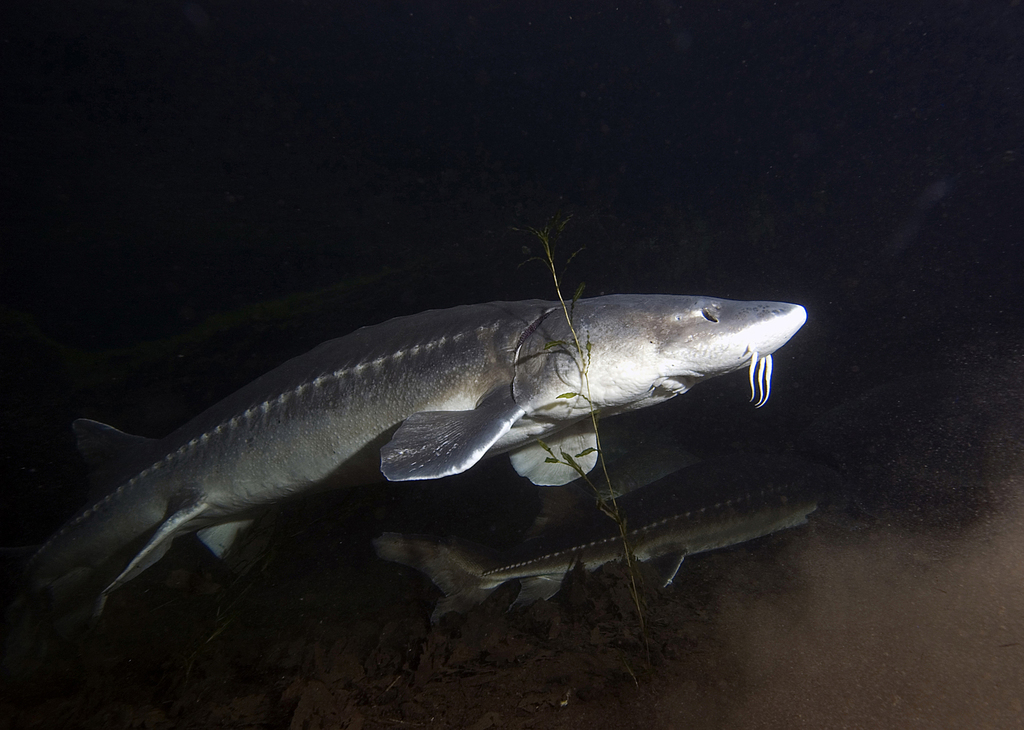
White Sturgeon
Acipenser transmontanus
White sturgeon (Sinosturio transmontanus) is a species of sturgeon in the family Acipenseridae of the order Acipenseriformes. They are an anadromous (migratory) fish species ranging in the Eastern Pacific; from the Gulf of Alaska to Monterey, California. However, some are landlocked in British Columbia, the Fraser River and Columbia River, Montana, Snake River, and Clearwater River in Idaho, and Lake Shasta in California, with reported sightings in northern Baja California, Mexico.
From the article White sturgeon on Wikipedia (CC BY-SA), quoted section by section
Description
S. transmontanus is distinguished by the two rows of four to eight ganoid bony plates between the anus and anal fin, with about 45 rays present in the dorsal fin. Coloring can range from gray to brownish on the dorsal side, paler on the ventral side, and gray fins. Barbels are situated anterior to the mouth, closer to the snout than the mouth. At sexual maturity, S. transmontanus can reach 1.6 m (5.2 ft) in length, while the maximum length recorded of any age class is 6.1 m (20 ft), with common lengths around 2.1 m (6.9 ft). While age at maturity is uncertain, possible age ranges of known S. transmontanus specimens range from 11 to 34 years old. The most authentic record of the maximum weight of this species is reported to be 630 kg (1,390 lb), while other unauthenticated records show a higher weight estimate, as with the 816 kg (1,799 lb) estimate for an individual with a reported age of 104 years. In one 1995 study, a sample of adults weighed from 34 to 75 kg (75 to 165 lb). A specimen, considered the largest in the state in recent years, of 210 kg (460 lb) at a length of 2.8 m (9.2 ft) was recorded relatively recently in California.
Range & habitat
White sturgeon are native to several large North American rivers that drain to the Pacific Ocean. They primarily live in estuaries of large rivers, but migrate to spawn in freshwater, and travel long distances between river systems. Reproducing populations have been documented along the West Coast, from northern Mexico up to the Aleutian Islands in Alaska. White sturgeon are commonly found in deep, soft bottomed areas of estuaries, where movements in the water column is dependent on salinity. Historical ranges have been modified substantially by overharvesting, habitat changes due to dams, and river regulations; all affecting habitat quality, suitability and connectivity. In the lower Fraser River, British Columbia, movement and abundance are assessed by acoustic tags and mark recapture methods. While the model developed by Robichaud, English and Nelson assumes a closed homogenous population, acoustic tags and mark-recapture data shows that they are sedentary during the winter months and mobile in the spring and fall, with data indicating that they leave the Fraser River and enter the Strait of Georgia during their mobile periods; this conclusion has been validated by microchemical evidence of marine exposure in Fraser River white sturgeon fin rays. Construction of dams for hydroelectric power production affects seasonal movement of white sturgeon in many river systems, with th …
Wikipedia: “Distribution and habitat”
What it does
Larval white sturgeon 10–11 mm (0.39–0.43 in) in TL experience the highest mortality when they transition from endogenous to exogenous feeding, around 8–14 days post-hatch depending on conditions. Once larvae metamorphose into young of the year (YOY) and juveniles, they actively feed on the substrate, dominantly Corophium spp., relying on water currents to carry them downriver to areas of suitable food. The availability of Corophium spp. could play a key role in the survival of larval and YOY white sturgeon in the Columbia River and could possibly explain the apparent poor survival of larvae and YOY in some Snake and Columbia River reservoirs that apparently have successful spawning but poor recruitment. Juveniles less than 600 mm (2.0 ft) TL are known to feed on tube-dwelling amphipods, mysids, isopods, Corophium spp, and other benthic invertebrates, as well as on the eggs and fry of other fish species. Adults greater than 600 mm (2.0 ft) consume a variety prey species, adjusting to a piscivorous diet of herring, shad, starry flounder, goby, smelt, anchovy, lamprey, and salmon, as well as benthic items such as invasive overbite clam. …
Wikipedia: “Diet”
Where it lives
Recorded sightings
—
geo-referenced records in GBIF, from museums, herbaria and field observers.
Drag the globe to turn it. Dots are where records exist, not a range map; darker means more records.
In the stacks
Searching the stacks…
Every page naming Acipenser transmontanus in the Biodiversity Heritage Library →
This page is assembled live from iNaturalist, GBIF, Wikipedia, the Source Library and the Internet Archive. It is not yet part of the hand-edited codex. iNaturalist taxon 93194.