- Plants
- ›Vascular Plants
- ›flowering plants
- ›Dicots
- ›proteas, lotuses, planes, and allies
- ›Protea family
- ›Singlet Proteas
- ›Smokebushes and Blueboys
- ›Conosperminae
- ›Conospermum
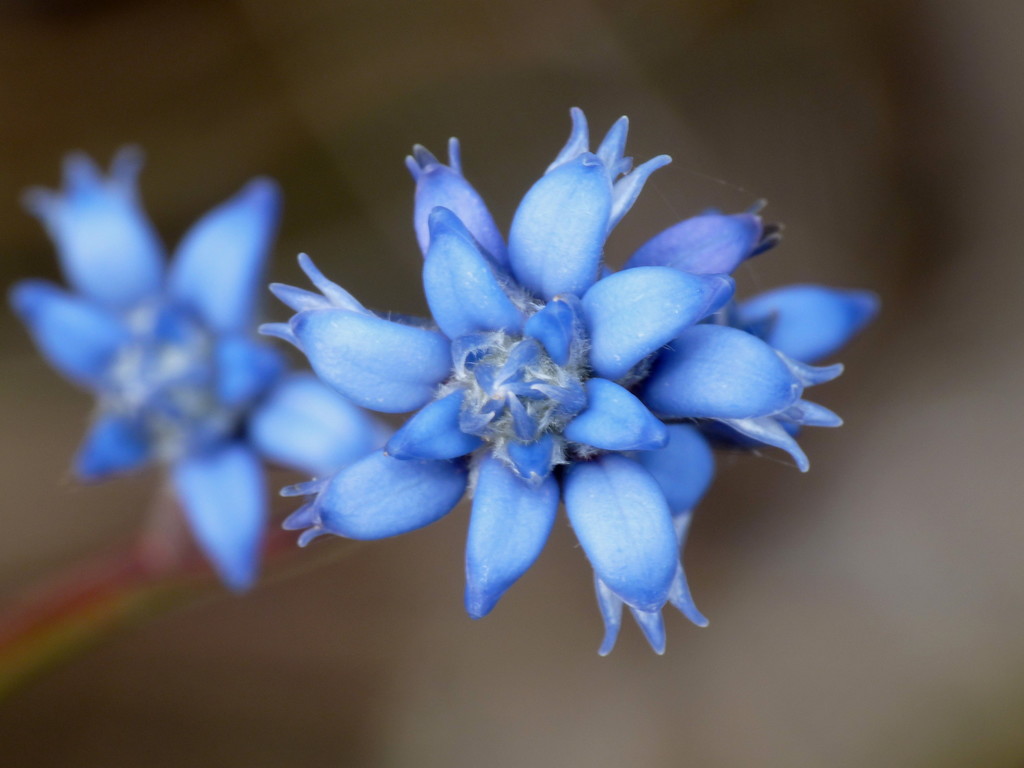
Conospermum caeruleum
Conospermum caeruleum, commonly known as blue brother, is a species of flowering plant in the family Proteaceae and is endemic to the south west of Western Australia. It is a prostrate shrub with small, dense heads of blue, rarely pink flowers and usually grows in heavy soils subject to flooding.
From the article Conospermum caeruleum on Wikipedia (CC BY-SA), quoted section by section
Description
It grows as a prostrate or straggly shrub usually growing to a height of about 0.5–1.0 metre (2–3 ft) and a spread of up to 2 metres (7 ft). The leaves are clustered at the base of the stem, have a stalk 5–60 millimetres (0.2–2 in) and a leaf blade that is thread-like to egg-shaped and 14–148 millimetres (0.6–6 in). The leaves have prominent veins and end abruptly in a sharp point. The flowers are arranged in dense clusters of up to 18 tube-like blue flowers, each about 5–8 millimetres (0.2–0.3 in) long. Flowers appear between July and October and are followed by the fruit which is a nut about 2 millimetres (0.08 in) long and 2–2.5 millimetres (0.08–0.1 in) wide.
Range & habitat
Conospermum caeruleum occurs from Busselton to east of Albany in the Avon Wheatbelt, Esperance, Geraldton Sandplains, Jarrah Forest, Mallee, Swan Coastal Plain and Warren biogeographical regions of Western Australia growing on sand, sandy peat, stony clay, laterite or granite in areas that are wet in winter.
Wikipedia: “Distribution and habitat”
How it is grown
Conospermum species, especially the Western Australian ones are difficult to cultivate.
Wikipedia: “Use in horticulture”
Where it lives
Recorded sightings
—
geo-referenced records in GBIF, from museums, herbaria and field observers.
Drag the globe to turn it. Dots are where records exist, not a range map; darker means more records.
In the stacks
Searching the stacks…
Every page naming Conospermum caeruleum in the Biodiversity Heritage Library →
This page is assembled live from iNaturalist, GBIF, Wikipedia, the Source Library and the Internet Archive. It is not yet part of the hand-edited codex. iNaturalist taxon 932013.