- Plants
- ›Vascular Plants
- ›flowering plants
- ›Dicots
- ›Sunflowers, Bellflowers, Fanflowers, and Allies
- ›Sunflowers, Daisies, Asters, and Allies
- ›Thistles and Allies
- ›Cardueae
- ›Knapweeds and Allies
- ›Centaurea
- ›Cyanus
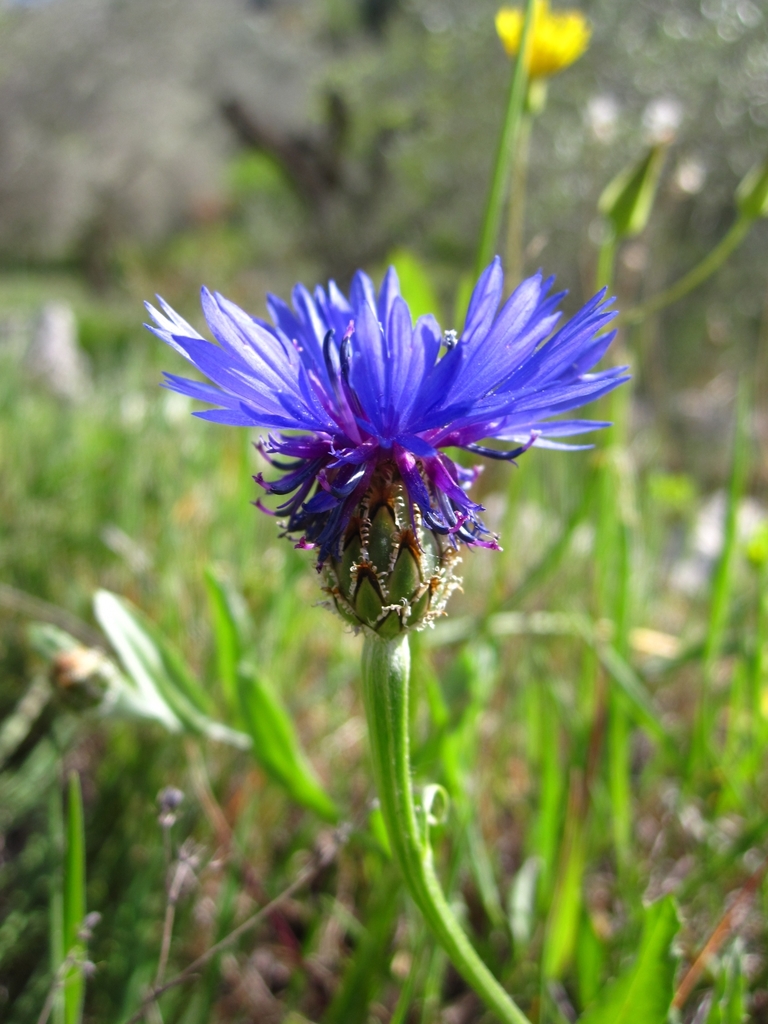
Cornflower
Centaurea cyanus
Centaurea cyanus, commonly known as cornflower or bachelor's button (among other names), is an annual flowering plant in the family Asteraceae native to Europe. In the past, it often grew as a weed in cornfields (in the broad sense of "corn", referring to grains, such as wheat, barley, rye, or oats), hence its name.
C. cyanus is now endangered in its native habitat by agricultural intensification, particularly by over-use of herbicides. However, it is now also naturalized in many other parts of the world, including North America and parts of Australia.
From the article Centaurea cyanus on Wikipedia (CC BY-SA), quoted section by section
Description
Centaurea cyanus is an annual plant growing to 20–100 centimetres (8–39 in) tall, with grey-green branched stems. The leaves are lanceolate and 3–10 cm (1–4 in) long. The flowers are most commonly an intense blue colour and arranged in flowerheads (capitula) of 1.5–3 cm diameter, with a ring of a few large, spreading ray florets surrounding a central cluster of disc florets. The blue pigment is protocyanin, which in roses is red. Fruits are approx. 3.5 mm long with 2–3 mm-long pappus bristles. It flowers all summer.
Range & habitat
Centaurea cyanus is native to temperate Europe, but is widely naturalized in many other parts of the world, including North America and parts of Australia through introduction as an ornamental plant in gardens and as a seed contaminant in crop seeds. It has been present in Britain and Ireland as an archaeophyte (ancient introduction) since the Iron Age. In the United Kingdom, it has declined from 264 sites to just 3 sites in the last 50 years. In reaction to this, the conservation charity Plantlife named it as one of 101 species it would actively work to bring 'back from the brink'. In County Clare (VC H9), Ireland, C. cyanus is recorded in arable fields as very rare and almost extinct, while in northeast Ireland, it was abundant before the 1930s.
Wikipedia: “Distribution and habitat”
At the table
The flowers of Centaurea cyanus can be eaten raw, dried or cooked. Dried petals are used in foods, including in spices. Their main purpose is to add colour to food. There are cheeses or oils that contain raw petals. Petals can also be added to salads, drinks, and desserts for garnishing purposes in raw or dried form. Dried petals are also used in teas and other beverages. Blue cornflower petals are sometimes one of the ingredients in Lady Grey tea.
Wikipedia: “Culinary”
In medicine
Centaurea cyanus contains a wide range of pharmacologically active compounds, such as flavonoids, anthocyanins and aromatic acids. Especially the flower head finds application in herbal medicine, but leaves and seeds are also used for pharmacological purposes, albeit to a lesser extent. In particular, extracts from the flower heads have anti-inflammatory properties used in the treatment of minor ocular inflammations. Antioxidant properties are high due to ascorbic acid and phenolic compounds. Furthermore, extracts of the flower head and vegetative parts of the plant were shown to have gastroprotective effects due to their content of quercetin, apigenin and caffeic acid derivates.
Wikipedia: “Medicine”
How it is grown
Several cultivars of Centaurea cyanus with varying pastel colours, including pink and purple, have been selected for ornamental purposes. The species is also grown for the cut flower industry in Canada for use by florists. Doubled blue cultivars (such as 'Blue Boy' or 'Blue Diadem') are most commonly used for this purpose, but white, pink, lavender and black (actually a very dark maroon) cultivars are also used, albeit to a lesser extent.
Breeding goals. As for all ornamental plants, important goals of Centaurea cyanus breeding include the induction of phenotypic variation (e.g. in flower coloration, size and shape, foliage characteristics or plant height), higher flower yield, resistance to pests and diseases as well as tolerance to abiotic stress (e.g., extreme temperatures, drought or salinity).
Soil and climate requirements. Centaurea cyanus requires full sun and neutral (pH 6.6–7.5) to mildly alkaline (pH 7.6–7.8), moist and well-drained soil. However, Centaurea cyanus is quite tolerant to drought once established.
Sowing. For summer-blooming plants, sowing should be executed in late spring. In moderate climates, however, it is also possible to sow Centaurea cyanus in early autumn. In this case, plants will already start to flower in the following spring. Recommended spacing between plants is approx. 20 to 30 cm. …
Wikipedia: “Cultivation”
In human culture
In folklore, cornflowers were worn by young men in love; if the flower faded too quickly, it was taken as a sign that the man's love was not returned. The blue cornflower was one of the national symbols of Germany. This is partly due to the story that when Queen Louise of Prussia was fleeing Berlin and pursued by Napoleon's forces, she hid her children in a field of cornflowers and kept them quiet by weaving wreaths for them from the flowers. The flower thus became identified with Prussia, not least because it was the same color as the Prussian military uniform. After the unification of Germany in 1871, it went on to become a symbol of the country as a whole. For this reason, in Austria the blue cornflower is a political symbol for pan-German and rightist ideas. It was worn as a secret symbol identifying members of the then-illegal NSDAP in Austria in the 1930s. Members of the Freedom Party wore it at the openings of the Austrian parliament since 2006. After the 2017 general election, they replaced it with the edelweiss. It was also the favourite flower of Louise's son Kaiser Wilhelm I. …
Wikipedia: “In culture”
Where it lives
Recorded sightings
—
geo-referenced records in GBIF, from museums, herbaria and field observers.
Drag the globe to turn it. Dots are where records exist, not a range map; darker means more records.
In the old herbals & bestiaries

Maria Sibylla Merian — Der rupsen begin, voedzel en wonderbaare verandering (1712)
Maria Sibylla Merian · 1717 · p.179

The Book of Health: The Art of Distillation
Brunschwig, Hieronymus · 1505 · p.102

The Great Herbary with all the figures of the herbs
1532 · p.164

Notable Commentaries on the History of Plants
Leonhart Fuchs · 1542 · p.462

Notable Commentaries on the History of Plants
Leonhart Fuchs · 1549 · p.460

On the Names of Plants
Hieronymus Bock (Tragus) · 1552 · p.638

Commentaries on the Six Books of Dioscorides
Pietro Andrea Mattioli · 1560 · p.408

Commentaries on the Six Books of Dioscorides
Pietro Andrea Mattioli · 1560 · p.408

Commentaries on the Six Books of Dioscorides on Medical Matter
Pietro Andrea Mattioli · 1563 · p.393

Commentaries on the Six Books of Dioscorides on Medical Matter
Pietro Andrea Mattioli · 1563 · p.393

Florum et coronariarum historia
Rembert Dodoens · 1568 · p.56

Florum et coronariarum historia
Rembert Dodoens · 1568 · p.54
In the stacks
Searching the stacks…
Every page naming Centaurea cyanus in the Biodiversity Heritage Library →
This page is assembled live from iNaturalist, GBIF, Wikipedia, the Source Library and the Internet Archive. It is not yet part of the hand-edited codex. iNaturalist taxon 933404.