- Plants
- ›Vascular Plants
- ›flowering plants
- ›Dicots
- ›Sunflowers, Bellflowers, Fanflowers, and Allies
- ›Sunflowers, Daisies, Asters, and Allies
- ›Asteroideae
- ›stinkworts and allies
- ›Plucheinae
- ›Streptoglossa
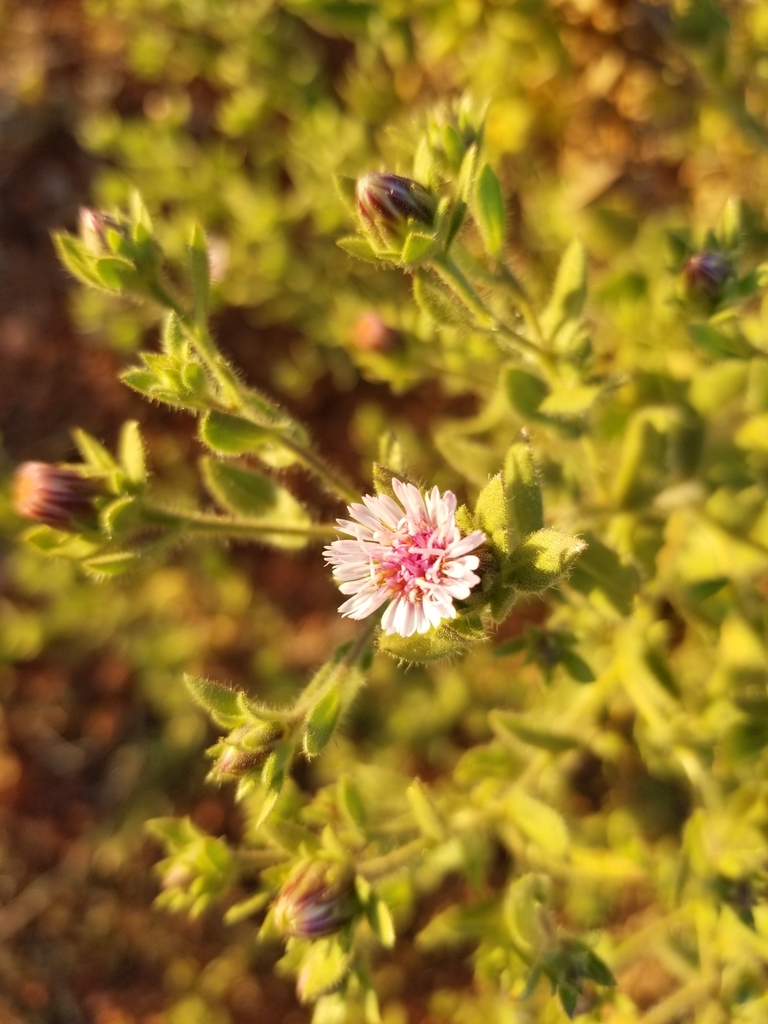
Streptoglossa decurrens
Streptoglossa decurrens is a species of flowering plant in the family Asteraceae. It grows in Queensland, Western Australia and the Northern Territory. It is an upright, aromatic perennial herb or shrub with pink-purplish or reddish purple flowers.
From the article Streptoglossa decurrens on Wikipedia (CC BY-SA), quoted section by section
Description
Streptoglossa decurrens is a shrub growing to 70 cm (28 in) high. The leaves and branches are strongly fragrant, sticky and covered with soft, weak, thin hairs to long, soft, straight hairs and thickly glandular. The stems are upright leafy, older branches maybe leafless. The leaves are decurrent, elliptic, oblong or rarely oblong-lance shaped, leaves of main branches and stems 2–6 cm (0.79–2.36 in) long, 0.8–2.3 cm (0.31–0.91 in) wide, margins smooth or toothed. The capitula are usually in a corymb cluster on lateral branches of 45-80 florets and the involucre 0.8–1.4 cm (0.31–0.55 in) long. The pink-purple or red-purple corolla has 5 lobes, 6–7 mm (0.24–0.28 in) long, smooth and usually not glandular. Flowering occurs from July to November and the fruit is dry, one-seeded, 2–2.5 mm (0.079–0.098 in) long, silky with flattened hairs.
Range & habitat
This species is found growing on rocky soils and hillsides, creek beds and clay depressions in Queensland, Western Australia and the Northern Territory.
== References ==
Wikipedia: “Distribution and habitat”
Where it lives
Recorded sightings
—
geo-referenced records in GBIF, from museums, herbaria and field observers.
Drag the globe to turn it. Dots are where records exist, not a range map; darker means more records.
In the stacks
Searching the stacks…
Every page naming Streptoglossa decurrens in the Biodiversity Heritage Library →
This page is assembled live from iNaturalist, GBIF, Wikipedia, the Source Library and the Internet Archive. It is not yet part of the hand-edited codex. iNaturalist taxon 937166.