- Plants
- ›Vascular Plants
- ›flowering plants
- ›Dicots
- ›Sunflowers, Bellflowers, Fanflowers, and Allies
- ›Sunflowers, Daisies, Asters, and Allies
- ›Asteroideae
- ›stinkworts and allies
- ›Plucheinae
- ›Streptoglossa
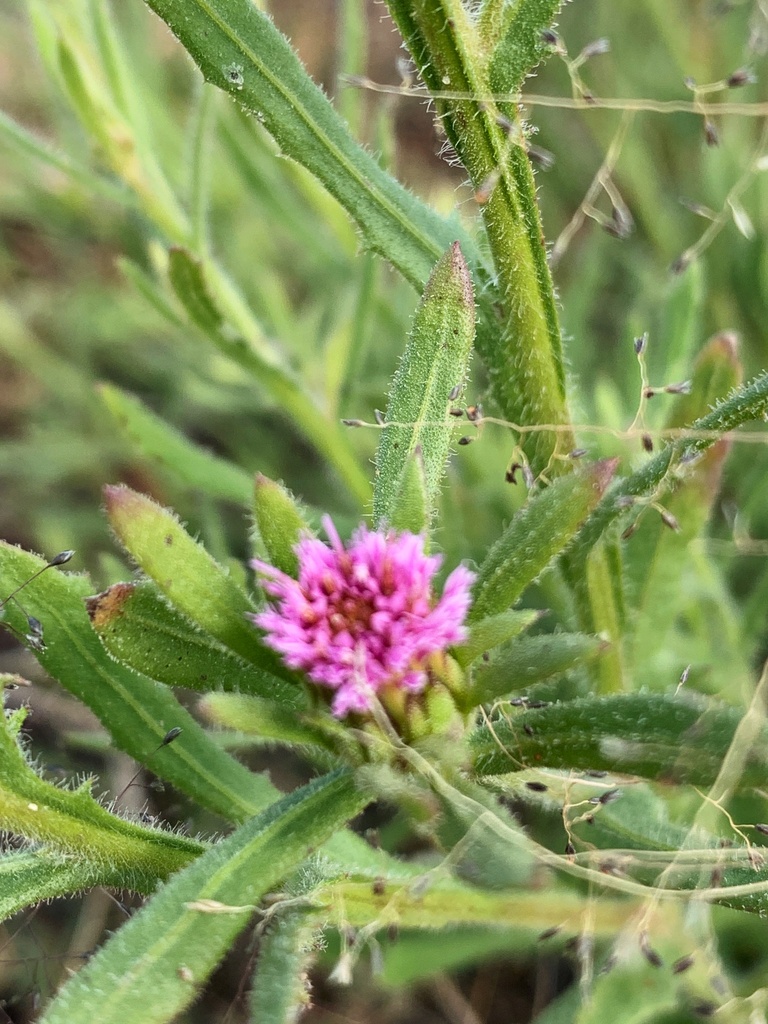
Desert Daisy
Streptoglossa adscendens
Streptoglossa adscendens, commonly known as desert daisy, is a species of flowering plant in the family Asteraceae and grows in all mainland states of Australia with the exception of Victoria. It is a ground cover, upright or ascending perennial or annual herb with purple or pink flowers.
From the article Streptoglossa adscendens on Wikipedia (CC BY-SA), quoted section by section
Description
Streptoglossa adscendens is a short-lived, leafy, many branched perennial or prostrate herb to 40 cm (16 in) high with faintly aromatic, glandular leaves and upright stems covered in soft, thin hairs. The leaves are oblong to lance shaped, rarely spoon shaped, 1–5 cm (0.39–1.97 in) long, 0.1–1.7 mm (0.0039–0.0669 in) wide, narrowing gradually at the base, margins smooth or toothed and ending in a point. The flowers are borne on a short peduncle or almost sessile usually in clusters near the apex of leafy branches, consisting of 20-40 pink florets, involucre 0.7–1.1 cm (0.28–0.43 in) long, enclosed by a distinctive whorl of 3 or 4 leaves 0.5–1.5 cm (0.20–0.59 in) long, bracts purplish or green, smooth or with soft hairs. Flowering occurs from March to October and the fruit is dry, one-seeded, ribbed, 2–3 mm (0.079–0.118 in) long and densely covered with silky, flattened hairs.
Range & habitat
Desert daisy grows in a variety of habitats including granite hills and the edges of salt lakes in rocky, clay soils in all Australian mainland states other than Victoria.
== References ==
Wikipedia: “Distribution and habitat”
Where it lives
Recorded sightings
—
geo-referenced records in GBIF, from museums, herbaria and field observers.
Drag the globe to turn it. Dots are where records exist, not a range map; darker means more records.
In the stacks
Searching the stacks…
Every page naming Streptoglossa adscendens in the Biodiversity Heritage Library →
This page is assembled live from iNaturalist, GBIF, Wikipedia, the Source Library and the Internet Archive. It is not yet part of the hand-edited codex. iNaturalist taxon 937169.