Children's Python
Antaresia childreni
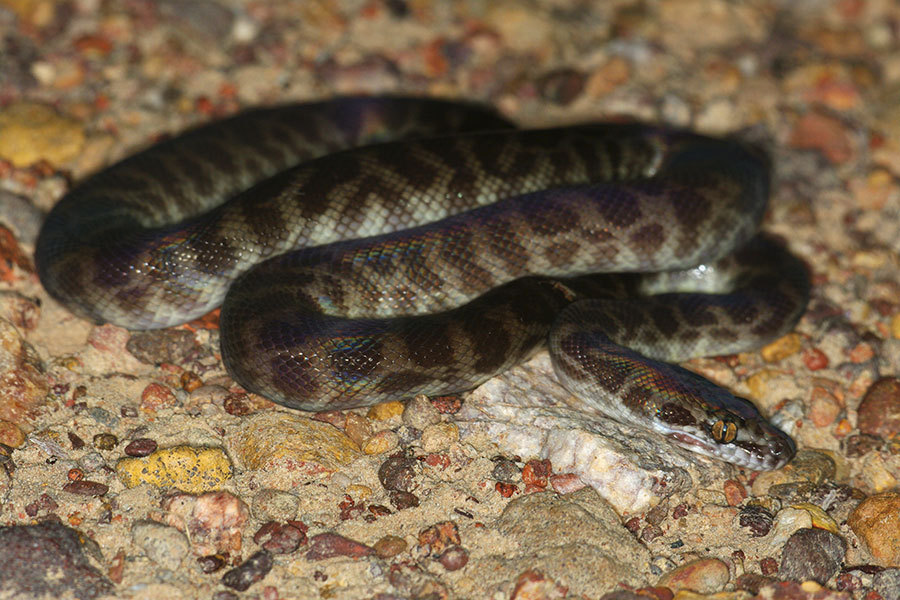
Children's python (Antaresia childreni) is a species of nonvenomous snake in the family Pythonidae. The species is named after John George Children. It is a nocturnal species occurring in the northern half of Australia and generally found on the ground, although it often climbs trees. Usually growing to about 1.0 m (3 ft) in length or more depending on the polymorphic variant, it is typically a reddish-brown colour, darker on the upper surface, and with many darker blotches, especially on younger specimens. The Stimson's python variant has much stronger and more variable colours; often being adorned with reddish-brown to chocolate blotches against lighter tan. It feeds mostly on small mammals and birds, and as with other pythons, it constricts its prey before swallowing it whole. It is a popular pet among reptile enthusiasts.
From the article Children's python on Wikipedia (CC BY-SA), quoted section by section
Description
Adults of A. childreni grow to a total length (including tail) around 1–1.5 m (3–5 ft) depending on locality and polymorphic variant. The scales on the top of the head are enlarged, while those on the upper surface of the body are small and smooth, with a rainbow sheen that can be seen when exposed to direct sunlight. The upper surface of the snake is brown with darker spots in five or six longitudinal series in the type variant. A dark streak on each side of the head passes across the eye. The lips are yellowish, spotted with brown. The lower surface of the snake is uniformly yellowish. The head of the snake is distinct from the neck. The nostril is superolateral, pierced in a large semidivided nasal scale. The eye is moderate in size, with a vertical pupil. The body is slightly laterally compressed. The tail is short. About 41 to 45 rows of dorsal scales cross the snake's back, and 257 to 287 ventral scales are seen along the lower surface. A single undivided anal scale is found immediately in front of the anus, and 38 to 53 subcaudal scales are on the lower surface between the anus and the tip of the tail, all or mostly in two rows. The polymorphic variant known as the Stimson's python has much stronger and more variable colours; often being adorned with reddish-brown to chocolate blotches against lighter tan.
The rostral is broader than high, barely visible from above. …
Range & habitat
A. childreni is found in Australia in the extreme north of Western Australia, the northern third of the Northern Territory, and northern Queensland, and also on the islands of the Torres Strait. The Stimson's python variant is found throughout an even greater range; it occupies much of the interior of Australia, from Queensland to Perth. The type locality is given by Gray (1842) as "—?", is listed as "N.W. Australia" by Boulenger (1893) in his Catalogue of the Snakes in the British Museum (Natural History). Volume I., and is listed as "unknown" in Stimson (1969). A. childreni occurs specifically in the region spanning the coast between the Kimberleys in Western Australia to Mount Isa in northwestern Queensland.
Wikipedia: “Geographic range”
What it does
The diet of Children's python consists of reptiles, birds, and small mammals, particularly microbats, which it catches by dangling from stalactites in caves, which they commonly inhabit, and snatching them out of the air as they fly past.
Wikipedia: “Diet”
Where it lives
Recorded sightings
—
geo-referenced records in GBIF, from museums, herbaria and field observers.
Drag the globe to turn it. Dots are where records exist, not a range map; darker means more records.
In the stacks
Searching the stacks…
Every page naming Antaresia childreni in the Biodiversity Heritage Library →
This page is assembled live from iNaturalist, GBIF, Wikipedia, the Source Library and the Internet Archive. It is not yet part of the hand-edited codex. iNaturalist taxon 94205.