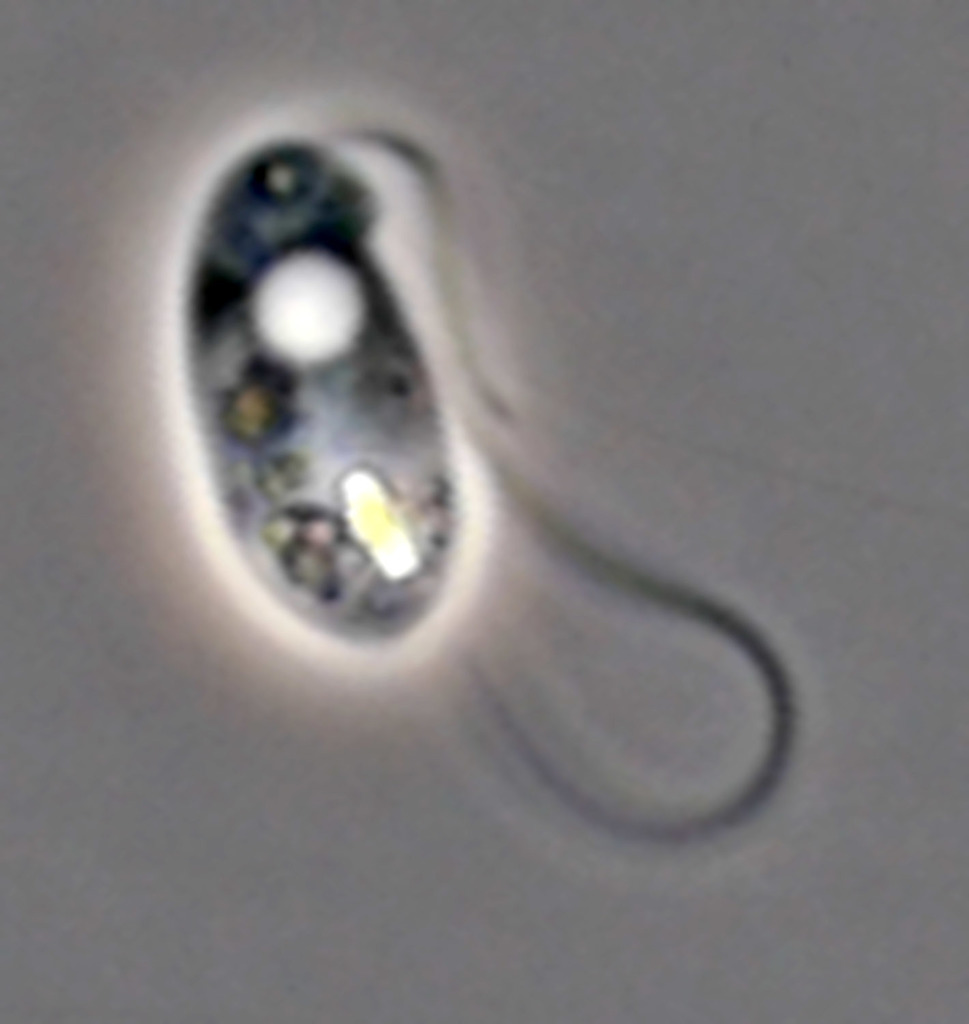
Kinetoplastea
Kinetoplastida (or Kinetoplastea, as a class) is a group of flagellated protists belonging to the phylum Euglenozoa, and characterised by the presence of a distinctive organelle called the kinetoplast (hence the name), a granule containing a large mass of DNA. The group includes a number of parasites responsible for serious diseases in humans and other animals, as well as various forms found in soil and aquatic environments. The organisms are commonly referred to as "kinetoplastids" or "kinetoplasts".
The kinetoplastids were first defined by Bronislaw M. Honigberg in 1963 as the members of the flagellated protozoans. They are traditionally divided into the biflagellate Bodonidae and uniflagellate Trypanosomatidae; the former appears to be paraphyletic to the latter. One family of kinetoplastids, the trypanosomatids, is notable as it includes several genera which are exclusively parasitic. Bodo is a typical genus within kinetoplastida, which also includes various common free-living species which feed on bacteria. Others include Cryptobia and the parasitic Leishmania.
3 branches of this class, most-observed first

Metakinetoplastia
subclassMetakinetoplastia

Trypanosomatida
orderTrypanosomatida
Prokinetoplastia
subclassProkinetoplastia
Where it lives
Recorded sightings
—
geo-referenced records in GBIF, from museums, herbaria and field observers.
Drag the globe to turn it. Dots are where records exist, not a range map; darker means more records.
In the stacks
Searching the stacks…
Every page naming Kinetoplastea in the Biodiversity Heritage Library →
This page is assembled live from iNaturalist, GBIF, Wikipedia, the Source Library and the Internet Archive. It is not yet part of the hand-edited codex. iNaturalist taxon 942252.