- Plants
- ›Vascular Plants
- ›flowering plants
- ›monocots
- ›grasses, sedges, cattails, and allies
- ›grasses
- ›Panicums, Bluestems, Paspalums, and Allies
- ›bristle, rosette, and barnyard grasses, and allies
- ›Cenchrinae
- ›Cenchrus
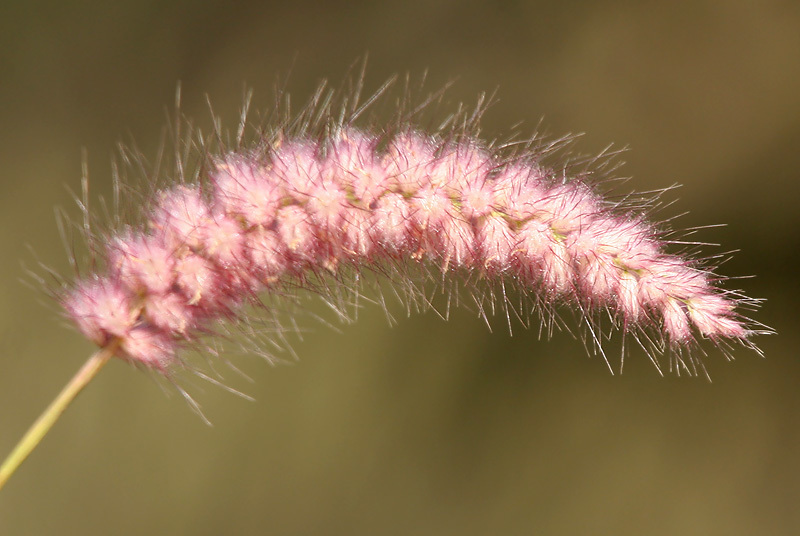
Cenchrus pedicellatus
Cenchrus pedicellatus, previously Pennisetum pedicellatum, known simply as desho or as desho grass, is an indigenous grass of Ethiopia of the monocot angiosperm plant family Poaceae. It is also known as annual kyasuwa grass in Nigeria, bare in Mauritania, and deenanath grass in India. It grows in its native geographic location, naturally spreading across the escarpment of the Ethiopian highlands. Widely available in this location, it is ideal for livestock feed and can be sustainably cultivated on small plots of land. Thus desho is becoming increasingly utilized, along with various soil and water conservation techniques, as a local method of improving grazing land management and combating a growing productivity problem of the local region.
From the article Cenchrus pedicellatus on Wikipedia (CC BY-SA), quoted section by section
Description
Desho is a herbaceous perennial grass which has a massive root system that anchors to the soil. It has a high biomass producing capacity and grows upright with the potential of reaching 90 cm to 120 cm in height depending on soil fertility. Desho is planted by cuts which have good survival rates and establish better compared to grasses planted by seed. Moreover, desho grows rapidly and is drought resistant once established. Desho is said to have high nutritive values and is naturally palatable for livestock.
At the table
Desho is used as a year round fodder. To maintain the sustainability of the intervention, the plot is permanently made inaccessible to free grazing livestock; instead a cut-and-carry system is encouraged. Cut-and-carry means that desho is harvested and brought to livestock for stall-feeding. Due to its rapid growth rate, desho provides regular harvests, even reaching monthly cuts during the rainy reason. Once a year, just before the dry season, sufficient grass is harvested and stored as hay to feed the livestock until the rains return. One study assessed the effectiveness of another use for desho, the use of desho as grass strips, or hedgerows, to protect against runoff and soil loss on the slopes on the Ethiopian highlands. The results of the study showed that desho grass strips reduce soil loss by approximately 45% in the first few years of establishment compared to areas with no barriers. However, vetiver grass was found to be more effective than desho, and thus vetiver should be used as the preferred grass for hedgerow technology.
Wikipedia: “Uses”
How it is grown
The technical specifications for cultivating desho are essential to improve grazing land management practices. Cuts of the grass are ideally planted in rows, spaced at 10 cm by 10 cm, using a hand hoe. This spacing gives each plant sufficient soil nutrients and access to sunlight to achieve optimal growth, while ensuring the soil will be completely covered by the grass once established. It is recommended to plant other species alongside desho to promote biodiversity. Multipurpose shrubs/trees, for example Leucaena sp and Sesbania sp, can be planted approximately 5 m apart with no particular layout. Other legumes, such as alfalfa and clover, can be mixed in with desho by being broadcast throughout the plot. Once planted, maintenance activities such as applying fertilizer, weeding and gap filling, ensure proper establishment and persistence of desho. Fertilizer should be applied throughout the plot one month after planting. It is recommended to use organic compost in the form of animal manure, leaf litter, wood ash, food scraps, and/or any other rich biodegradable matters. After this initial treatment, fertilizer is only applied sporadically when desho plants are struggling to grow or where replanting has taken place. Weeding and gap filling are continuous activities. …
Wikipedia: “Growing conditions”
Where it lives
Recorded sightings
—
geo-referenced records in GBIF, from museums, herbaria and field observers.
Drag the globe to turn it. Dots are where records exist, not a range map; darker means more records.
In the stacks
Searching the stacks…
Every page naming Cenchrus pedicellatus in the Biodiversity Heritage Library →
This page is assembled live from iNaturalist, GBIF, Wikipedia, the Source Library and the Internet Archive. It is not yet part of the hand-edited codex. iNaturalist taxon 943637.