- Plants
- ›Vascular Plants
- ›flowering plants
- ›Dicots
- ›Buttercups, Poppies, and Allies
- ›buttercup family
- ›Anemones, buttercups, larkspurs and allies
- ›anemones and allies
- ›Eriocapitella
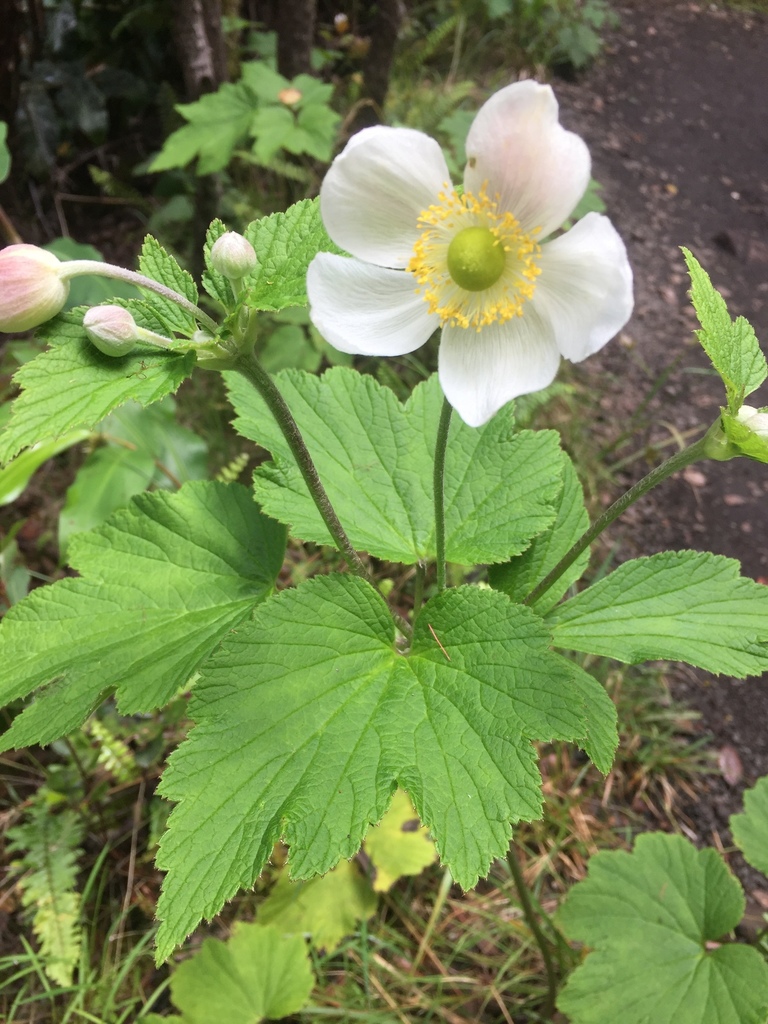
Japanese anemone
Eriocapitella japonica
Eriocapitella japonica is a species of flowering plant in the buttercup family Ranunculaceae commonly cultivated as an ornamental. The specific epithet japonica means "from Japan", which is a misnomer since the species is introduced in Japan. It is native to China, Taiwan, and Vietnam. It was formerly a member of genus Anemone and shares the common name Japanese anemone with several other Eriocapitella species.
From the article Eriocapitella japonica on Wikipedia (CC BY-SA), quoted section by section
Description
Eriocapitella japonica is a perennial herbaceous plant that stands 60 to 90 cm (2 to 3 ft) high. Plant parts are soft and downy, with short hairs. The basal leaves are ternate, lobed, and toothed. The inflorescence is a cyme with flower stalks rising from a whorl of leaves wrapped around the top of the stem. Each flower is approximately 5 to 7.5 cm (2.0 to 3.0 in) across, with 1–3 whorls of sepals (but no petals) and yellow stamens. The sepals are rosy purple or carmine in color. The fruits are silky achenes.
Range & habitat
Eriocapitella japonica is native to Central China, East China, South China, Taiwan, and Vietnam. It has been cultivated and naturalized in the following Chinese provinces:
East China: Anhui, Jiangsu, Jiangxi, Zhejiang, Fujian South China: Guangdong Southwest China: Yunnan E. japonica was introduced to Japan and Korea. It has been naturalized in Japan for hundreds of years.
Wikipedia: “Distribution”
What it does
Eriocapitella japonica along with four other taxa (E. hupehensis, E. vitifolia, E. tomentosa, and E. × hybrida) are known as fall-blooming anemones. Like E. hupehensis, E. japonica flowers from July to October in its native habitat.
Wikipedia: “Ecology”
How it is grown
Varieties of Eriocapitella japonica are cultivated worldwide, especially in China, Japan, and Korea, where naturalized populations are known to exist. Hundreds of years ago, a form of E. hupehensis with smaller, semi-double flowers and pink sepals escaped cultivation and spread across China to Japan and Korea. After finding this form in a Shanghai graveyard in 1843, the plant explorer Robert Fortune sent it home to England where it became known as E. japonica, the Japanese anemone. European horticulturists crossed the Japanese anemone with E. vitifolia to produce cultivars of the artificial hybrid E. × hybrida. At the Chicago Botanic Garden, Rudy experimented with 26 cultivars of fall-blooming anemones over a 5-year period beginning in 1998. His experiments included 4 cultivars of E. japonica, one of which (E. japonica 'Prinz Heinrich') had the longest bloom length (65 days) of any cultivar.
As of March 2020, the following cultivars have gained the Award of Garden Merit (AGM) from the Royal Horticultural Society:
E. japonica 'Pamina' E. japonica 'Rotkäppchen' The cultivar E. japonica 'Prinz Heinrich' was removed from the AGM list in 2013.
Wikipedia: “Cultivation”
Where it lives
Recorded sightings
—
geo-referenced records in GBIF, from museums, herbaria and field observers.
Drag the globe to turn it. Dots are where records exist, not a range map; darker means more records.
In the stacks
Searching the stacks…
Every page naming Eriocapitella japonica in the Biodiversity Heritage Library →
This page is assembled live from iNaturalist, GBIF, Wikipedia, the Source Library and the Internet Archive. It is not yet part of the hand-edited codex. iNaturalist taxon 950313.