- Plants
- ›Vascular Plants
- ›flowering plants
- ›Dicots
- ›Buttercups, Poppies, and Allies
- ›buttercup family
- ›Anemones, buttercups, larkspurs and allies
- ›anemones and allies
- ›Eriocapitella
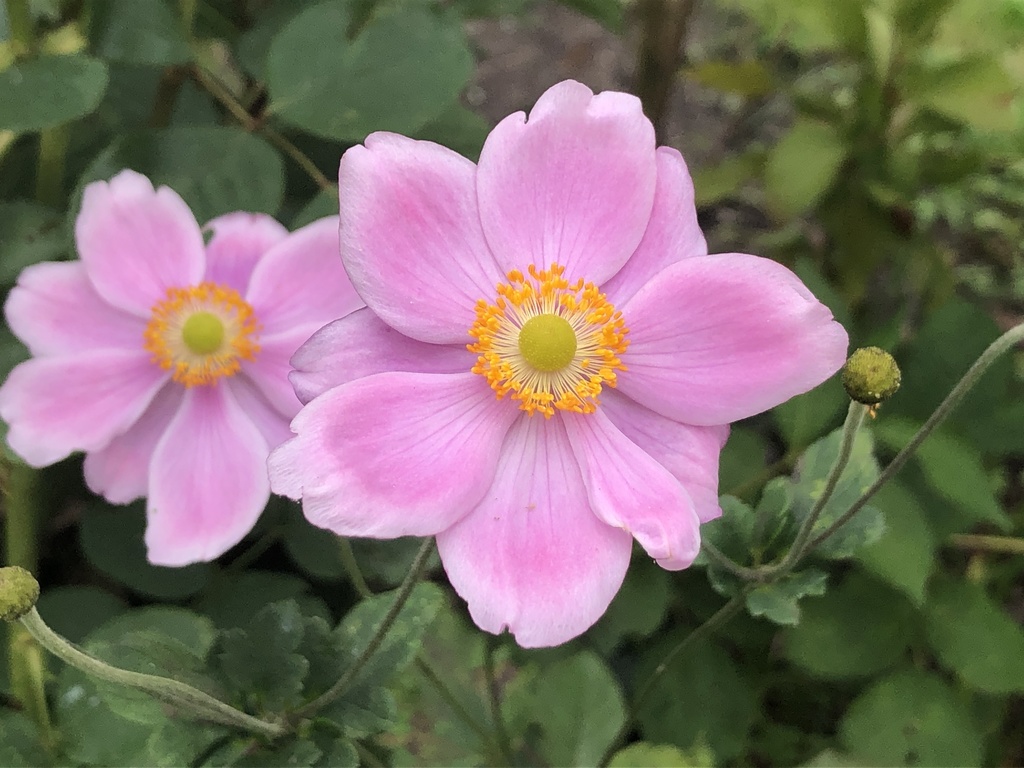
Japanese Anemone
Eriocapitella × hybrida
Eriocapitella × hybrida is a hybrid of flowering plants in the buttercup family Ranunculaceae. The parents of the hybrid are E. japonica and E. vitifolia. Cultivars of the hybrid are commonly known as Japanese anemone hybrids.
From the article Eriocapitella × hybrida on Wikipedia (CC BY-SA), quoted section by section
Description
Eriocapitella × hybrida is a perennial herbaceous plant up to 1.5 m (4.9 ft) tall. It forms large clumps of dark green, ternate, basal leaves on long petioles (leaf stalks). The pubescent leaflets are ovate, with deep lobes and serrate margins (edges). The inflorescence is a large, loose cyme with semi-double flowers. The flower is approximately 8 cm (3.1 in) across with 7–11 white, pink, or rose sepals (no petals) each having a silky sheen on the backside. The center of the flower is surrounded by prominent golden stamens.
What it does
Eriocapitella × hybrida along with four other taxa (E. hupehensis, E. japonica, E. tomentosa, and E. vitifolia) are known as fall-blooming anemones. The bloom period depends on the particular cultivar and location, but at Longwood Gardens for example, E. × hybrida 'Königin Charlotte' bloomed from mid September to early November.
Wikipedia: “Ecology”
How it is grown
The artificial hybrid Eriocapitella × hybrida was developed at the gardens of the Royal Horticultural Society in 1848. As reported by Joseph Paxton at the time, gardeners crossed the so-called Japanese anemone E. japonica with E. vitifolia to produce a hardy fall-blooming hybrid with rose-colored flowers. The parent species were previously brought to England from their native Asia: E. vitifolia was brought from Nepal in 1829 while E. japonica was brought from China in 1844. European horticulturalists in Great Britain, Germany, and France subsequently introduced dozens of cultivars. Commonly called Japanese anemone hybrids, the cultivars of E. × hybrida have single, semi-double, or double flowers with white, pink, or purple sepals. At the Chicago Botanic Garden, Rudy experimented with 26 cultivars of fall-blooming anemones over a 5-year period beginning in 1998. His experiments included 18 cultivars of E. × hybrida, of which more than half had a bloom length greater than 48 days.
As of March 2020, the following cultivars of E. × hybrida have gained the Award of Garden Merit (AGM) from the Royal Horticultural Society:
E. × hybrida 'Elegans', also known as E. × hybrida 'Max Vogel' E. × hybrida 'Honorine Jobert' E. × hybrida 'Königin Charlotte' ('Queen Charlotte') E. × hybrida 'September Charm' The cultivars E. × hybrida 'Andrea Atkinson', E. × hybrida 'Lady Gilmour', and E. …
Wikipedia: “Cultivation”
Where it lives
Recorded sightings
—
geo-referenced records in GBIF, from museums, herbaria and field observers.
Drag the globe to turn it. Dots are where records exist, not a range map; darker means more records.
In the stacks
Searching the stacks…
Every page naming Eriocapitella × hybrida in the Biodiversity Heritage Library →
This page is assembled live from iNaturalist, GBIF, Wikipedia, the Source Library and the Internet Archive. It is not yet part of the hand-edited codex. iNaturalist taxon 950339.