- Animals
- ›Arthropods
- ›Crustaceans
- ›Typical Crustaceans
- ›Malacostracans
- ›Decapods, Isopods, and allies
- ›Decapods and Krill
- ›Decapods
- ›Crabs, Lobsters, Shrimps, and Allies
- ›True Crabs
- ›Eubrachyuran Crabs
- ›Heterotrematan Crabs
- ›Spider Crabs and Decorator Crabs
- ›Mithracidae
- ›Maguimithrax
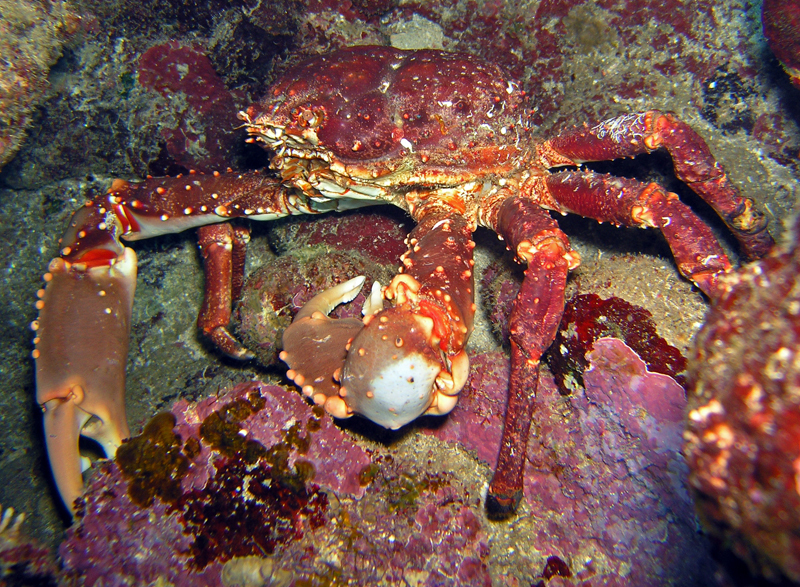
West Indian spider crab
Maguimithrax spinosissimus
Mithrax spinosissimus, also known as the West Indian spider crab, channel clinging crab, reef or spiny spider crab, or coral crab, is a species of spider crab that occurs throughout South Florida and across the Caribbean Islands. The diet of this crab is largely unknown; however, it is considered a large omnivore, reaching size up to 2 kg, which has been noted to feed on algae and carrion. Unlike crabs such as the blue crab, the West...
From the article Maguimithrax on Wikipedia (CC BY-SA), quoted section by section
Description
Maguimithrax spinosissimus has a reddish-brown carapace and walking legs. The claws are smooth, purplish gray, with a single row of nodules along the outer edge, and blunt claw tips. The legs are covered with numerous short spines and nodules. It is the largest native crab species of the Atlantic. It can reach up to 3 kg of weight and a carapace length of 18 cm.
Range & habitat
Maguimithrax spinosissimus is found from North Carolina to Venezuela. It inhabits caves and reef underhangs from the shallow intertidal to depths of up to 200 m. It was made the type species of a separate genus Maguimithrax by Klompmaker et al. (2015). This genus is named after actor Tobey Maguire, who has starred as Spider-Man in 4 films.
Wikipedia: “Distribution”
What it does
The diet of this crab is largely unknown; however, it is considered a large omnivore that has been noted to feed on algae and carrion. It has been studied for its ability to remove seaweed from coral reefs due to its "powerful grazing ability". Unlike crabs such as the blue crab, the West Indian spider crab is not commercially harvested for its meat.
Wikipedia: “Diet”
Where it lives
Recorded sightings
—
geo-referenced records in GBIF, from museums, herbaria and field observers.
Drag the globe to turn it. Dots are where records exist, not a range map; darker means more records.
In the stacks
Searching the stacks…
Every page naming Maguimithrax spinosissimus in the Biodiversity Heritage Library →
This page is assembled live from iNaturalist, GBIF, Wikipedia, the Source Library and the Internet Archive. It is not yet part of the hand-edited codex. iNaturalist taxon 951390.