- Plants
- ›Vascular Plants
- ›flowering plants
- ›Dicots
- ›Mints, Plantains, Olives, and Allies
- ›figwort family
- ›Eremophila
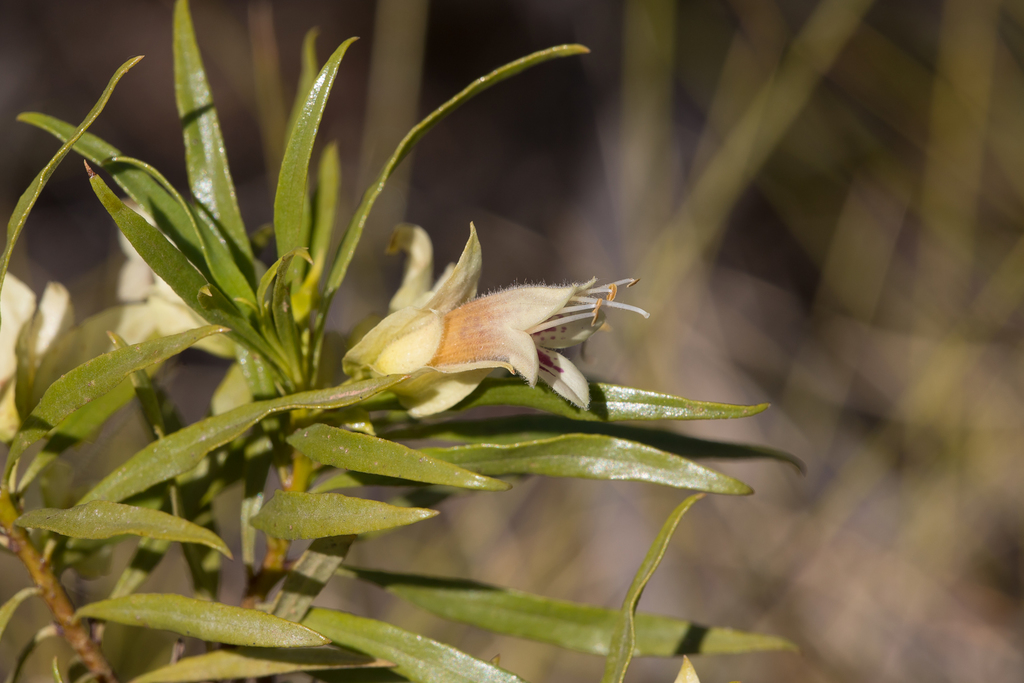
Eremophila alatisepala
Eremophila alatisepala is a plant in the figwort family, Scrophulariaceae and is endemic to the south-west of Queensland in Australia. It is a very sticky shrub covered with many glandular hairs which produce a resin that often obscures the hairs that produce it. The plant is usually found in stony places on ridges and slopes in the Queensland Channel Country.
From the article Eremophila alatisepala on Wikipedia (CC BY-SA), quoted section by section
Description
Eremophila alatisepala is a rounded, highly branched shrub, sometimes growing to a height of 2 m (7 ft) or more with rough branches with many resin glands, making the stems very sticky. The leaves are arranged alternately and are mostly 40–50 mm (1.6–2.0 in) long, 1.5–5 mm (0.06–0.2 in) wide, linear to narrow lance-shaped often with wavy or blunt serrations on the margins. The flowers are borne singly in leaf axils on stalks 10–25 mm (0.4–1 in) long. There are 5 green or yellowish sepals which are of different sizes and are usually more brightly coloured than the petals. The three upper sepals are longer and wider, curve outwards and have wings which partly cover the sides of the flower stalk. The petals are 20–26 mm (0.8–1 in) long and are joined at their bases to form a bell-shaped tube. The tube is cream-coloured but pink or dark orange on the top and the inner surface of the petal lobes and the inside of the tube have darker spots. There are four stamens which are about the same length as or slightly longer than the tube. The fruit is an oval shape, flattened sideways and is about 7–8.5 mm (0.28–0.33 in) long.
Range & habitat
This eremophila is only found in south-west Queensland where it grows in hard stony ground, often with Senna and Triodia species.
Wikipedia: “Distribution and habitat”
How it is grown
This eremophila is an attractive shrub with its creamy pink flowers contrasting with the shiny, dark green leaves. It can be propagated from cuttings, although they take a few months to form roots and it can be grafted onto Myoporum. It grows best in full sun in a well-drained soil and is drought tolerant but susceptible to frosts.
== References ==
Wikipedia: “Use in horticulture”
Where it lives
Recorded sightings
—
geo-referenced records in GBIF, from museums, herbaria and field observers.
Drag the globe to turn it. Dots are where records exist, not a range map; darker means more records.
In the stacks
Searching the stacks…
Every page naming Eremophila alatisepala in the Biodiversity Heritage Library →
This page is assembled live from iNaturalist, GBIF, Wikipedia, the Source Library and the Internet Archive. It is not yet part of the hand-edited codex. iNaturalist taxon 952670.