- Plants
- ›Vascular Plants
- ›flowering plants
- ›Dicots
- ›carrots, ivies, and allies
- ›cheesewood family
- ›Billardiera
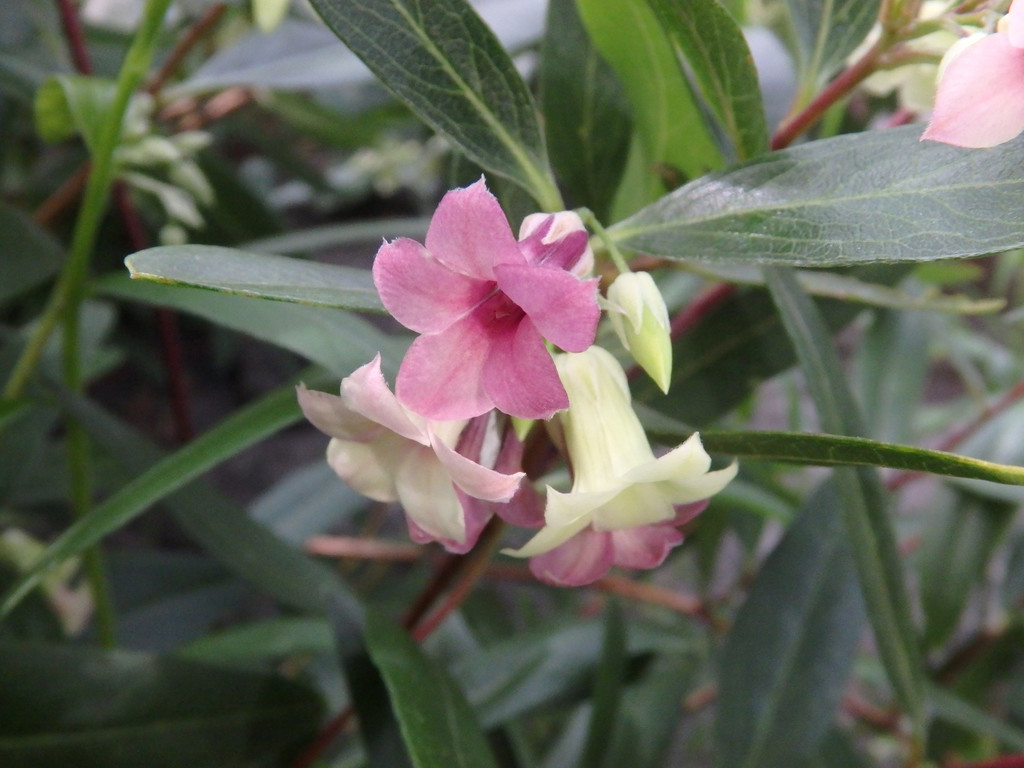
Sweet Appleberry
Billardiera versicolor
Billardiera versicolor, commonly known as pale appleberry or sweet appleberry, is a species of flowering plant in the family Pittosporaceae and is endemic to south-eastern continental Australia. It is a robust, shrubby twiner or scrambler that has mostly narrowly elliptic or narrowly egg-shaped leaves and white, cream-coloured or pale yellow flowers with mauve-red blotches that spread as the flowers age.
From the article Billardiera versicolor on Wikipedia (CC BY-SA), quoted section by section
Description
Billardiera versicolor is robust, shrubby twiner or scrambler with stems up to several metres long. The adult leaves are more or less sessile, narrowly egg-shaped to narrowly elliptic, 25–60 mm (0.98–2.36 in) long and 4–15 mm (0.16–0.59 in) wide. The flowers are arranged in sessile groups of about five to twelve, each flower on a pedicel 10–12 mm (0.39–0.47 in) long. The sepals are yellowish-green and 2–3 mm (0.079–0.118 in) long and the petals white, cream-coloured or pale yellow, 10–12 mm (0.39–0.47 in) long, with mauve-red blotches that spread as the flower ages. Flowering mainly occurs from September to December and the mature fruit is a green berry 13–15 mm (0.51–0.59 in) long containing many seeds.
Range & habitat
This species of Billardiera mainly grows in mallee, but also in woodland and scrub, and occurs in western New South Wales, in the western half of Victoria and on the Eyre Peninsula and in the Flinders Ranges in South Australia.
== References ==
Wikipedia: “Distribution and habitat”
Where it lives
Recorded sightings
—
geo-referenced records in GBIF, from museums, herbaria and field observers.
Drag the globe to turn it. Dots are where records exist, not a range map; darker means more records.
In the stacks
Searching the stacks…
Every page naming Billardiera versicolor in the Biodiversity Heritage Library →
This page is assembled live from iNaturalist, GBIF, Wikipedia, the Source Library and the Internet Archive. It is not yet part of the hand-edited codex. iNaturalist taxon 956300.