- Plants
- ›Vascular Plants
- ›flowering plants
- ›Dicots
- ›Buttercups, Poppies, and Allies
- ›buttercup family
- ›Columbines and Meadow-Rues
- ›Paraquilegia
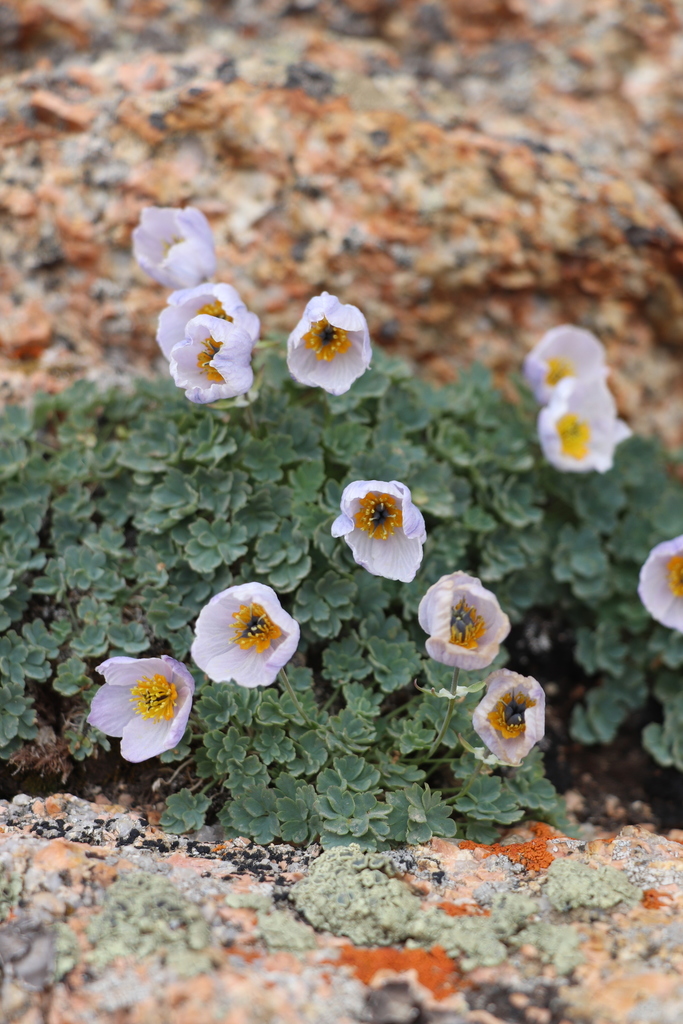
Paraquilegia caespitosa
Paraquilegia caespitosa (Chinese: 密丛拟耧斗菜; pinyin: mi cong ni lou dou cai) is a species of perennial flowering plant in the family Ranunculaceae. It is native to a range spanning between northern Iran to the western Himalayas into China. As with other Paraquilegia, P. caespitosa is a cushion plant. The species forms dense tufts. The flowers appear singly on scapes up to 60 mm (2.4 in) long and possess purplish red to pink sepals and yellow petals.
From the article Paraquilegia caespitosa on Wikipedia (CC BY-SA), quoted section by section
Description
Paraquilegia caespitosa is a species of perennial flowering plant in the genus Paraquilegia in the family Ranunculaceae. As with other Paraquilegia, the species is a cushion plant. It forms dense tufts at the base of the plant. The leaves of the plant are ternate (in three parts) on petioles that are approximately 2 cm (0.79 in) long. The grayish-green blades of the leaves are broad and ovate, ranging from 6 mm (0.24 in) to 8 mm (0.31 in) long and 3 mm (0.12 in) to 4 mm (0.16 in) wide. The plants possess broadly obovate to broadly rhombic leaflets which range from 5 mm (0.20 in) to 9 mm (0.35 in) long and wide. The leaflets are borne on slender petiolules that are between 2 mm (0.079 in) and 9 mm (0.35 in) long. The species's flowers bloom from late May to July. The flowers present singly on scapes and are between 2.5 cm (0.98 in) and 3 cm (1.2 in) in diameter. The scapes range from 35 mm (1.4 in) to 60 mm (2.4 in) long. All flowers in the genus possess five sepals and five shorter yellow petals. The sepals are purplish red to pink. These sepals are 12 mm (0.47 in) long and 7 mm (0.28 in) wide. The petals are narrowly obovate and range between 4 mm (0.16 in) and 6 mm (0.24 in) long. Fruiting plants possess follicles that are approximately 1 cm (0.39 in) long. Follicles appear in sets of three to five, occasionally up to six. P. …
Range & habitat
The range of Paraquilegia caespitosa spans from northern Iran to Xinjiang in China and the western Himalayas. The Flora of China records the species's range including Afghanistan, Kashmir, Kyrgyzstan, Russia, and Tajikistan. The plant favors shady, gravelly slopes at elevations of approximately 2,900 m (9,500 ft) to 4,800 m (15,700 ft) above sea level, with occurrences occasionally as low as 2,500 m (8,200 ft) above sea level. Wild specimens have been noted in fissures and screes. An erroneous description in the Flora Iranica suggested the species was endemic to Iran and attributed examples of what were likely P. carspitosa in the Hindu Kush and Pakistani mountains as Paraquilegia anemonoides. The presence of the species in Afghanistan was first confirmed with photographs of occurrences in rock crevices in the Hindu Kush, taken in the 1970s by Bob Gibbons.
Wikipedia: “Distribution”
How it is grown
Rock gardeners have generally considered Paraquilegia a challenging genus to cultivate. According to botanist and gardener Christopher Grey-Wilson, the "basic requirement [for Paraquilegia] is very good drainage, a cool root run and part shade". While substantial quantities of Paraquilegia seeds have been acquired from the Himalayas and western China, relatively few plants have been successfully grown in cultivation.
== References ==
Wikipedia: “Cultivation”
In human culture
The genus name Paraquilegia means "next to" or "besides" Aquilegia (the genera of columbines). While the leaves of Paraquilegia and columbines may have similar appearances, the flowers of Paraquilegia are more similar to those of the genus Anemone. The word aquilegia itself may come from the Latin word for "eagle", aquila, in reference to the columbine's petals' resemblance to eagle talons. Aquilegia may also derive from aquam legere, which is Latin for "to collect water", or aquilegium, a Latin word for a container of water. The specific name caespitosa is Latin for "tufted".
Wikipedia: “Etymology”
Where it lives
Recorded sightings
—
geo-referenced records in GBIF, from museums, herbaria and field observers.
Drag the globe to turn it. Dots are where records exist, not a range map; darker means more records.
In the stacks
Searching the stacks…
Every page naming Paraquilegia caespitosa in the Biodiversity Heritage Library →
This page is assembled live from iNaturalist, GBIF, Wikipedia, the Source Library and the Internet Archive. It is not yet part of the hand-edited codex. iNaturalist taxon 956525.