- Plants
- ›Vascular Plants
- ›flowering plants
- ›Dicots
- ›Mints, Plantains, Olives, and Allies
- ›figwort family
- ›Eremophila
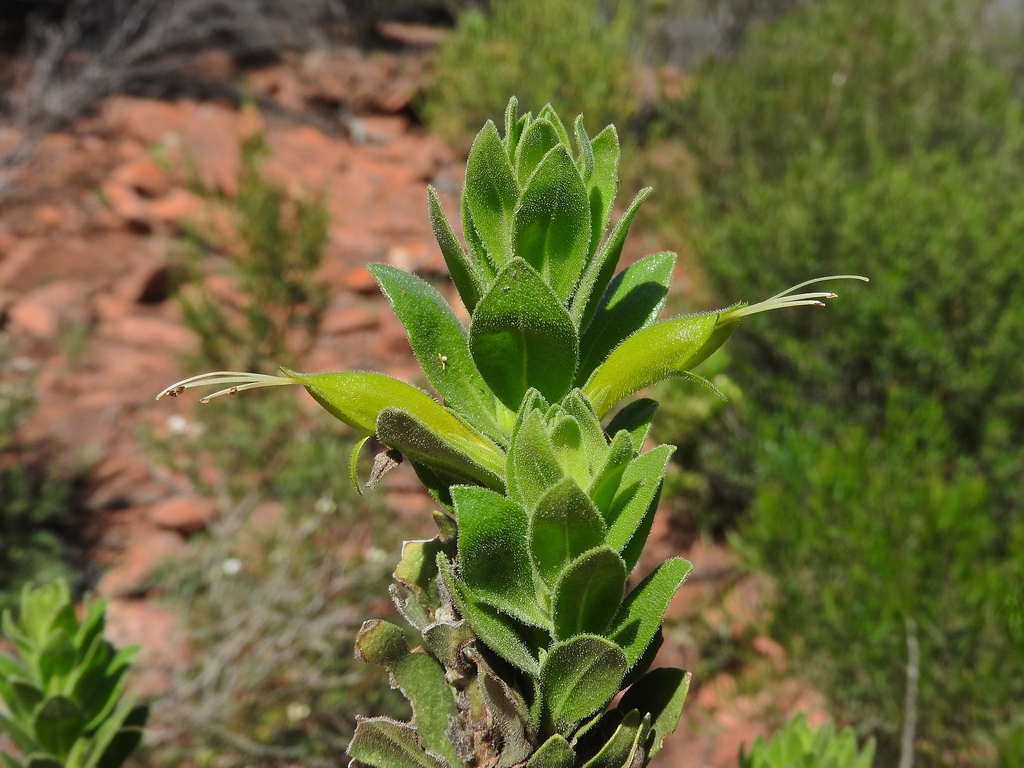
dense-felted eremophila
Eremophila subfloccosa
Eremophila subfloccosa, also known as dense-felted eremophila is a plant in the figwort family, Scrophulariaceae and is endemic to Australia. It is a shrub which often has foliage covered with soft hairs, giving the plant a silvery grey hue and making it soft to touch. The leaves are strongly scented when crushed. Its flowers are usually greenish yellow in colour and have the stamens protruding from the ends. Dense-felted eremophila is common after fire, but becomes less so as others recover and compete with it.
From the article Eremophila subfloccosa on Wikipedia (CC BY-SA), quoted section by section
Description
Eremophila subfloccosa is often a low spreading shrub, which usually grows to less than 1 m (3 ft) tall but can spread to about 2 m (7 ft). Its leaves are usually 15–37 mm (0.6–1 in) wide and 5.5–11 mm (0.2–0.4 in) wide and are egg-shaped, elliptic or oblong. The leaves and branches are often densely covered, usually with more than one kind of soft hairs making the foliage soft to touch, although there is variation between subspecies. The foliage is often strongly scented when crushed. The flowers are yellow to green and occur singly in the axils of leaves on a stalk up to 4 mm (0.2 in) long which is covered with soft, white hairs. The flowers are tubular in shape, up to 25 mm (1 in) long, surrounded at their base by 5 sepals. They are not spotted and the four stamens extend beyond the tube formed by the petals. Flowering usually occurs in spring but often occurs also at other times and is followed by fruits which are glabrous, roughly spherical and 5–9 mm (0.2–0.4 in) in diameter.
Range & habitat
Eremophila subfloccosa occurs in semi-arid parts of Western Australia and in South Australia, mainly near the Eyre Peninsula. It grows in a range of soils, often near saline areas and on disturbed sites such as road verges. It often thrives after bushfire but suffers in competition from others as they recover after several years. Subspecies subfloccosa grows in sandy soils or laterite in disturbed areas between Hyden and Wongan Hills in the Avon Wheatbelt, and Yalgoo biogeographic regions. Subspecies glandulosa occurs in two disjunct populations. In Western Australia it occurs between Balladonia and Ravensthorpe in the Coolgardie, Esperance Plains and Mallee biogeographic regions. It is often found after bushfires and near roadsides whilst absent from nearby undisturbed bush. In South Australia it occurs in the Yorke Peninsula, Northern Lofty, Murray and Southern Lofty botanical regions. Subspecies lanata also occurs in two disjunct populations in two states. In Western Australia it grows in a broad area between Cue and Rawlinna in the Avon Wheatbelt, Carnarvon, Coolgardie, Esperance Plains, Geraldton Sandplains, Great Victoria Desert, Mallee, Murchison and Yalgoo biogeographic regions and is often found in sandy soils on plains and on the margins of salt lakes. …
Wikipedia: “Distribution”
How it is grown
The soft, silvery foliage of dense-felted eremophila make it a suitable garden plant. It grows best in drier areas, needs full sun and prefers alkaline, well drained soil. Propagation is easier from cutting than from seed but the use of mist will cause fungal problems.
== References ==
Wikipedia: “Use in horticulture”
Where it lives
Recorded sightings
—
geo-referenced records in GBIF, from museums, herbaria and field observers.
Drag the globe to turn it. Dots are where records exist, not a range map; darker means more records.
In the stacks
Searching the stacks…
Every page naming Eremophila subfloccosa in the Biodiversity Heritage Library →
This page is assembled live from iNaturalist, GBIF, Wikipedia, the Source Library and the Internet Archive. It is not yet part of the hand-edited codex. iNaturalist taxon 956798.