- Plants
- ›Vascular Plants
- ›flowering plants
- ›monocots
- ›Spiderworts and Allies
- ›Bloodroots
- ›Haemodoroideae
- ›Bloodroots, Redroots & relatives
- ›Haemodorum
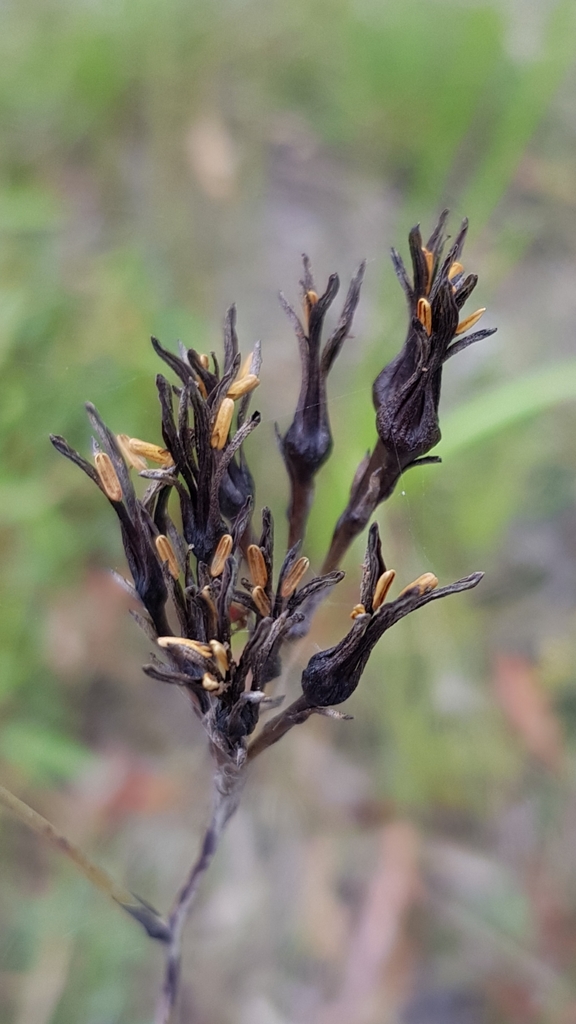
Haemodorum corymbosum
Haemodorum corymbosum, commonly known as the rush-leaf bloodroot, is a shrub native to southeastern Australia. Danish-Norwegian naturalist Martin Vahl described this species in his 1805 work Enumeratio Plantarum.
It grows as a strappy herbaceous shrub 40–70 cm high, with three to four 40–75 cm long leaves arising from the base. These are narrow to terete and 1–1.5 mm in diameter. Its roots contain a bright red pigment. Flowering occurs over the warmer months (October to January) and is profuse only after bushfire. The brown-black flowers are 12–15 mm long and arranged in a corymb.
Where it lives
Recorded sightings
—
geo-referenced records in GBIF, from museums, herbaria and field observers.
Drag the globe to turn it. Dots are where records exist, not a range map; darker means more records.
In the stacks
Searching the stacks…
Every page naming Haemodorum corymbosum in the Biodiversity Heritage Library →
This page is assembled live from iNaturalist, GBIF, Wikipedia, the Source Library and the Internet Archive. It is not yet part of the hand-edited codex. iNaturalist taxon 960016.