- Plants
- ›Vascular Plants
- ›flowering plants
- ›Dicots
- ›Soapberries, Cashews, Mahoganies, and Allies
- ›soapberry family
- ›Dodonaea
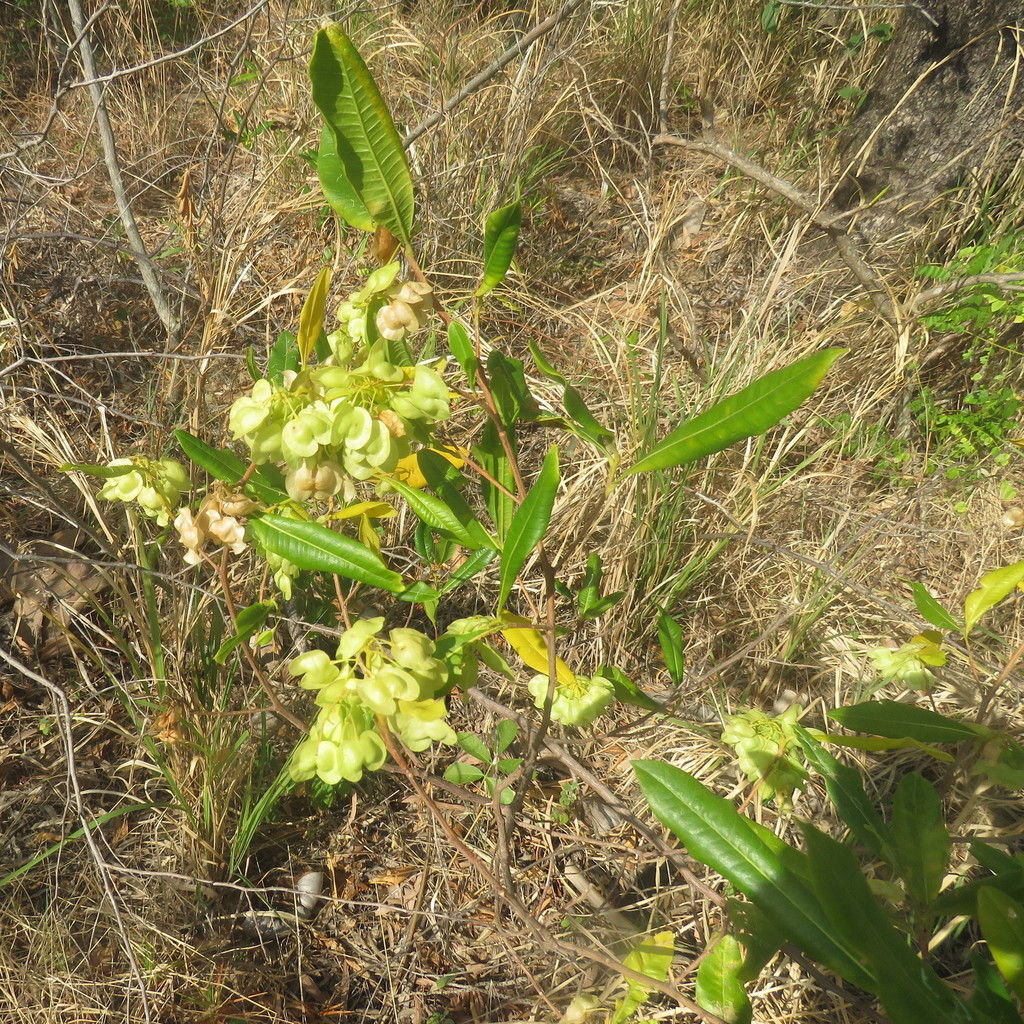
Dodonaea polyandra
Dodonaea polyandra is a species of plant in the family Sapindaceae and is native to Queensland, Australia and New Guinea. It is a spreading, dioecious shrub or tree with simple elliptic leaves, flowers arranged in panicles on the ends of branches, the flowers usually with four sepals and 11 to 14 stamens, and capsules usually with two wings.
From the article Dodonaea polyandra on Wikipedia (CC BY-SA), quoted section by section
Description
Dodonaea polyandra is a spreading dioecious shrub or tree that typically grows to a height of up to 8 m (26 ft). Its leaves are simple, elliptic, 55–105 mm (2.2–4.1 in) long, 1.6–4.25 mm (0.063–0.167 in) long and glabrous on a petiole 3–10 mm (0.12–0.39 in) long. The flowers are arranged in panicles on the ends of branches, each flower on a pedicel 4.5–14 mm (0.18–0.55 in) long, usually with linear sepals, 2.5–3.0 mm (0.098–0.118 in) long that fall off as the flower develops, and 11 to 14 stamens. The ovary is glabrous. The fruit is a two-winged, broadly oblong capsule 16–28 mm (0.63–1.10 in) long and 15–30 mm (0.59–1.18 in) wide and glabrous with membranous wings 6–9 mm (0.24–0.35 in) wide.
Range & habitat
This species of Dodonaea grows on the edges of rainforest or in open woodland in sandy or gravelly soil on the north and east of Cape York Peninsula, in the White Mountains National Park and in the Western Province (Papua New Guinea) of New Guinea.
Wikipedia: “Distribution and habitat”
Where it lives
Recorded sightings
—
geo-referenced records in GBIF, from museums, herbaria and field observers.
Drag the globe to turn it. Dots are where records exist, not a range map; darker means more records.
In the stacks
Searching the stacks…
Every page naming Dodonaea polyandra in the Biodiversity Heritage Library →
This page is assembled live from iNaturalist, GBIF, Wikipedia, the Source Library and the Internet Archive. It is not yet part of the hand-edited codex. iNaturalist taxon 960169.