- Animals
- ›Chordates
- ›Vertebrates
- ›Mammals
- ›Therians
- ›Placental Mammals
- ›Afromammals
- ›Proboscideans
- ›Elephants
- ›Palaeoloxodon
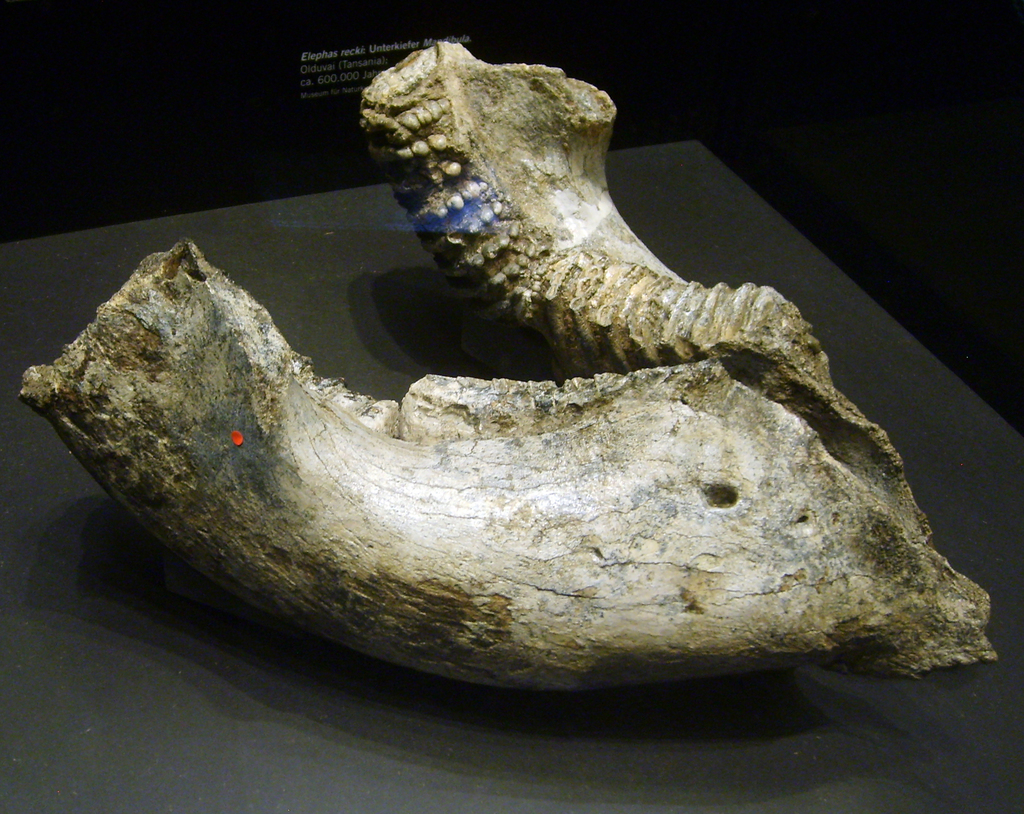
African Straight-tusked Elephant
Palaeoloxodon recki
Palaeoloxodon recki, often known by the synonym Elephas recki, is an extinct species of elephant native to Africa and West Asia from the Pliocene or Early Pleistocene to the Middle Pleistocene. During most of its existence, the species (in its broad sense) represented the dominant elephant species in East Africa. The species is divided into five roughly chronologically successive subspecies, collectively termed the "Elephas recki complex". While the type and latest subspecies P. recki recki as well as the preceding P. recki ileretensis are widely accepted to be closely related and ancestral to Eurasian Palaeoloxodon, the relationships of the other, chronologically earlier subspecies to P. recki recki, P. recki ileretensis and Palaeoloxodon are uncertain, with it being suggested they are unrelated and should be elevated to separate species.
From the article Palaeoloxodon recki on Wikipedia (CC BY-SA), quoted section by section
Description
Members of the species were larger than any living elephant. A large mostly complete male specimen of P. recki atavus from Koobi Fora, Kenya, suggested to have been approximately 40 years old when it died, was estimated in a 2016 study to have measured 4.27 metres (14.0 ft) tall at the shoulder and weighed 12.3 tonnes (27,000 lb), with the tusks of some P. recki individuals reaching 4 metres (13 ft) in length, and masses likely considerably in excess of 100 kilograms (220 lb). In 2024, Biswas, Chang and Tsai estimated its maximum shoulder height at 4.23 metres (13.9 ft), with the estimated body masses of 7 measured specimens ranging from 4.5–15.3 tonnes (9,900–33,700 lb). In comparison to most Eurasian species of Palaeoloxodon, the parieto-occipital crest of P. recki recki at the top of the skull is only weakly developed. The frons (forehead) is tall and biconvex. Like Eurasian Palaeoloxodon species, the premaxillary bones of P. recki recki containing the tusks flare laterally outwards. Over time the molar teeth of P. recki show an increasing number of lamellae, and taller crown height (hypsodonty).
What it does
All named subspecies of P/E. recki, regardless of true evolutionary relationships, are thought to have been dedicated grazers, with the molar teeth of later subspecies showing greater adaption to grazing than earlier subspecies. Carbon isotope analysis of P. recki recki suggests that while it always primarily consumed C4 grasses, it showed a degree of dietary flexibility, and particularly towards the end of its existence it consumed some C3 plants, likely including a degree of browse. Oxygen isotope analysis of P. recki recki also shows a shift from using stable, permanent water sources during the Early Pleistocene to adapting to using transient water sources during the Middle Pleistocene.
Wikipedia: “Ecology”
In human culture
Genetic evidence from Eurasian Palaeoloxodon suggests that around 1 million years ago, P. recki recki underwent a significant episode of introgressive hybridisation with West African populations of the African forest elephant, resulting in over 30% of the nuclear genome as well as the entire mitochondrial genome lineage of P. recki being replaced with those of African forest elephants. Following the emergence of P. recki in Africa, at the end of the Early Pleistocene, around 800,000 years ago, a population of P. recki recki migrated out of Africa, giving rise to the Eurasian radiation of Palaeoloxodon. Its descendant taxon or last evolutionary stage, Palaeoloxodon jolensis, is known from remains found across Africa of late Middle Pleistocene to Late Pleistocene age, with a number of authors suggesting that P. jolensis likely became extinct at the Middle-Late Pleistocene boundary around 130,000 years ago. Following the extinction of P. jolensis it was replaced by the modern African bush elephant (Loxodonta africana). The extinction of the P. recki/jolensis lineage in Africa has either been attributed to the increasing aridification of Africa across the Middle Pleistocene, or the growing sophistication of human hunters.
Wikipedia: “Evolutionary history and extinction”
Listen
Looking for field recordings…
Where it lives
Recorded sightings
—
geo-referenced records in GBIF, from museums, herbaria and field observers.
Drag the globe to turn it. Dots are where records exist, not a range map; darker means more records.
In the stacks
Searching the stacks…
Every page naming Palaeoloxodon recki in the Biodiversity Heritage Library →
This page is assembled live from iNaturalist, GBIF, Wikipedia, the Source Library and the Internet Archive. It is not yet part of the hand-edited codex. iNaturalist taxon 961924.