- Animals
- ›Arthropods
- ›Hexapods
- ›Insects
- ›Winged and Once-winged Insects
- ›True Bugs, Hoppers, Aphids, and allies
- ›True Hoppers
- ›Planthoppers
- ›Delphacoidea
- ›Delphacid Planthoppers
- ›Delphacinae
- ›Delphacini
- ›Megamelus
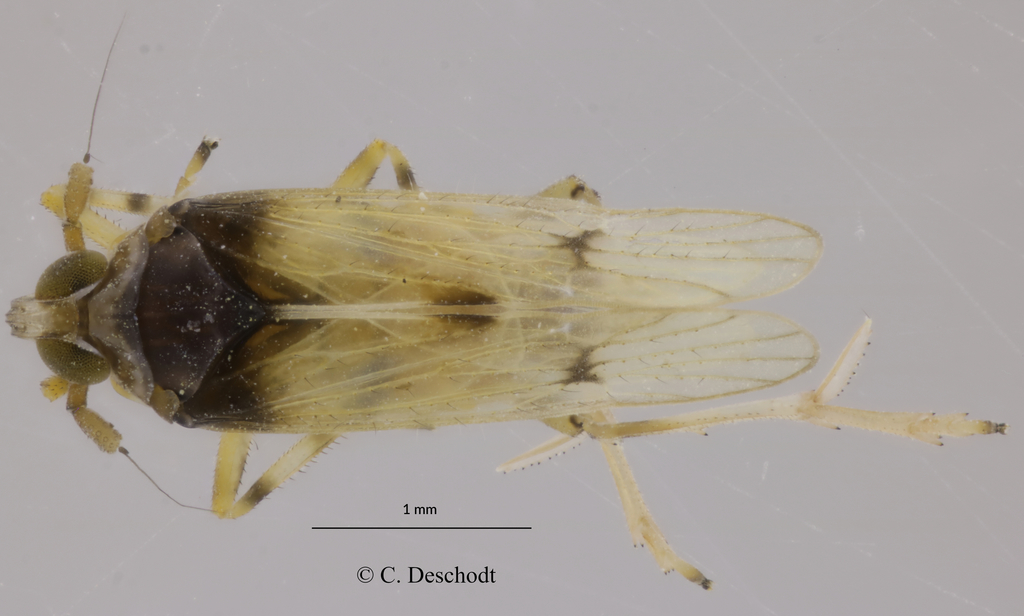
Waterhyacinth Planthopper
Megamelus scutellaris
Megamelus scutellaris, the water hyacinth planthopper, is a true bug native to South America. It is used as a biological control agent to manage and reduce the spread of the water hyacinth (Pontederia crassipes, formerly Eichhornia crassipes), an invasive aquatic plant native to South America that has invaded many freshwater systems globally.
From the article Megamelus scutellaris on Wikipedia (CC BY-SA), quoted section by section
Description
Megamelus scutellaris has a widespread distribution in South America. Populations have been recorded in Argentina, Brazil, Peru and Uruguay, and it is likely that the insect mirrors much of the distribution of its host plant, water hyacinth. It is primarily pale yellow to light brown in color with darker markings on the head and thorax. It measures approximately 3-4 mm in length, with a distinct, helmet-like scutellum covering most of its abdomen.
The insect's life cycle consists of egg, nymph, and adult stages. They are wing dimorphic, whereby the adults can be either wingless (brachypterous) or winged (macropterous).
Listen
Looking for field recordings…
Where it lives
Recorded sightings
—
geo-referenced records in GBIF, from museums, herbaria and field observers.
Drag the globe to turn it. Dots are where records exist, not a range map; darker means more records.
In the stacks
Searching the stacks…
Every page naming Megamelus scutellaris in the Biodiversity Heritage Library →
This page is assembled live from iNaturalist, GBIF, Wikipedia, the Source Library and the Internet Archive. It is not yet part of the hand-edited codex. iNaturalist taxon 963213.