- Plants
- ›Vascular Plants
- ›flowering plants
- ›Dicots
- ›Sunflowers, Bellflowers, Fanflowers, and Allies
- ›fanflower family
- ›Scaevola
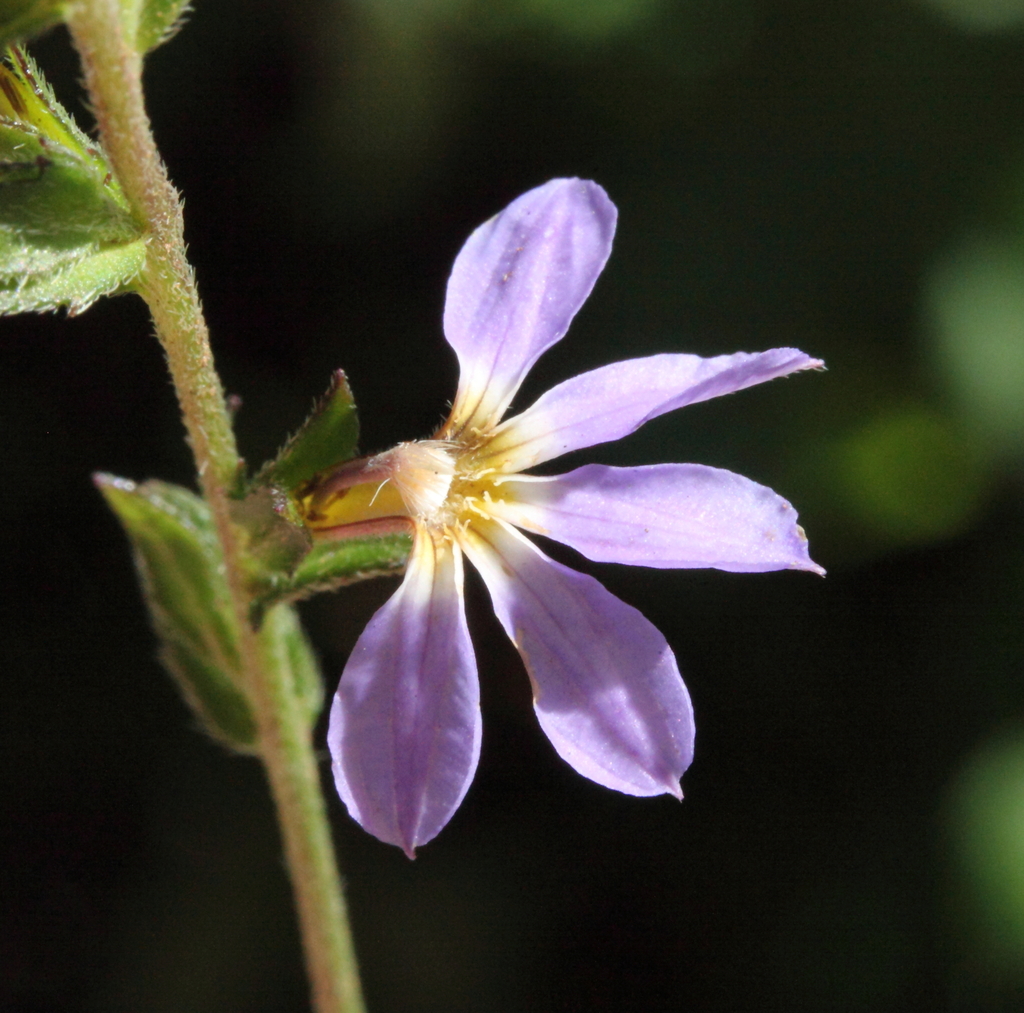
Scaevola microphylla
Scaevola microphylla, commonly known as small-leaved scaevola, is a species of flowering plant in the family Goodeniaceae and is endemic to the south-west of Western Australia. It is a prostrate to low-lying herb with sessile, more or less stem-clasping, egg-shaped to elliptic toothed leaves, spikes of blue, pink or white flowers and more or less spherical, hairy fruit.
From the article Scaevola microphylla on Wikipedia (CC BY-SA), quoted section by section
Description
Scaevola microphylla is a prostrate to low-lying herb with a woody base, with stems up to 50 cm (20 in) long and covered with hairs. Its leaves are sessile, more or less stem-clasping, egg-shaped with the narrower end towards the base to elliptic, 8–53 mm (0.31–2.09 in) long and 3–29 mm (0.12–1.14 in) wide with conspicuous teeth on the edges. The flowers are borne in loose racemes up to 150 mm (5.9 in) long, with leaf-like bracts and oblong bracteoles 5–8 mm (0.20–0.31 in) long. The sepals are broadly egg-shaped, about 0.5 mm (0.020 in) long and joined at the base, and the petals are blue, pink or white, 10–21 mm (0.39–0.83 in) long, sometimes with soft hairs on the outside and bearded inside. The ovary has two locules. Flowering occurs from September to January, and the fruit is more or less cylindrical, 2–3 mm (0.079–0.118 in) in diameter and covered with soft hairs.
Range & habitat
This species of Scaevola grows in, and on the edges of forests in the extreme south-west of Western Australia, in the Esperance Plains, Jarrah Forest, Swan Coastal Plain and Warren bioregions.
Wikipedia: “Distribution and habitat”
Where it lives
Recorded sightings
—
geo-referenced records in GBIF, from museums, herbaria and field observers.
Drag the globe to turn it. Dots are where records exist, not a range map; darker means more records.
In the stacks
Searching the stacks…
Every page naming Scaevola microphylla in the Biodiversity Heritage Library →
This page is assembled live from iNaturalist, GBIF, Wikipedia, the Source Library and the Internet Archive. It is not yet part of the hand-edited codex. iNaturalist taxon 963570.