- Plants
- ›Vascular Plants
- ›flowering plants
- ›Dicots
- ›Legumes, Milkworts, and Allies
- ›Legumes
- ›Faboideae
- ›Mirbelieae
- ›Gastrolobium
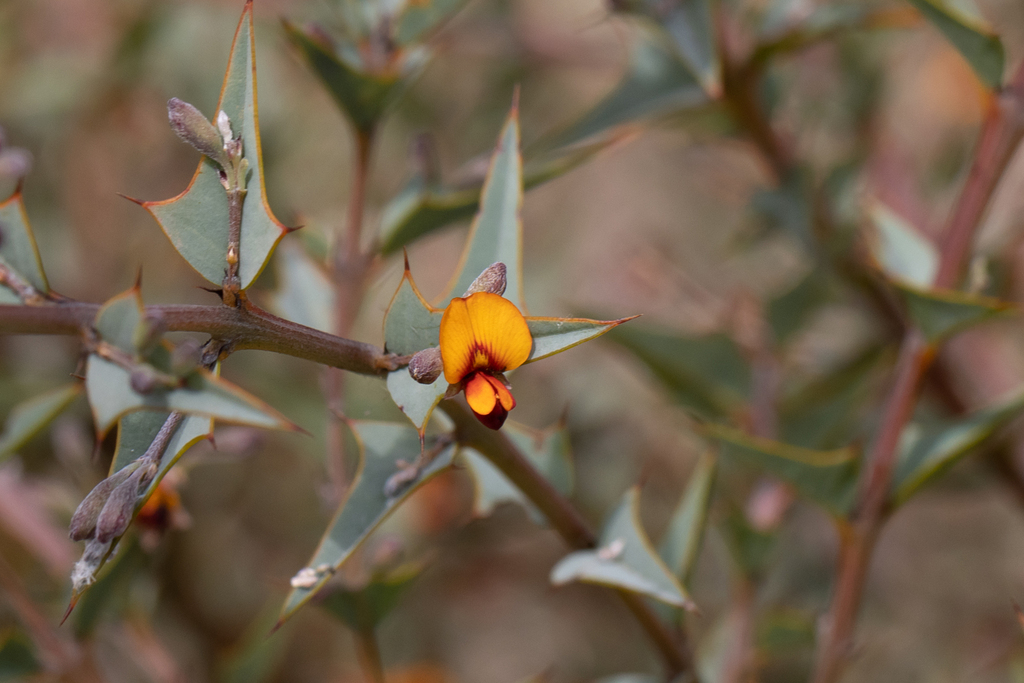
Bullock Poison
Gastrolobium trilobum
Gastrolobium trilobum, commonly known as bullock poison, is a flowering plant in the family Fabaceae, and is endemic to Western Australia. It is a small, rigid shrub with orange, yellow and red flowers.
From the article Gastrolobium trilobum on Wikipedia (CC BY-SA), quoted section by section
Description
Gastrolobium trilobum is a spindly, spreading, prostrate shrub with needle-shaped hairy stems, some sections partly spiky. The leaves are arranged in opposite pairs, smooth, 10–35 mm (0.39–1.38 in) long, flat, margins lobed, the pedicel 1.5–2 mm (0.059–0.079 in) long and hairy. The calyx 5 mm (0.20 in) long has simple hairs and the bracteoles deciduous. The flower petals are mostly red, orange or yellow with markings in either red, yellow or orange, and the corolla is 8–9.5 mm (0.31–0.37 in) long. The standard petal is 6–7.5 mm (0.24–0.30 in) long, the wings are 9–9.5 mm (0.35–0.37 in) long and the keel 9–9.7 mm (0.35–0.38 in) long and smooth. Flowering occurs from July to November and the fruit is a pod or a follicle.
Range & habitat
Bullock poison grows in the Avon Wheatbelt, Jarrah Forest and mallee.
== References ==
Wikipedia: “Distribution”
Where it lives
Recorded sightings
—
geo-referenced records in GBIF, from museums, herbaria and field observers.
Drag the globe to turn it. Dots are where records exist, not a range map; darker means more records.
In the stacks
Searching the stacks…
Every page naming Gastrolobium trilobum in the Biodiversity Heritage Library →
This page is assembled live from iNaturalist, GBIF, Wikipedia, the Source Library and the Internet Archive. It is not yet part of the hand-edited codex. iNaturalist taxon 972949.