 NL·0557
Herbarium of the Nature Library
- Name
- Chitala chitala
- Family
- Notopteridae
- Native to
- Indus, Ganges, Brahmaputra and Mahanadi basins of Pakistan, India, Nepal and Bangladesh
- Habitat
- Large rivers, Floodplain lakes, Reservoirs
Indian featherback (humped featherback)
Chitala chitala
Also calledChital চিতল (Bengali) · Moh / Chital (Hindi) · Pari (Assamese)
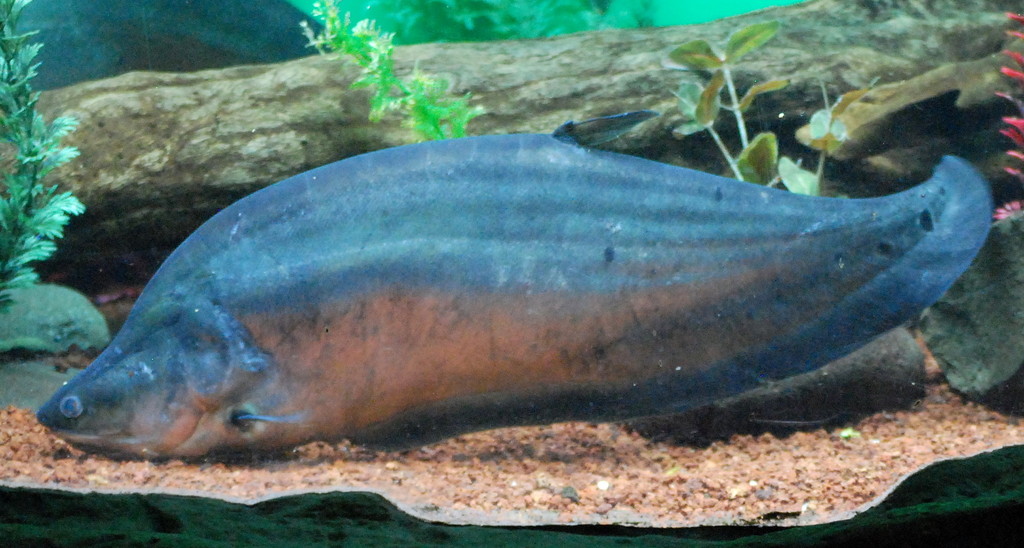
A hump-backed, knife-shaped fish that swims by rippling a single long fin under its body and can move forwards or backwards. It belongs to the bonytongues, an ancient fish lineage, and in Bengal it is a luxury food fish.
Chitala chitala is a knifefish from Bangladesh, India, Nepal, and Pakistan, found in the Brahmaputra, Indus, Ganges and Mahanadi River basins. It is sometimes known as the Indian featherback or Indian knifefish. In the past, it frequently included several related Chitala species, but these are now regarded as separate species. The main species confused with this species is C. ornata ; a Southeast Asian species seen regularly in the aquarium trade. The true C. chitala is very rare in the aquarium trade. Wikipedia
What it can do
- iSwims forwards or backwards by sending waves along a long anal fin that merges with the tail
- iiGulps air with a specialised swim bladder, so it survives in warm, oxygen-poor water
- iiiMales guard eggs stuck to submerged logs and posts
In the field
Field marks
- aStrongly humped back behind the head, with a small feather-like dorsal fin
- bBody tapers to a knife-blade shape; anal fin runs from belly to tail
- cSilvery with about 15 or more thin silvery bars on the back and sometimes rows of small dark spots near the tail
- dLarge mouth with the jaw extending well past the eye
- Not to be confused with
- The clown knifefish (Chitala ornata) of Southeast Asia, common in the aquarium trade, has large white-ringed black eyespots along the rear flank. The bronze featherback (Notopterus notopterus) is smaller (under 60 cm), has no hump, and has a much smaller mouth.
- Where to see it
- Floodplain beels of Assam and Bangladesh; the Ganges in Bihar and West Bengal; Kolkata fish markets
- When
- Resident; spawns May–July
Life & habits
- Diet
- Carnivore: fish, prawns, insects and molluscs
- Habitat
- Deep, clear pools of large rivers, floodplain lakes and reservoirs with submerged cover
- Size
- Commonly 60–80 cm; up to about 1.2 m
- Lifespan
- Not well documented; probably over 10 years
Mostly nocturnal; by day it hovers among submerged roots and timber. Pairs spawn on hard surfaces in the monsoon and the male fans and guards the eggs.
Where it lives
Recorded sightings
—
geo-referenced records in GBIF, from museums, herbaria and field observers.
Native range
Indus, Ganges, Brahmaputra and Mahanadi basins of Pakistan, India, Nepal and Bangladesh
Drag the globe to turn it. Dots are where records exist, not a range map; darker means more records.
In the stacks
Searching the stacks…
Every page naming Chitala chitala in the Biodiversity Heritage Library →
Marginalia
Buchanan-Hamilton described it in 1822 under the Bengali name chitala. In Bengal, a chital muitha curry has long been a festive dish for weddings and guests of honour.
Curiosity
Featherbacks belong to the bonytongues (Osteoglossiformes), a lineage that also includes the arapaima, the arowanas and Africa's elephantfishes and goes back more than 100 million years.
Kinship

Photographs: iNaturalist contributors under the licences shown. Records: GBIF.org. Historical plates: Source Library (CC BY-SA 4.0; originals public domain). Summary text: Nature Library editors and Wikipedia (CC BY-SA). Medicinal and edibility notes are historical and educational, not advice. iNaturalist taxon 97543.