- Fungi Including Lichens
- ›Ascomycete Fungi
- ›Sac Fungi and Lichens
- ›Dothideomycetes
- ›Pleosporomycetidae
- ›Pleosporales
- ›Didymellaceae
- ›Epicoccum
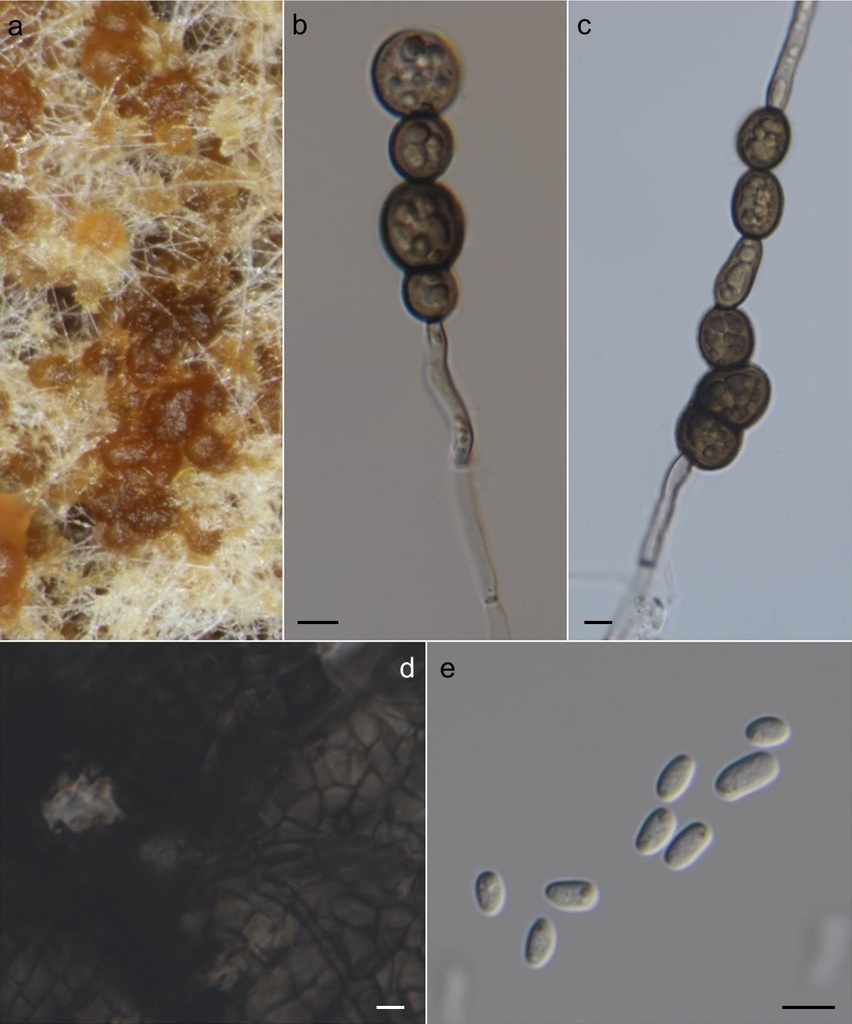
Epicoccum sorghinum
Epicoccum sorghinum (former Phoma sorghina) is an ascomycete fungus with known plant pathogenicity to sugarcane and rice, causing ring spot disease and leaf spot disease. This fungus is primarily known for its production of tenuazonic acid, which leads to complications with growth and causes the symptoms of leaf spot disease. Tenuazonic acid not only affects plant growth, but has recently been proven to impact human health due to its prevalence in food and beverages. It is widely dispersed, affecting multiple hosts in different countries. Although not a serious threat, Epicoccum sorghinum has been known to influence the sorghum grain-mold complex in ways which reduce crop yields, seed viability, and kernel weight. As a result of continuous phylogenetic and morphological discoveries relevant to Epicoccum sorghinum, this fungus has undergone a number of name changes.
From the article Epicoccum sorghinum on Wikipedia (CC BY-SA), quoted section by section
Description
On a medium, Epicoccum sorghinum produces a reddish/brown pigment. Colonies are 5–9 cm and circular in shape. The mycelium of Epicoccum sorghinum is dense and fluffy. The color of mycelium varies and can be gray, green, and salmon colored. Under a microscope, Epicoccum sorghinum produces brown or translucent, subglobose pycnidia with straight necks. Size varies from 67.9 to 117.5 x 44.5 to 90.1 micrometers. Chlamydospores are unicellular or multicellular, botryoid, and brown or translucent. Conidia are unicellular, oval shaped or curved, translucent (hyaline), and 3.6 to 5.3 x 1.8 to 2.8 micrometers.
Wikipedia: “Characteristics”
Range & habitat
Epicoccum sorghinum is typically found in tropical and subtropical regions of a variety of countries including Brazil, China, France, India, South Africa, Thailand, Turkey, United States, etc. Epicoccum sorghinum has also been known to inhabit temperate regions and grasses (gramineae).
Wikipedia: “Distribution and habitat”
Where it lives
Recorded sightings
—
geo-referenced records in GBIF, from museums, herbaria and field observers.
Drag the globe to turn it. Dots are where records exist, not a range map; darker means more records.
In the stacks
Searching the stacks…
Every page naming Epicoccum sorghinum in the Biodiversity Heritage Library →
This page is assembled live from iNaturalist, GBIF, Wikipedia, the Source Library and the Internet Archive. It is not yet part of the hand-edited codex. iNaturalist taxon 976282.