- Fungi Including Lichens
- ›Ascomycete Fungi
- ›Sac Fungi and Lichens
- ›Dothideomycetes
- ›Botryosphaeriales
- ›Phyllostictaceae
- ›Phyllosticta
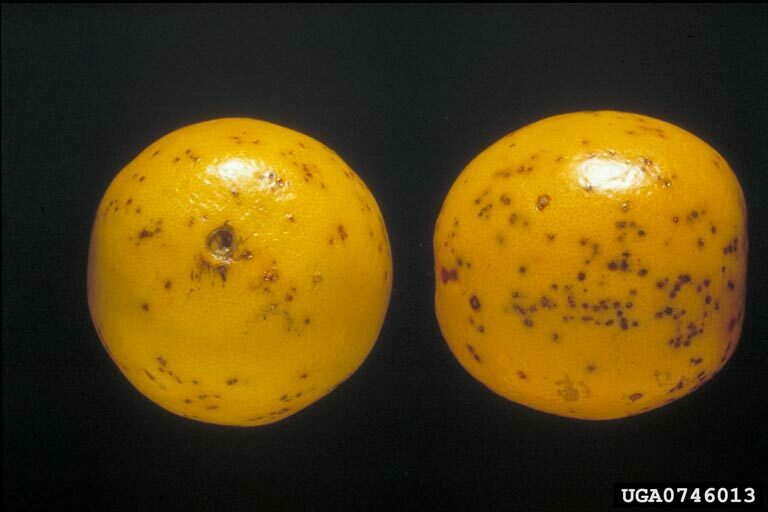
Citrus Black Spot
Phyllosticta citricarpa
Citrus black spot is a fungal disease caused by Phyllosticta citricarpa(previously known as Guignardia citricarpa). This Ascomycete fungus affects citrus plants throughout subtropical climates, causing a reduction in both fruit quantity and quality.
Symptoms include both fruit and leaf lesions, the latter being critical to inter-tree dispersal. Strict regulation and management is necessary to control this disease since there are currently not many citrus varieties that are resistant.
From the article Citrus black spot on Wikipedia (CC BY-SA), quoted section by section
What it does
After overwintering in leaf debris, ascostroma begin producing ascospores. Ascospore formation is accelerated by sequential wetting and drying of the leaf litter. However, very wet conditions inhibit ascospore development due to leaf decomposition and competition from saprophytes. The ascospores are ejected from the fruiting bodies of the fungus during rainfall or irrigation and then dispersed by wind and water. Upon landing on susceptible tissue, the ascospores germinate and form appresoria after a 24-48 hour wetting period. (Different tissues are susceptible to infection at different times. Leaves are susceptible up to 10 months of age. Fruits are susceptible during the 4–5 months after fruitset, though trees less than ten years old are only susceptible up to 3 months .) Soon after, the infection peg along with mycelia colonize the area between the cuticle and epidermal wall. The symptoms are not visible right away because the infection remains latent, or dormant, until the fruit is mature. The infection in leaves usually remains latent until the leaves drop, but leaf spots may be found on older leaves. The leaf lesions usually produce ascospores, but sometimes produce pycnidia. These pycnidia release pycnidiospores (conidia) in a gelatinous mass. Under wet conditions, the gelatinous mass dissolves and the spores are dispersed by splashes of water. …
Wikipedia: “Life cycle”
Where it lives
Recorded sightings
—
geo-referenced records in GBIF, from museums, herbaria and field observers.
Drag the globe to turn it. Dots are where records exist, not a range map; darker means more records.
In the stacks
Searching the stacks…
Every page naming Phyllosticta citricarpa in the Biodiversity Heritage Library →
This page is assembled live from iNaturalist, GBIF, Wikipedia, the Source Library and the Internet Archive. It is not yet part of the hand-edited codex. iNaturalist taxon 979020.