- Plants
- ›Vascular Plants
- ›flowering plants
- ›Dicots
- ›myrtles, evening primroses, and allies
- ›myrtle family
- ›Myrtoideae
- ›Chamelaucieae
- ›Calytricinae
- ›Calytrix
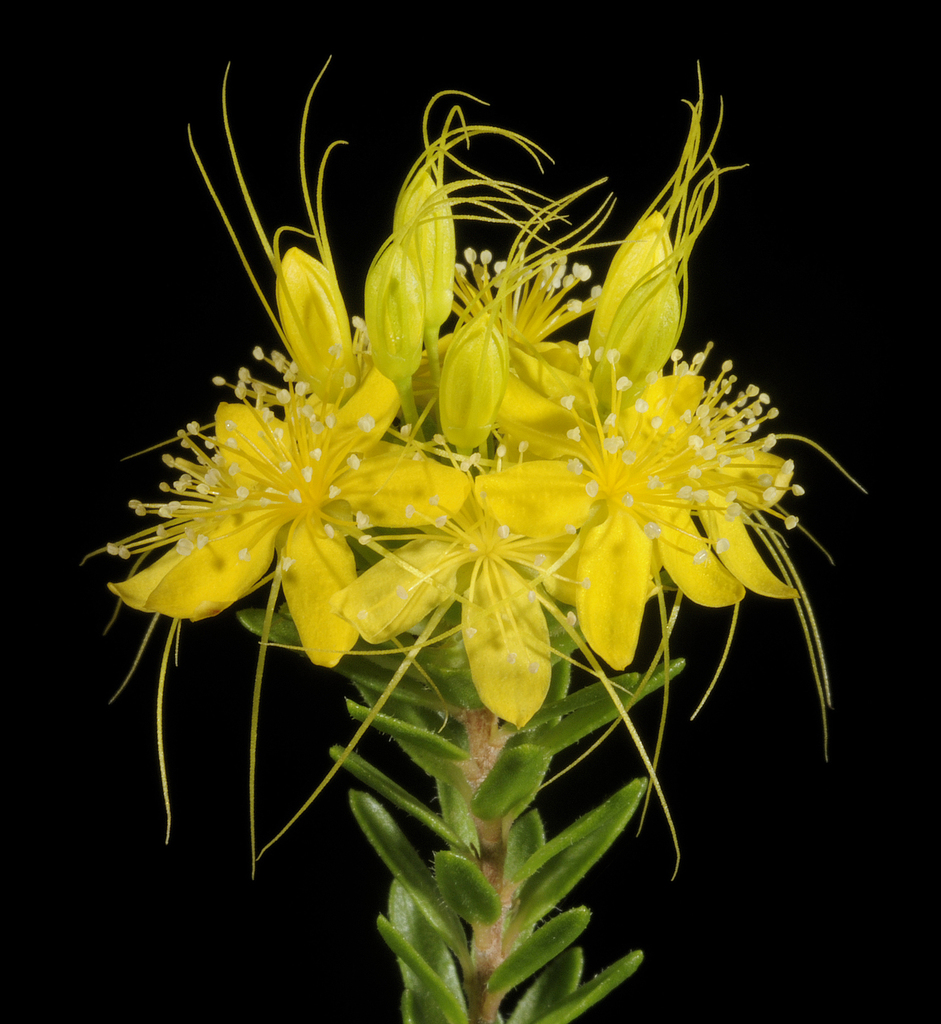
Calytrix aurea
Calytrix aurea is a species of flowering plant in the myrtle family Myrtaceae and is endemic to the south-west of Western Australia. It is a shrub with elliptic, lance-shaped or linear leaves and clusters of yellow flowers with 25 to 55 yellow stamens in several rows.
From the article Calytrix aurea on Wikipedia (CC BY-SA), quoted section by section
Description
Calytrix aurea is a shrub that typically grows to a height of 0.2–1.3 m (7.9 in – 4 ft 3.2 in). Its leaves are elliptic, lance-shaped or linear, 5–12 mm (0.20–0.47 in) long and 1.5–5 mm (0.059–0.197 in) wide on a petiole up to 0.5–2 mm (0.020–0.079 in) long. There is a stipule 0.5 mm (0.020 in) long at the base of the petiole. The flowers are arranged singly in clusters, each flower on a peduncle 0.5–1 mm (0.020–0.039 in) long. The floral tube has 10 to 12 ribs and is 9–13 mm (0.35–0.51 in) long. The sepals are joined at the base, 2.0–2.5 mm (0.079–0.098 in) long with an awn up to 17 mm (0.67 in) long. The petals are yellow, egg-shaped to elliptic, 6.5–10 mm (0.26–0.39 in) long and 3.0–4.5 mm (0.12–0.18 in) wide, and there are about 25 to 55 yellow stamens in 2 or 3 rows. Flowering occurs from October to December or January.
Range & habitat
This species of Calytrix grows in heath on sand, often over laterite and occurs between the Arrowsmith River area and Perth, in the Avon Wheatbelt, Geraldton Sandplains, Jarrah Forest and Swan Coastal Plain bioregions of south-western Western Australia.
Wikipedia: “Distribution and habitat”
How it is grown
This plant performs best in a sunny position and requires a well-drained situation, such as a built-up rockery. Plants are readily propagated by cuttings.
== References ==
Wikipedia: “Use in horticulture”
Where it lives
Recorded sightings
—
geo-referenced records in GBIF, from museums, herbaria and field observers.
Drag the globe to turn it. Dots are where records exist, not a range map; darker means more records.
In the stacks
Searching the stacks…
Every page naming Calytrix aurea in the Biodiversity Heritage Library →
This page is assembled live from iNaturalist, GBIF, Wikipedia, the Source Library and the Internet Archive. It is not yet part of the hand-edited codex. iNaturalist taxon 981011.