- Plants
- ›Vascular Plants
- ›flowering plants
- ›Dicots
- ›myrtles, evening primroses, and allies
- ›myrtle family
- ›Myrtoideae
- ›Chamelaucieae
- ›Micromyrtinae
- ›Micromyrtus
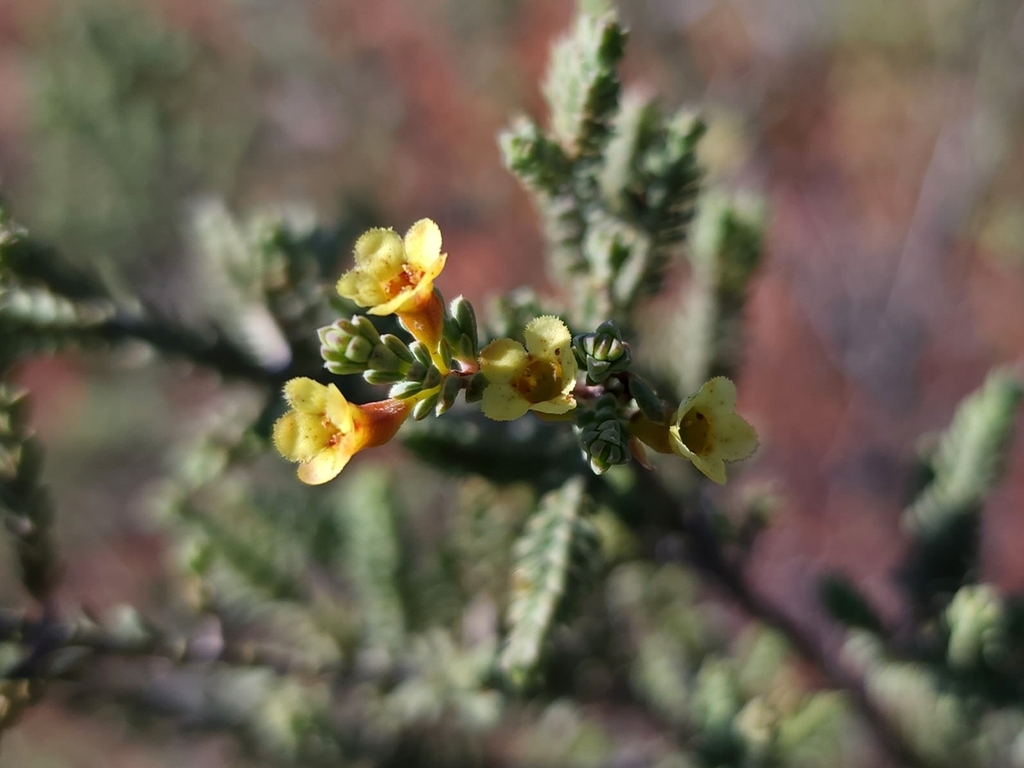
Micromyrtus flaviflora
Micromyrtus flaviflora is a species of flowering plant in the myrtle family, Myrtaceae and is endemic to inland areas of Australia. It is an erect shrub with overlapping, keeled, oblong leaves, and yellow flowers arranged singly in leaf axils, but often appearing clustered.
From the article Micromyrtus flaviflora on Wikipedia (CC BY-SA), quoted section by section
Description
Micromyrtus flaviflora is an erect, loose or spreading shrub that typically grows to a height of 0.3–1.5 m (1 ft 0 in – 4 ft 11 in) and has reddish-brown, papery bark. Its leaves are oblong, 1–2 mm (0.039–0.079 in) long and 0.5–1 mm (0.020–0.039 in) wide and keeled. The flowers are arranged singly in leaf axils on a peduncle 1.5–2.5 mm (0.059–0.098 in) long but often appear clustered on side-branches. There are bracteoles 1.5–2.8 mm (0.059–0.110 in) long at the base but fall off as the flowers open. The sepals are about 0.9 mm (0.035 in) long and 1–2 mm (0.039–0.079 in) wide and the petals are yellow, more or less round and about 2 mm (0.079 in) in diameter. There are 5 stamens, the filaments about 0.8 mm (0.031 in) long. Flowering occurs in January or from April to November.
Range & habitat
Micromyrtus flaviflora is widespread and common in desert, growing on red, sandy dunes and plains mainly in inland Western Australia, but also in adjacent areas of the Northern Territory and South Australia.
== References ==
Wikipedia: “Distribution and habitat”
Where it lives
Recorded sightings
—
geo-referenced records in GBIF, from museums, herbaria and field observers.
Drag the globe to turn it. Dots are where records exist, not a range map; darker means more records.
In the stacks
Searching the stacks…
Every page naming Micromyrtus flaviflora in the Biodiversity Heritage Library →
This page is assembled live from iNaturalist, GBIF, Wikipedia, the Source Library and the Internet Archive. It is not yet part of the hand-edited codex. iNaturalist taxon 981327.