- Animals
- ›Molluscs
- ›Bivalves
- ›Autobranchia
- ›Heteroconchia
- ›Freshwater Mussels and Brooch Clams
- ›Freshwater Mussels
- ›Unionoidea
- ›Freshwater Pearl Mussels
- ›Margaritiferinae
- ›Cumberlandia
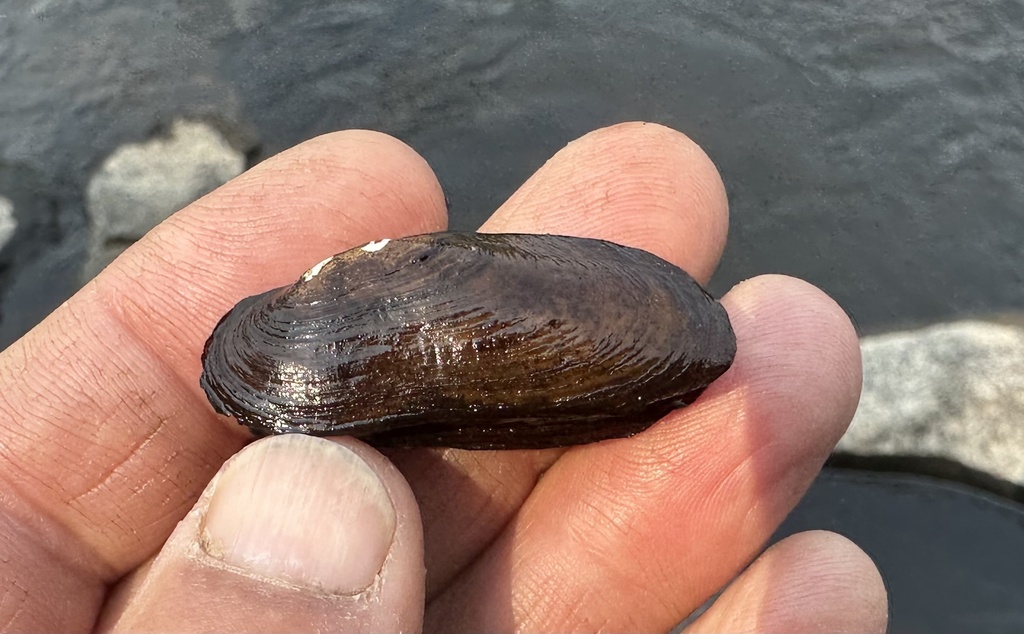
Spectaclecase
Cumberlandia monodonta
Cumberlandia monodonta (common name spectaclecase) is a freshwater mussel endemic to the United States. Currently, C. monodonta is listed as an endangered species by the U.S. Fish and Wildlife Service and the International Union for Conservation of Nature.
Cumberlandia monodonta was first reported in a newspaper titled The Disseminator (New Harmony, Ind.) by Thomas Say in 1829 under the name Unio monodonta. The spectaclecase was then reclassified into the genus Cumberlandia by A. E. Ortmann in 1912.
From the article Spectacle case pearly mussel on Wikipedia (CC BY-SA), quoted section by section
Range & habitat
Cumberlandia monodonta is endemic to the Mississippi, Ohio, and Missouri River basins and is found most often in larger rivers. They are most commonly found in aggregated clumps within mild water, between large rocks and wedged into firm mud. C. monodonta take shelter from the current by clustering beneath slab boulders or bedrock shelves. Historically, C. monodonta has occurred in at least 44 streams within its three endemic basins. As of 2014, the mussel was known to occupy only 20 streams, representing a 55% decline in range. Furthermore, these populations are highly fragmented and cover only short stretches of a given river. The mussel's 5-Year Review reports that there has been no change in C. monodonta's range since its listing as Endangered. C. monodonta does not reside in any critical habitat. A map of C. monodonta's historical and present range can be found on its IUCN Red List web page.
Wikipedia: “Population and range”
What it does
Specific life history requirements of C. monodonta's life cycle are still widely unknown. The mussel is estimated to reach sexual maturity at 4- to 5-years-old for males and 5- to 7-years-old for females. The life cycle of C. monodonta consists of many steps. Males release sperm into the water, and females intake the sperm while filter feeding. The fertilized eggs will grow into larvae called glochidia. When the glochidia mature in early April to late May, the females will release them into the water column. Glochidia have a brief but mandatory parasitic stage on fish—two host species have been confirmed (Hiodon tergisus and Hiodon alosoides), but further research is being conducted to identify additional hosts.
Wikipedia: “Life history and reproduction”
In human culture
Cumberlandia monodonta was first included in the "Review of Invertebrate Wildlife for Listing as Endangered for Threatened Species" in 1984. This list does not officially recognize species as endangered, threatened, or otherwise, but encourages species on the list to be more thoroughly researched in order to designate an Endangered Species Act listing. The IUCN listed Cumberlandia monodonta (under its synonym Margaritifera monodonta) as "Near Threatened" in 1996 and updated its status to "Endangered" in 2012. On March 13, 2012, The United States Fish and Wildlife Services officially declared the species as endangered due to its declining populations. A recovery outline was developed for C. monodonta in January 2014, but a full recovery plan has not yet been developed. Since the species was declared endangered by the Endangered Species Act, there have been no changes in its listing status.
Wikipedia: “Conservation status listing history”
Where it lives
Recorded sightings
—
geo-referenced records in GBIF, from museums, herbaria and field observers.
Drag the globe to turn it. Dots are where records exist, not a range map; darker means more records.
In the stacks
Searching the stacks…
Every page naming Cumberlandia monodonta in the Biodiversity Heritage Library →
This page is assembled live from iNaturalist, GBIF, Wikipedia, the Source Library and the Internet Archive. It is not yet part of the hand-edited codex. iNaturalist taxon 98790.