- Plants
- ›Vascular Plants
- ›flowering plants
- ›Dicots
- ›Legumes, Milkworts, and Allies
- ›Legumes
- ›Faboideae
- ›Loteae
- ›Lotus
- ›Tetragonolobus
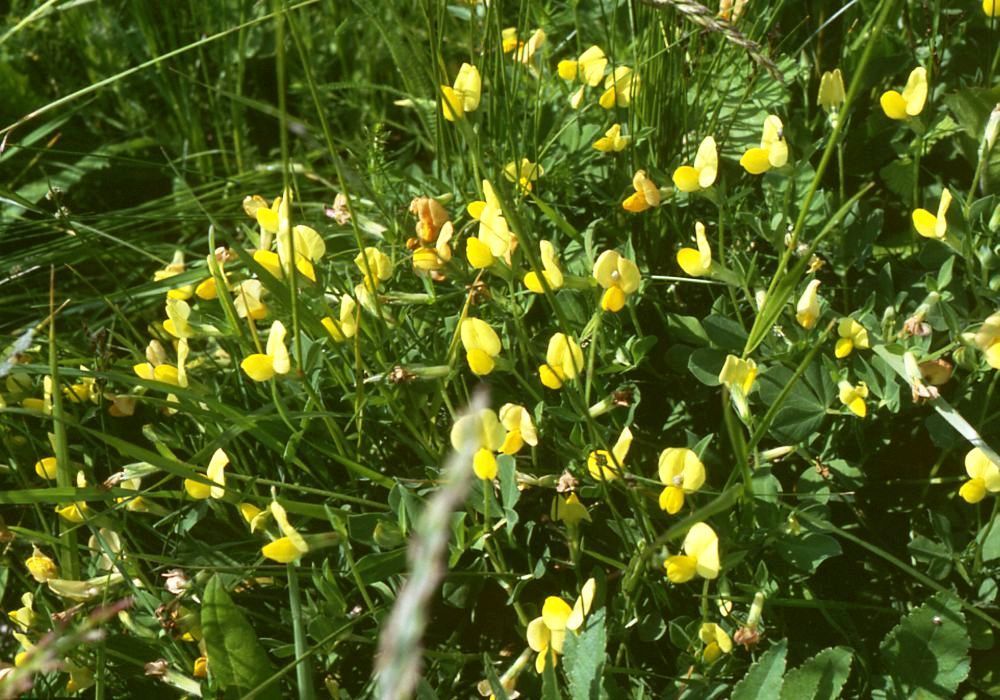
Dragon's-teeth
Lotus maritimus
Tetragonolobus maritimus, synonym Lotus maritimus, dragon's teeth is a plant species in the legume family, native to Europe, Africa and temperate Asia. It is one of several species known as dragon's teeth.
From the article Lotus maritimus on Wikipedia (CC BY-SA), quoted section by section
Description
Dragon's-teeth is a prostrate or debumbent (curving up at the tips), herbaceous perennial with branched stems up to about 30 cm long. The leaves are alternate and consist of three leaflets at the end of a short stalk (petiole) about 0.5 cm long. The leaflets are sessile, 10-30 mm long by 4-15 mm wide, oblanceolate, and finely hairy. At the base of the petiole there are two ovate stipules about 10 mm long. Flowering takes place in spring and summer (May - August in Britain). The inflorescences arise from the leaf axils and have just one or two flowers on a peduncle that is considerably longer than the adjacent leaf. Each flower is subtended by a 3-lobed bract with narrow, pointed lobes. The flower consists of a reddish-green, hairy calyx up to 15 mm long which splits about halfway along into 5 unequal, pointed teeth. The corolla is about 25-30 mm long and has a pale yellow standard with reddish veins, and darker yellow wings and keel. The flowers have 10 stamens and one style.
The superior ovary develops into a 4-winged sword-shaped fruit about 50 mm long, which is light green when fresh turning brown, woody and brittle when ripe. The fruit is dehiscent and contains many small, round seeds about 2 mm in diameter.
Range & habitat
The native range of dragon's-teeth is in central to southern Europe, north Africa and western Asia. It extends northwards to Britain and Scandinavia where populations are often transient and it is sometimes classified as an introduction. However, despite speculation that it may be a contaminant of seed mixes, its occurrence in calcareous grassland nature reserves, shingle beaches and chalk pits does not point strongly towards such a source, and it could just as easily be classed as a native plant that is expanding through natural means in northern areas.
Wikipedia: “Distribution and status”
What it does
Although it is a perennial, dragon's-teeth is usually found in places where there is bare ground available for the establishment of seedlings, including path edges and sandy or shingly beaches. In these situations it often behaves more like an annual, reproducing by seed rather than becoming permanently established.
== References ==
Wikipedia: “Habitat and ecology”
Where it lives
Recorded sightings
—
geo-referenced records in GBIF, from museums, herbaria and field observers.
Drag the globe to turn it. Dots are where records exist, not a range map; darker means more records.
In the stacks
Searching the stacks…
Every page naming Lotus maritimus in the Biodiversity Heritage Library →
This page is assembled live from iNaturalist, GBIF, Wikipedia, the Source Library and the Internet Archive. It is not yet part of the hand-edited codex. iNaturalist taxon 989787.