- Animals
- ›Chordates
- ›Vertebrates
- ›Ray-finned Fishes
- ›Spiny-rayed fishes
- ›Freshwater Sunfishes, Grunters, and Allies
- ›Freshwater Sunfishes and relatives
- ›Pygmy Sunfishes
- ›Elassoma
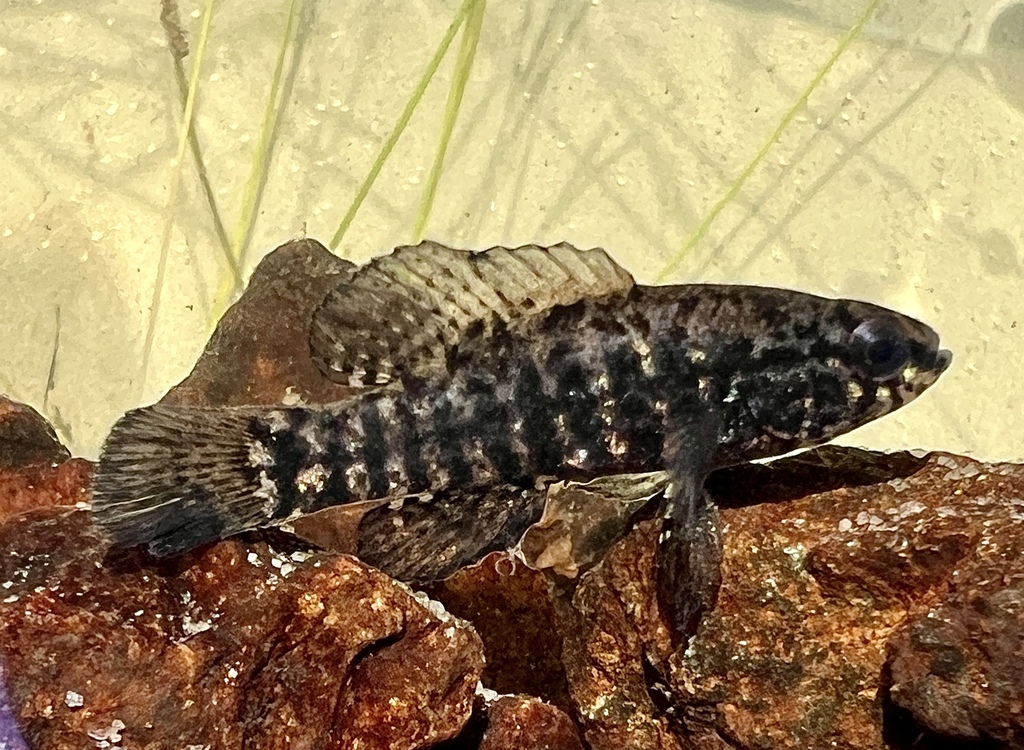
Banded Pygmy Sunfish
Elassoma zonatum
The banded pygmy sunfish, Elassoma zonatum, is a species of pygmy sunfish endemic to the United States, where it is found from Indiana and Illinois to Texas to the Atlantic coast. It prefers densely vegetated bodies of slow-moving water. This species can reach 4.7 cm (1.9 in) in total length, though most do not exceed 3.5 cm (1.4 in).
The banded pygmy sunfish are capable of retaining their juvenile characteristics while they are sexually mature; that is to say that they are neotenous.
From the article Banded pygmy sunfish on Wikipedia (CC BY-SA), quoted section by section
Range & habitat
The banded pygmy sunfish is a small fish that can live in rivers, streams, lakes, ponds, and even swamps. This species is historically found only in the continental United States, with relatively little change in distribution. One exception to this is minor decreases in species distribution due to habitat loss. They have historically been residents of the Mississippi River drainage system and Gulf coastal plain region. Currently, they are found from the lower Roanoke River drainage in North Carolina to the southern to middle parts of the St. Johns River in Florida. Also, they are found west to the Brazos River drainage in Texas and north to lower Wabash River drainage in Indiana and Illinois. Being a member of Elassomatidae, this species of pygmy sunfish is similar in habitat preferences. It prefers to live in slower to still water conditions with higher sedimentation content, hence the swamps and ponds. However, the human development of wetland habitat over the ages has caused a decrease in banded pygmy sunfish and other pygmy sunfish habitat. Though the banded pygmy sunfish can retreat to lakes, streams, and rivers when wetlands are being drained, they need the wetlands for breeding. Thus, the true reason for the disappearance of the banded pygmy sunfish from certain areas is not just a loss of any habitat, but the loss of its breeding habitat. …
Wikipedia: “Distribution”
What it does
Stomach contents of 46 individual banded pygmy sunfish (26 of which were spawning adults) collected at Mound, Louisiana, were examined for food identification. The main food identified included insect larvae (mostly from the family Chironomidae), small crustaceans, and snail eggs. The crustaceans and snail eggs combined constituted the majority of the content. Next in quantity were insect larvae. Minute amounts of algal spores were ingested by these fish. These algae were most likely taken in accidentally with other prey in the presence of algal blooms. Lastly, no other fish species or banded pygmy sunfish larvae were found in the stomach contents. The banded pygmy sunfish lives in rather eutrophic conditions such as swamps and ponds. They are able to live in sedimentation levels that make oxygen availability less than 0.5 mg/L of water. Very few fish species can survive in this hypoxic condition. The only other notable fish that affect E. zonatum are live-bearers (Poeciliidae), grass pickerel (Esox americanus), and bowfins (Amia calva). The bowfins are known to be occasional predators on the pygmy sunfish family. Occasionally, the grass pickerel and live-bearers are competitors for food with the pygmy sunfish. Other than fish, water snakes and fish-eating birds are known to be enemies. Water beetles and Odonata nymphs are known to be competitors for insect larvae. …
Wikipedia: “Ecology”
In human culture
The banded pygmy sunfishes scientific name is Elassoma zonatum where Elassoma means small body and Zonatum means banded.
Wikipedia: “Etymology”
Where it lives
Recorded sightings
—
geo-referenced records in GBIF, from museums, herbaria and field observers.
Drag the globe to turn it. Dots are where records exist, not a range map; darker means more records.
In the stacks
Searching the stacks…
Every page naming Elassoma zonatum in the Biodiversity Heritage Library →
This page is assembled live from iNaturalist, GBIF, Wikipedia, the Source Library and the Internet Archive. It is not yet part of the hand-edited codex. iNaturalist taxon 99757.