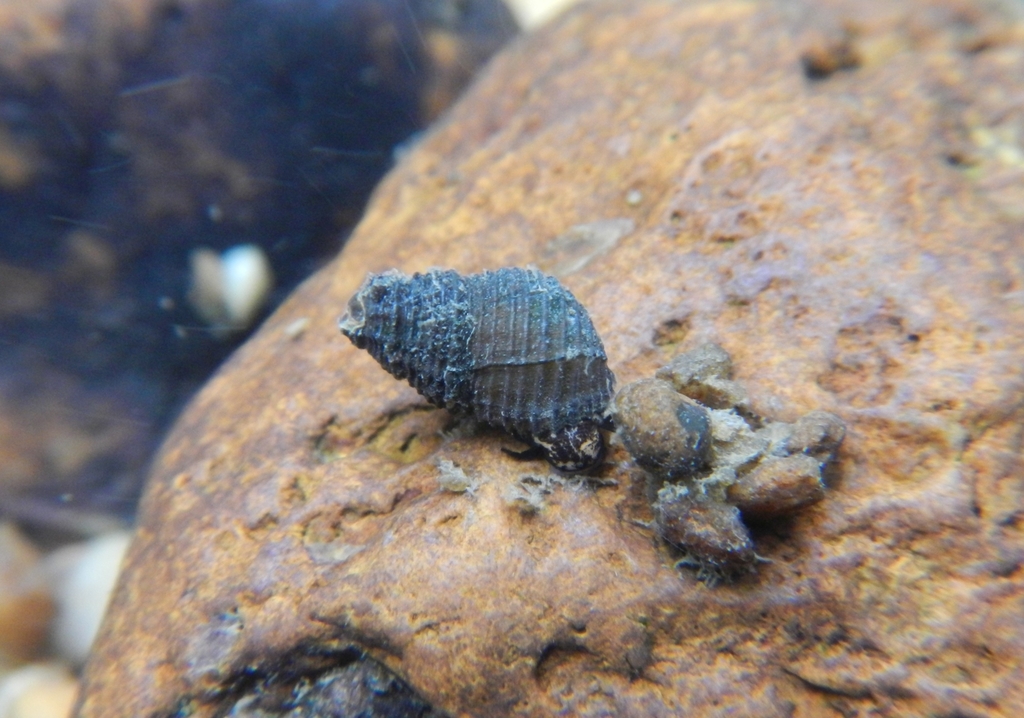
Lacy Elimia
Elimia crenatella
The lacy elimia, also known as the lacey elimia, scientific name Elimia crenatella, is a species of freshwater snail with a gill and an operculum, an aquatic gastropod mollusk in the family Pleuroceridae.
This species is endemic to the United States, specifically the state of Alabama. The snail has been listed as threatened on the United States Fish and Wildlife Service list of endangered species since October 28, 1998.
From the article Lacy elimia on Wikipedia (CC BY-SA), quoted section by section
Description
The lacy elimia is a small species in the family Pleuroceridae. Growing to about 1.1 centimeters (cm) (0.4 in) in length, the shell is conic in shape, strongly striate, and often folded in the upper whorls. The shell color is dark brown to black, often purple in the aperture, and without banding. The aperture is small and ovate. The lacy elimia is easily distinguished from other Elimia species by a combination of characters (i.e., size, ornamentation, color).
Range & habitat
The lacy elimia was historically abundant in the Coosa River main stem from St. Clair County, Alabama to Chilton County, Alabama, and was also known in several Coosa River tributaries: Big Will's Creek, DeKalb County; Kelley's Creek, St. Clair County; and Choccolocco Creek and Tallaseehatchee Creek, Talladega County, Alabama. Currently, the lacy elimia is only known to survive in three Coosa River tributaries: Cheaha Creek, Emauhee Creek, and Weewoka Creek, Talladega County, Alabama. The species is locally abundant in the lower reaches of Cheaha Creek. This stream originates within the Talladega National Forest; however, no specimens of the lacy elimia have been collected on United States Forest Service lands. The species has also been found at single sites in Emauhee and Weewoka creeks, where specimens are rare, and difficult to locate. All of these streams are variously impacted by sediments and nutrients from a variety of upstream rural, suburban, and/or urban sources. Because of their small sizes and limited flows, their water and habitat quality can be rapidly affected by local and off site pollution sources.
Wikipedia: “Distribution”
What it does
Little is known of the ecology specific to the lacy elimia, however, common information about genus Elimia are as follows.
Habitat. Elimia snails are gill-breathing snails that typically inhabit highly oxygenated waters on rock shoals and gravel bars. It is associated with river or stream habitats characterized by flowing currents, and hard, clean bottoms (e.g., bedrock, boulder, gravel).
Feeding habits. Most elimia species graze on periphyton (attached algae) growing on benthic (bottom) substrates.
Life cycle. Individual snails are either male or female. Eggs are laid in early spring and hatch in about 2 weeks. Snails apparently become sexually mature in their first year, but, in some cases, females may not lay eggs until their second year. Some elimia species may live as long as 5 years.
Wikipedia: “Ecology”
Where it lives
Recorded sightings
—
geo-referenced records in GBIF, from museums, herbaria and field observers.
Drag the globe to turn it. Dots are where records exist, not a range map; darker means more records.
In the stacks
Searching the stacks…
Every page naming Elimia crenatella in the Biodiversity Heritage Library →
This page is assembled live from iNaturalist, GBIF, Wikipedia, the Source Library and the Internet Archive. It is not yet part of the hand-edited codex. iNaturalist taxon 99814.