- Animals
- ›Molluscs
- ›Bivalves
- ›Autobranchia
- ›Heteroconchia
- ›Freshwater Mussels and Brooch Clams
- ›Freshwater Mussels
- ›Unionoidea
- ›River Mussels
- ›Ambleminae
- ›Pleurobemini
- ›Elliptio
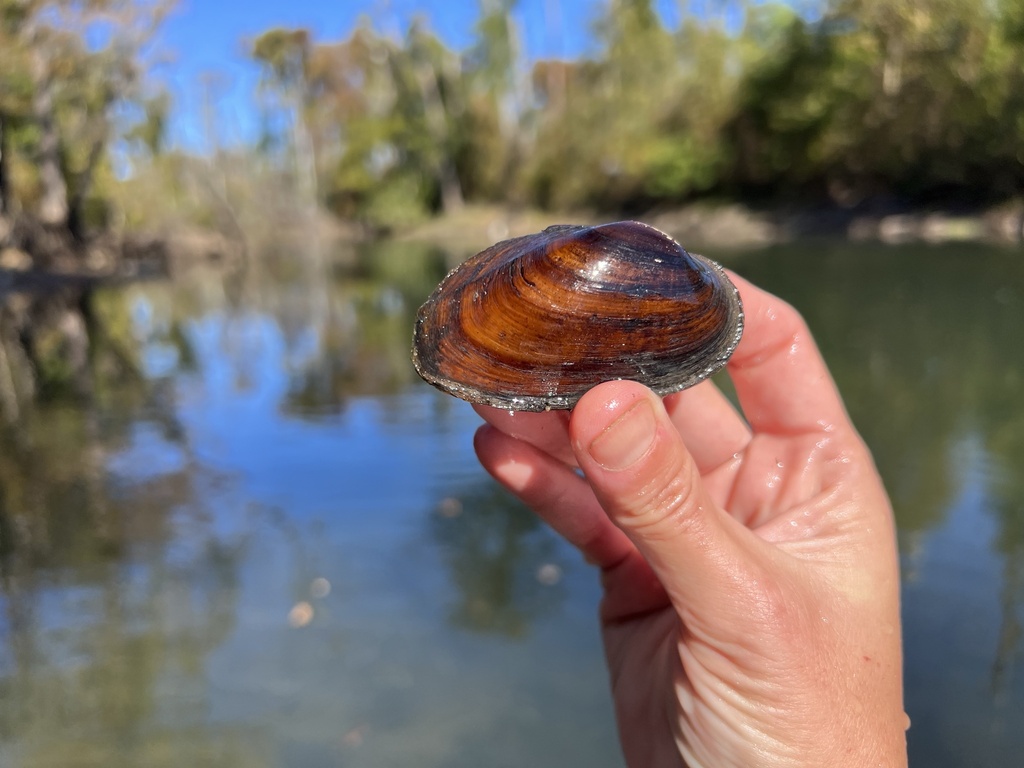
Chipola Slabshell
Elliptio chipolaensis
The Chipola slabshell, scientific name Elliptio chipolaensis, is a species of freshwater mussel in the family Unionidae, the river mussels. It is native to Florida in the United States, where it is now found only in the Chipola River and associated creeks. It is extirpated from Alabama. There are no more than about 2500 individuals remaining. It is a federally listed threatened species of the United States.
From the article Chipola slabshell on Wikipedia (CC BY-SA), quoted section by section
Description
The Chipola slabshell is a freshwater mussel that is oval shaped with a reddish-brown outer shell. They can have dark and light bands on the outer shell and the inside of the shell is reddish-yellow. They can reach a length of up to 8.5 cm (3.3 in). There is no sexual dimorphism shown in the characteristic of the shells.
Range & habitat
Specifically found in northwest Florida in the Chipola River. They inhabit freshwater rivers with slow to medium currents and rest in a sandy or silt floor. Many are found in sloping bank habitats as well.
Wikipedia: “Habitat”
What it does
In their immature life stage, they are considered parasitic and retrieve their nutrients from a host fish. In their mature life stage, they filter feed for plankton and detritus (dead organic matter).
Wikipedia: “Diet”
Toxicity
Currently listed at threatened (LT) as of 2019 under the U.S. Endangered Species Act.
Wikipedia: “Listing under Endangered Species Act”
In human culture
Currently, there is little information known about their complete life history. However, current beliefs suggest that males release sperm in the water and the female collects it via a siphon. Then, the eggs are fertilized in the shell of the female before the larvae are released into the water. Larvae development is dependent on a host fish. Meaning, larvae will attach themselves to the fins and gills of a host fish and young mussels will fall to the ground where it will settle. Once reaching sexual maturity, it can reach a length of up to 8.5 cm (3.3 in.). There is currently no information on its growth rate, offspring quality and quantity, age of dispersal, annual dormancy, or age-specific mortality rates.
Wikipedia: “Life history”
Where it lives
Recorded sightings
—
geo-referenced records in GBIF, from museums, herbaria and field observers.
Drag the globe to turn it. Dots are where records exist, not a range map; darker means more records.
In the stacks
Searching the stacks…
Every page naming Elliptio chipolaensis in the Biodiversity Heritage Library →
This page is assembled live from iNaturalist, GBIF, Wikipedia, the Source Library and the Internet Archive. It is not yet part of the hand-edited codex. iNaturalist taxon 99845.