- Animals
- ›Molluscs
- ›Bivalves
- ›Autobranchia
- ›Heteroconchia
- ›Freshwater Mussels and Brooch Clams
- ›Freshwater Mussels
- ›Unionoidea
- ›River Mussels
- ›Ambleminae
- ›Pleurobemini
- ›Elliptio
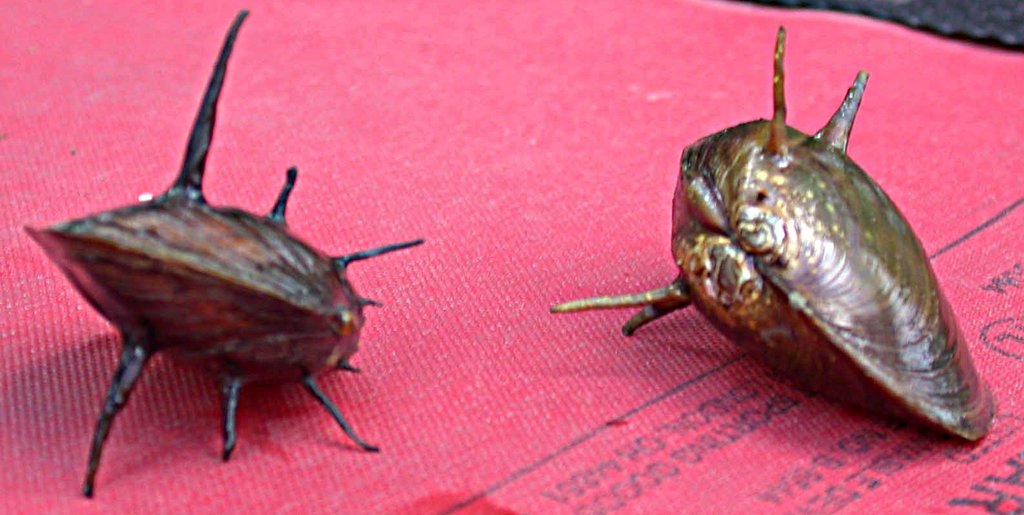
Altamaha Spiny Mussel
Elliptio spinosa
Elliptio spinosa, the Altamaha spinymussel, is an endangered species of freshwater mussel in the family Unionidae. They live in southeastern Georgia in the Altamaha river and its tributaries. It is one of three species of North American spinymussels which are recognizable by their prominent spines. The Altamaha spinymussel genetically diverged from the other spinymussels 3.76 million years ago. This suggests that their spines evolved separately from the spines of other North American spinymussels. The Altamaha spinymussel is on the Endangered Species Act because of many threats with the most prominent threats being habitat loss, decrease in water quality, shrinking range, small population size, and vulnerability to disturbances.
From the article Elliptio spinosa on Wikipedia (CC BY-SA), quoted section by section
Description
The Altamaha spinymussel grows up to 11 cm (4.3 in) in length, and its shell is smooth and shiny. In young mussels, the outside of the shell is greenish yellow with green rays that darken over time to brown while the inside of the shell is pink or purple. The overall shape of the shell is triangular or diamond-like and has moderate inflation. Each mussel has one to four or five spines on each valve that vary from 1–2.5 cm (0.39–0.98 in) in length, can be either crooked or straight and are in a parallel line from the shell's hinge to the wide outer edge of the mussel.
Range & habitat
Altamaha spinymussels are generally found in a range of coarse to fine sediments in sandbars, sloughs, and mid-channel islands. These habitats provide the spinymussel with cover and sites for breeding and reproduction. Altamaha spinymussels are restricted to areas of swift flowing water and will bury 5–10 cm into the sediment (1.96-3.94 inches). They need swift flowing water because it transports food, removes waste, and provides oxygen. Their habitat is the coastal plains region of the Altamaha river and its tributaries. The tributaries include the Ohoopee, Ocmulgee, and Oconee rivers. The water quality that Altamaha spinymussels need has not been studied but mussels in general need to tolerate a wide range of conditions because they are sedentary. The Altamaha spinymussel survives in an area as long as the sandbar, slough, or mid-channel island habitat is maintained and water quality is high enough year-round.
Wikipedia: “Habitat”
What it does
Juvenile Altamaha spinymussels feed with their foot by pulling bacteria, algae, and decomposing organisms from the sediment on the river floor. Adult spinymussels are filter feeders which are capable of filtering up to 40 gallons of water per day. As water passes through their gills they are able to capture their food and can filter out the undesirable parts and intake small pieces of prey all at once. This prey comes in the forms of phytoplankton, diatoms, and other microorganisms.
Wikipedia: “Diet”
In human culture
The life history traits of the Altamaha spiny mussel have not been studied, but the life histories of other species in the Elliptio genus have. Scientists have used this information to construct an approximate life history of the Altamaha spinymussel. Female mussels have eggs that get fertilized by sperm in late spring. The fertilized eggs brood in the female until they are mature larvae called glochidia. The glochidia are released into the water in May or June. In order for glochidia to survive and become a juvenile mussel they need to attach to a host fish. The host fish species for Altamaha spinymussel is not known. Once the spinymussel matures in the host fish it will release and settle into the sandy river floor. For the first few months of life the spinymussel will feed through its foot. It will later be able to use filter feeding. Neither the longevity nor the age at sexual maturity are known for the Altamaha spinymussel. (It is also currently unknown how many times they reproduce in a lifetime, offspring quality and quantity (e.g., number and size of offspring, sex ratio of offspring), age of dispersal, annual dormancy, and age-specific mortality rates.)
Wikipedia: “Life history”
Where it lives
Recorded sightings
—
geo-referenced records in GBIF, from museums, herbaria and field observers.
Drag the globe to turn it. Dots are where records exist, not a range map; darker means more records.
In the stacks
Searching the stacks…
Every page naming Elliptio spinosa in the Biodiversity Heritage Library →
This page is assembled live from iNaturalist, GBIF, Wikipedia, the Source Library and the Internet Archive. It is not yet part of the hand-edited codex. iNaturalist taxon 99857.