- Animals
- ›Arthropods
- ›Hexapods
- ›Insects
- ›Winged and Once-winged Insects
- ›Butterflies and Moths
- ›Butterflies
- ›Brush-footed Butterflies
- ›Fritillaries and Longwings
- ›Acraeas, Actinotes, and Allies
- ›Acraea
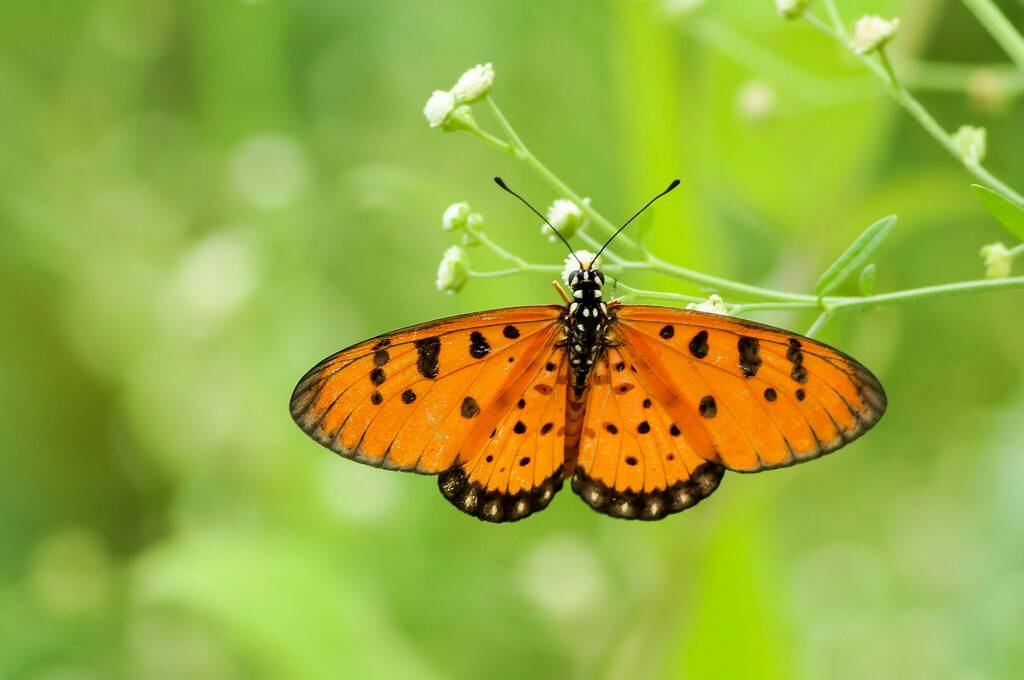
Tawny Coster
Acraea terpsicore
Acraea terpsicore, the tawny coster, is a small, 53–64 millimetres (2.1–2.5 in), leathery-winged butterfly common in grassland and scrub habitats. It belongs to the Nymphalidae or brush-footed butterfly family. It has a weak fluttery flight. It is avoided by most insect predators. This species and the yellow coster (Acraea issoria) are the only two Indian representatives of the predominantly African tribe Acraeini. It is found in India, Sri Lanka, Indonesia, Maldives to Myanmar, Thailand, Laos, Cambodia, Vietnam, Bangladesh, Malaysia, Singapore, and recently Australia.
From the article Acraea terpsicore on Wikipedia (CC BY-SA), quoted section by section
Range & habitat
This species does not fly high, but seems to keep within 3 m of the ground and tends to rest on vegetation in the regions of a meter off the ground. Acraea terpsicore can be seen in abundance wherever its larval food plant (Passiflora species) is found. The adult tends to avoid dense undergrowth and shady areas, instead keeping to open spaces in all types of vegetation. The adult flies slowly with weak seemingly unsteady wing beats. It is one of the boldest butterflies, protected as it is from predators by a nauseous chemical. When attacked it plays dead and exudes a noxious yellowish fluid from glands in the joints of the legs. Like all butterflies protected in this manner, Acraea terpsicore has a tough exoskeleton which enables the adult to survive a few pecks of a bird or even the bites of a lizard. Once left alone the adult immediately takes off and resumes its uncaring flight. When feeding on flowers, this butterfly is unhurried, often spending a long time sitting on the same flower. When sitting it either spreads its wings or closes them over its back the hindwings covering the forewings to a large extent. Sometimes the butterfly will not sit, but rest gently on the flower while feeding, while doing this, to maintain balance, it beats only its forewings while keeping the hindwings completely steady.
Mating plugs. …
Wikipedia: “Distribution, habits and habitat”
What it does
The butterfly breeds on plants of the family Loganiaceae and species of Passiflora many of which contain toxins that are sequestered by the caterpillars. They have also been noted to feed on the leaves of Hybanthus enneaspermus (Violaceae) in Bengal and on Turnera ulmifolia (Passifloraceae) in Maharashtra.
Eggs. Eggs are laid in batches of anywhere between 20 and 100. Eggs are yellow and slightly elongated and tall and display shallow transverse ribbing.
Larva. The fully grown caterpillar is about 21 mm (0.83 in) in length. It is reddish brown on the upperside and a yellowish white on the underside. Each body segment bears a number of branched spines. The head is reddish. The caterpillars of a batch tend to feed gregariously and devour all soft tissue of the host plant. In this manner they can become a major menace to the passion flower plant they are feeding on. Like the adults, the caterpillar is protected by the toxins, processed from the Passiflora species.
Cylindrical, slender, with six longitudinal rows of fine branched spines; colour reddish brown with an oily gloss, much paler on the head, second and last segment; an unwholesome looking insect, doubtless protected like the butterfly. —Davidson & Aitken
Pupa. The pupa boldly marked with aposematic colours, advertising the fact that this is an unwholesome object if eaten. …
Wikipedia: “Life cycle”
Listen
Looking for field recordings…
Where it lives
Recorded sightings
—
geo-referenced records in GBIF, from museums, herbaria and field observers.
Drag the globe to turn it. Dots are where records exist, not a range map; darker means more records.
In the stacks
Searching the stacks…
Every page naming Acraea terpsicore in the Biodiversity Heritage Library →
This page is assembled live from iNaturalist, GBIF, Wikipedia, the Source Library and the Internet Archive. It is not yet part of the hand-edited codex. iNaturalist taxon 180386.